Kenya Met Reveals October-December Forecast as El Niño Intensifies
Share

The Kenya Meteorological Service Authority (KMSA), commonly known as Kenya Met, has forecast above-average rainfall across most parts of the country during the October-November-December (OND) 2026 short rains season as El Niño continues to intensify.
In the forecast issued on Wednesday, August 26, 2026, Kenya Met predict rains to remain fairly to well distributed across several parts of the country. The authority also anticipates prolonged wet spells and occasional isolated storms during the season.
According to Kenya Met, the OND season plays a crucial role in several parts of the country, where it contributes more than 40 per cent of the annual rainfall.
“The ‘Short Rains’ (October-November-December, OND) season is an important rainfall season in Kenya, especially over Garissa, Wajir, Mandera, Marsabit, Isiolo, Meru, Tharaka Nithi, Makueni, Kitui Taita Taveta, Machakos counties and parts of Kajiado and Tana River where it contributes to over 40% of the total annual rainfall,” the Service stated.
Kenya Met Forecasts Above-Average Rains Across Most Counties
Kenya Met expects above-average rainfall across Baringo, Bomet, Bungoma, Busia, Elgeyo Marakwet, Embu, Garissa, Homa Bay, Isiolo, Kajiado, Kakamega, Kericho, Kiambu, Kilifi, Kirinyaga, Kisii, Kisumu, Kitui, Kwale, Laikipia, Lamu, Machakos, Makueni, Mandera, Meru, Migori, Mombasa, Murang’a, Nairobi, Nakuru, Nandi, Narok, Nyamira, Nyandarua, Nyeri, Siaya, Taita/Taveta, Tana River, Tharaka-Nithi, Trans Nzoia, Uasin Gishu, Vihiga and Wajir.
The outlook also covers much of West Pokot, Samburu and Marsabit counties.
Meanwhile, Turkana and a few parts of West Pokot, Samburu and Marsabit could receive near-average to above-average rainfall.
Kenya Met links the expected rainfall to several climate systems, including the Intertropical Convergence Zone (ITCZ), Indian Ocean Dipole (IOD), El Niño, Madden-Julian Oscillation (MJO) and tropical cyclones.
“The season occurs due to the southward migration of the Intertropical Convergence Zone (ITCZ). Its duration and performance are influenced by the Indian Ocean Dipole (IOD), which enhances rainfall when in the positive phase. The ongoing strong El Niño event also enhances rainfall when it occurs concurrently with a positive IOD,” the Service stated.
To develop the outlook, Kenya Met selected 2015 as the analogue year because of similarities in the latest evolution and projections of El Niño and the Indian Ocean Dipole.
However, the authority stressed that the 2015 rainfall outcome does not represent the 2026 forecast.
Instead, Kenya Met uses analogue years to show the rainfall conditions that can occur under broadly similar global climate conditions.
Also Read: Kenya Met Lists Counties Set to Receive Rainfall as August Nears End
El Niño Continues To Strengthen
Meanwhile, El Niño continues to strengthen across the central-eastern equatorial Pacific, with the latest indicators pointing towards a very strong event.
“According to the most recent update, the 2026 El Niño event continues to intensify across the central-eastern equatorial Pacific. The traditional Niño 3.4 index shows a clear and sustained increase, with the most recent seasonal mean reaching +1.51°C during May-July 2026 and the July monthly value rising to +2.03°C. The latest weekly Niño 3.4 index, centred on 12 August 2026, reached +2.7°C. These observations indicate that El Niño is strengthening further and evolving toward a very strong event,” Kenya Met added.
At the same time, the Indian Ocean Dipole remains neutral but could move into its positive phase from September.
On August 23, 2026, the weekly IOD index stood at +0.17°C, below the +0.4°C threshold required to establish a positive IOD event.
Kenya Met expects the index to surpass that threshold from September, although the authority remains uncertain about the exact timing and strength.
“The Indian Ocean Dipole (IOD) is currently neutral. As of 23 August 2026, the weekly IOD index stood at +0.17°C which is below the positive IOD threshold (+0.4°C). Sustained values above this threshold are required for eight consecutive weeks before a positive IOD event is considered established,” it stated.
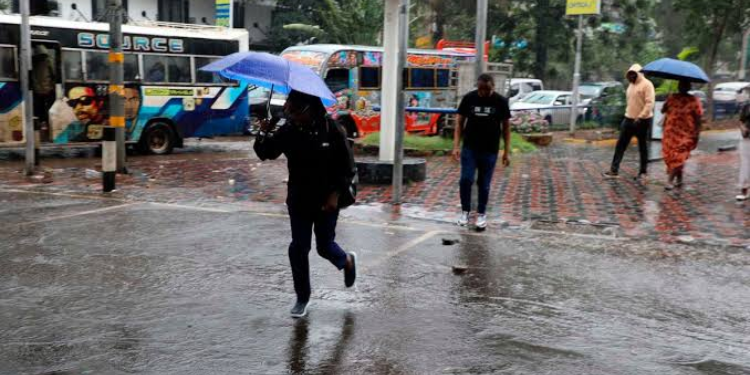
Nairobi residents shield themselves from the rain in the city centre on February 22, 2026. PHOTO/NMG
Kenya Met Expects Rains To Be Well Distributed
Overall, Kenya Met expects the OND rains to distribute fairly to well across the country in both time and space.
“The OND 2026 rainfall is expected to be fairly to well distributed, both in time and space, over several parts of the country, except over Turkana and Samburu where the distribution is likely to be poor to fair. This season will be marked by prolonged wet spells and occasional isolated storms over several parts of the country,” the Service stated.
The authority expects some western counties, including Nandi, Kakamega, Vihiga, Bungoma, Siaya, Busia, Kisii, Nyamira, Kericho, Bomet and Kisumu, to continue receiving rainfall from September.
In contrast, Nairobi, Kiambu, Murang’a, Nyeri, Nyandarua, Laikipia, Kirinyaga, Meru, Embu and Tharaka-Nithi could experience rainfall onset between the second and third weeks of October.
Similarly, Machakos, Kitui, Makueni, Kajiado, Taita-Taveta and inland parts of Tana River could receive the rains between the third and fourth weeks of October.
Along the Coast, Mombasa, Kwale, Lamu, Kilifi and the Tana Delta could experience onset between the second and third weeks of October.
Also Read: Sakaja Launches Fresh Nairobi Flood Measures as El Niño Rains Approach
Low Drought Risk Forecast
Despite the enhanced rainfall outlook, Kenya Met expects drought risk to remain low across most parts of the country.
“The SPI forecast for the October-November-December (OND) 2026 season indicates that the probability of the occurrence of mild, moderate or severe drought events is low over most parts of the country,” it said.
However, Turkana faces a 15 to 20 per cent probability of experiencing a mild drought event.
Temperatures Expected To Be Warmer
Beyond rainfall, Kenya Met expects temperatures to remain warmer than average during the October-December season, particularly along the Coast and in parts of eastern Kenya.
Kwale, Mombasa, Kilifi, Lamu and parts of Tana River, Taita/Taveta and Garissa have the highest probabilities of recording warmer-than-average temperatures.
Kenya Met expects the enhanced rainfall to produce both positive and negative impacts across different sectors. However, the authority noted that short-term weather systems, including tropical cyclones and the Madden-Julian Oscillation, can quickly influence rainfall intensity.
The authority advised the public to use the OND outlook alongside its 24-hour, five-day, seven-day, monthly and special forecasts, as well as regular advisories and county-level forecasts issued throughout the season.
“It is therefore imperative to stay up to date with subsequent forecasts and updates,” The Service said.
Follow our WhatsApp channel for instant news updates.

Edward Maina Muriuki is the Acting Director of Meteorological Services at the Kenya Meteorological Department (KMD). PHOTO/ File