Ruto Launches A8 Highways After PPP Disclose
Share
President William Ruto on Friday, November 28th, 2025, launched the Nairobi–Nakuru–Mau Summit (A8) and Nairobi–Maai Mahiu–Naivasha road projects in Kiambu County, describing the new infrastructure as the foundation of a “Kenya reborn,” driven by innovation rather than traditional state funding.
He said the initiative marked a decisive shift in the country’s development model after years of stalled progress.
Speaking during the ceremony, Ruto said Kenya could no longer depend on the national budget for major highways because “a single major highway can swallow nearly half of our entire annual development budget.”
He added that borrowing was equally unsustainable given the country’s fiscal constraints, while slowing development “was never an option.”
The President said Kenya had for decades been trapped in development paralysis.
“Stagnation convinced us that mediocrity was normal, that delay was destiny,” he said, emphasizing that the new projects signalled a break from that cycle.
Also Read: PPP Disclosure Raises Fresh Questions Over Nairobi–Nakuru Highway Project
Government Turns to PPP Model After Lengthy Negotiations
The President’s remarks came against the backdrop of a complex procurement process involving months of evaluation, stalled negotiations and legal reviews undertaken by the Kenya National Highways Authority (KeNHA).
The Authority recently disclosed that it received two Privately Initiated Proposals (PIPs) for the A8 corridor: one from Shandong Hi-Speed Road and Bridge International Engineering Co. (SDRBI) and another from the China Road and Bridge Corporation (CRBC) in partnership with the National Social Security Fund (NSSF).
KeNHA said, “Both proposals were evaluated for the design, build, finance, operate, maintain and transfer model.”
The proposals, covering 175km of A8 and 58km of A8 South, were submitted on 15 September 2025.
KeNHA noted the alternative options were prepared to “anticipate investment approval delays for Chinese State-Owned Enterprises.”
Following evaluation, CRBC–NSSF emerged the preferred proponent for the full corridor, a ranking confirmed by the PPP Committee on 9 October 2025.
Breakdown in Negotiations and Pivot to Split-Corridor Approach
However, the full-corridor talks collapsed when CRBC disclosed its participation was limited by China’s outbound investment rules, capped at USD 1 billion.
KeNHA explained, “This limitation meant the preferred proponent could not undertake the entire corridor within the required timelines.” SDRBI faced the same investment ceiling, rendering the full-corridor option unviable.
As a result, KeNHA initiated a return to the split-corridor model.
On 10 November 2025, during its 48th Extraordinary Meeting, the PPP Committee endorsed the revised structure, stating that the project “meets public interest and PPP suitability criteria,” according to the National Treasury.
Under the approved model, CRBC–NSSF will implement the Nairobi–Naivasha–Gilgil and A8 South sections covering about 81km, while SDRBI will take on the 94km Gilgil–Mau Summit stretch.
Also Read: Ruto Reveals 4 Strategic Actions to Move Kenya Forward
Project Cost, Regional Importance and Economic Benefits
Ruto said the new roads, costing more than KSh170 billion, will be delivered through a modern public-private partnership that shifts risk away from the taxpayer.
“This project is more than a highway; it’s a gateway to prosperity, unity, and transformation,” he said.
The Nairobi–Nakuru–Mau Summit and Maai Mahiu–Naivasha upgrades will improve cargo movement to Uganda, Rwanda, Burundi, South Sudan and the Democratic Republic of Congo.
They will feature interchanges, pedestrian bridges, truck lay-bys, lighting, drainage systems and intelligent transport systems designed to reduce accidents and congestion.
“For too long, this corridor carried more than it could bear. Today we say: no more,” Ruto said.
Jobs, Local Content and International Cooperation
The President announced the project will create at least 15,000 jobs, with young people receiving specialised training during construction.
He also welcomed the expertise of Chinese companies involved, saying, “Chinese participation would help strengthen local skills and technological capacity.”
Ruto linked the project to a broader nationwide infrastructure drive that includes new dual-carriageways from Muthaiga to Kiambu, Machakos Junction to Mariakani, Mau Summit to Kisumu, and on to Busia, among others.
He also reaffirmed that the Standard Gauge Railway will be extended from Naivasha to Kisumu and eventually to Malaba starting in January 2026.
Long-Term Financing Vision and Accountability Call
To sustainably finance future mega-projects, Ruto said the government is establishing a National Infrastructure Fund and a Sovereign Wealth Fund supported by budget allocations, privatisation proceeds, and resource royalties.
“This approach will reduce our dependence on debt and build long-term national wealth,” he said.
He urged contractors, businesses, and communities to maintain strict oversight.
“Together, we must uphold transparency and ensure this project becomes a beacon of pride,” he told the crowd, concluding that the country must “walk confidently and decisively into excellence.”
Follow our WhatsApp Channel and WhatsApp Community for instant news updates
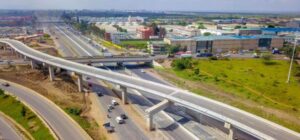
The 193- Kilometres Kenya- Uganda Multinational Expressway Project. PHOTO/ EAC
You Might also Like