
Kenya’s Notable Vice Presidents Who Never Made It to State House
Share

Kenya’s political history is marked by powerful deputy presidents and vice-presidents who held national influence but never ascended to the presidency.
While some deputies used the office as a springboard to higher power, several notable figures, named for statesmanship, policy roles and regional influence, concluded long public careers short of the top job.
The deputy office in Kenya has evolved, from the early vice-presidency to the current constitutional office of Deputy President, and with that evolution came changing political expectations.
Some deputies served briefly and dramatically; others held steady, technocratic roles over many years, shaping economic and security policy without ever becoming president.
Below are profiles of a few of the most consequential figures who admired but never saw the top seat.
Musalia Mudavadi
Musalia Mudavadi, a long-serving politician from Western Kenya, briefly served as vice-president in late 2002 under President Daniel Arap Moi and later as Deputy Prime Minister in the Grand Coalition government (2008–2013).
He began his parliamentary career in 1989, has held major ministries including Finance and Agriculture, and has been a perennial presidential contender whose bids have not reached the presidency.
Mudavadi’s political career is notable for its longevity and his ability to play kingmaker roles in coalition politics.
Currently, Mudavadi serves as the Prime Cabinet Secretary and CS for Foreign and Diaspora Affairs.
George Saitoti
George Saitoti served as Kenya’s vice-president for long stretches under President Moi.
He became the country’s longest-serving vice-president with terms spanning parts of 1989–1998 and 1999–2002.
His tenure is remembered for loyalty to the Moi years and for a reputation as an efficient, sober administrator.
A mathematician turned politician, Saitoti combined technical expertise with political clout, also holding key cabinet roles including Finance and Interior until his demise in a chopper crash.
Also Read: Linus Kaikai: From Newsroom to Courtroom
Kalonzo Musyoka, Coalition-era deputy president
Stephen Kalonzo Musyoka served as Vice President during the 2008–2013 Grand Coalition government formed after the 2007–08 post-election crisis.
A seasoned diplomat and minister before becoming deputy, Kalonzo played a central role in reconciliation politics and coalition governance, though he, too, did not make the final leap to the presidency despite multiple presidential runs.
Kalonzo’s bid is still alive as he is the current Wiper Patriotic Front leader and among the opposition chiefs as well, who are eying to unseat Ruto in 2027.
Moody Awori
Moody Awori served as Vice President from September 2003 until January 2008 under President Mwai Kibaki.
A veteran legislator and former cabinet minister, Awori’s tenure saw him positioned as an elder statesman within the ruling coalition, but like others profiled in this article, he left office without succeeding to the presidency.
His career spans decades of public service and policy involvement.
Also Read: Profile of Jeff Koinange: Kenya’s Journalist Who Made Headlines Globally
Jaramogi Oginga Odinga
Jaramogi Oginga Odinga was Kenya’s first vice-president after independence (1964–1966) and later emerged as a leading opposition figure.
A central player in the independence era, he broke with the ruling party and spent much of his later life in opposition, a trajectory that cut short a State House succession but cemented his legacy as a nationalist and elder statesman.
Follow our WhatsApp Channel and WhatsApp Community for instant news updates
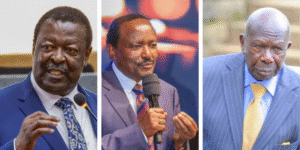
A Collage of Kenya’s Vice-President’s, from left, Musalia Mudavadi, Kalonzo Musyoka, and Moody Awori. PHOTO/ File