
Share
Several stakeholders have rejected the proposed measures in the Tobacco Control Amendment Bill 2024, warning that the amendments could cripple small businesses, endanger farmers’ livelihoods, and push consumers toward illicit markets.
The stakeholders, including the Retail Traders Association of Kenya, Harm Reduction Initiatives, Tobacco Farmers, Small Traders, Consumer Groups, and the Bars, Hotels and Liquor Traders Association of Kenya (BAHLITA), have raised concerns with multiple clauses they say are excessively restrictive and harmful to the economy.
They argue that the Bill, if passed unchanged, will undermine harm-reduction efforts and unfairly penalise legal businesses operating within the nicotine-product supply chain.
“These proposals will not achieve their intended goals but instead fuel illegal markets and hurt legitimate traders,” one group said.
Flavour Ban Sparks Outcry
One of the most contested provisions is the proposed ban or severe restriction on flavoured vapes and nicotine pouches.
The clause prohibits all characterising flavours, including fruit, candy, menthol, herbs, alcohol, and sweet flavours, across all nicotine products.
According to stakeholders, this measure “kills demand for legal safer alternatives and pushes users to illicit markets.”
They argue that flavours play a crucial role in helping smokers transition away from traditional cigarettes.
“The clause removes flavours that help smokers switch away from cigarettes,” the stakeholders stated.
Nicotine Strength Caps Criticised
The Bill also introduces strict caps on nicotine strength in vapes and pouches.
Under the proposal, vapes would be capped at 10 mg/mL, while nicotine pouches would be limited to 10 mg per pouch, accompanied by mandatory warning labels.
They add that such limits encourage a shift toward illicit, stronger, and unregulated products, posing greater health risks.
Stakeholders warn that the caps are “too low to satisfy adult users,” a situation they believe could force many back to cigarettes.
Also Read: Safaricom and Colgate Top List of Kenya’s Most Trusted Brands
Ban on Advertising, Online Sales and Hawking
Another major point of contention is the proposed total ban on online sales and digital advertising, including influencer partnerships.
The clause outlaws all online selling, promotion, digital visibility, and influencer-driven content, with penalties reaching up to KSh 500,000 or three years in jail.
Stakeholders argue that the ban “removes a crucial sales channel for small traders” and cuts off access to accurate information on safer alternatives for smokers.
They say such a move would especially hurt youth-led businesses and digital entrepreneurs who rely on online platforms.
Further opposition has been raised against the proposal to ban hawking, mobile vending, and sales from vehicles.
The clause criminalises selling nicotine products via hawkers or mobile vendors, with fines of up to KSh 50,000.
According to small traders, this measure eliminates income for mobile vendors and disrupts informal trading channels relied upon by thousands.
They warn it could “drive vending underground, benefitting illicit sellers instead of legitimate small-scale operators.”
Also Read: PSC Provides Update on Nationwide Internship Interviews
Costly Pre-Approval and Licensing Burdens
The Bill also introduces heavy, centralised pre-approval requirements, mandating ingredient disclosure, toxicology data, product samples, and approval by the Cabinet Secretary for Health before any product can be sold.
Stakeholders say this requirement is “too costly and complex for SMEs,” creating a system that favours larger companies with vast regulatory budgets while pushing small players out of the market entirely.
In addition, the Bill proposes extra county-level licensing for anyone selling, storing, or distributing nicotine products.
According to traders, this creates duplicate licensing layers and increases operational costs.
“It is unnecessary and will cripple kiosks and small outlets already struggling with compliance costs,” one traders’ group argued.
Clampdown on Safer Alternatives
The final contested clause applies cigarette-level controls to safer alternatives such as vapes and nicotine pouches, including flavour bans, nicotine caps, online sales bans, central approvals, and strict packaging.
Also, limiting access to safer alternatives will only fuel black-market products that lack safety checks.
Stakeholders insist that this approach “eliminates lower-risk options and keeps smokers on harmful cigarettes.”
Follow our WhatsApp Channel and WhatsApp Community for instant news updates
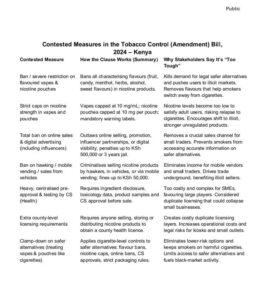
Contested measures in the Tobacco Control Amendment Bill 2024. PHOTO/FILE.
You Might also Like