
Why Museveni Wants the Ugandan Government to Own the Internet
Share

Ugandan President Yoweri Museveni now says the government should control internet infrastructure rather than allow private companies to own and dominate it, arguing that this is necessary to keep data costs low for ordinary citizens.
Speaking during a press briefing to the youth, the Ugandan president insisted that privately owned telecommunication firms are profit-driven and often monopolize their services, making connectivity unaffordable.
“When private businesses control the internet, they prioritise profits, leading to high costs for consumers, and that is why the backbone should be owned by the government,” Museveni said.
He maintained that the State should have control over the main digital processes to ensure affordable transmission, noting that private companies can provide services but should not control essential infrastructure.
His remarks have, however, sparked criticism over fears of a possible internet shutdown ahead of elections early next year.
However, Museveni insisted that the government should control the internet infrastructure so that Ugandans can have the choice to dump private retailers should they become expensive.
“I think the cost was coming down from 600 dollars per jigger bites or something, something else, something else, it should come down but the strategy is that the backbone should be owned by the government not the private people. So if the private people have their own backbone and they make it expensive, you abandon them and use the government one.”
Also Read: Trump Invites Ruto to Witness Historic Agreement
National Security and Technology
Museveni attributed his position to the rapid evolution of technology and provided a personal example of the military to explain why digital infrastructure has become a strategic consideration in the country.
“The internet and electronics have indeed helped us to do things much faster because when we were fighting in the earlier days, I had to use my eyes to estimate how far the enemy was so that I could adjust my gun sight to shoot properly,” he recounted.
These days, with a laser, it tells me the exact location of the target. I don’t have to calculate.”
According to the president, such advancement underscores the government’s responsibility to protect core communication systems.
Also Read:Inside Mudavadi Meeting Museveni After Controversial Indian Ocean Threat
Internet Control Concerns Ahead of the 2026 Elections
The comments by Museveni have, however, attracted criticism among the opposition groups and the digital rights activists who are concerned that the policy may allow the state to exert control over online communication and may have to close down or even censor online communication ahead of elections early next year.
Critics argue that government ownership of the backbone could be used to restrict dissent, especially as the President seeks a record seventh term in office.
Ruto Defends Computer Misuse Bill
In Kenya, President William Ruto is in support of the controversial Computer Misuse Bill, despite critics arguing that it can be used to curtail internet freedoms.
Ruto argues that the law is required to curb the increasing digital threats and protect vulnerable groups.
He explained how cyberbullying, radicalisation, and religious extremism are hurting the youth, giving an example of the Shakahola tragedy.
“Our young people are being terrorised, bullied, and subjected to pornography on social media. This is something that we, as a government, should avoid. Cyberbullying has led to depression and even suicide among our youth, and we cannot sit back and watch, Ruto said.
The Kenyan President refuted the misinformation about the bill, saying that it protects the national interest.
“The government is doing what is right for this country. We are determined to protect our youth and ensure that national security and well-being are not compromised by cybercrime,” he added.
Follow our WhatsApp Channel and WhatsApp Community for instant news updates
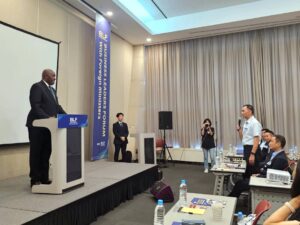
Minister of ICT Dr. Chris BaryoMunsi during a trade meeting in Kampala. PHOTO/Courtesy.