How a Man with a Cancer-Linked Gene Donated Sperm and Fathered 197 Children
Share
An international investigation has revealed that a sperm donor carrying a dangerous cancer-linked genetic mutation unknowingly fathered at least 197 children across Europe.
The findings, uncovered through a coordinated inquiry by 14 public broadcasters, show that some of the children conceived using his sperm have already died, while many others face a sharply increased lifetime risk of cancer.
The donor’s sperm was never supplied to the UK market, but authorities confirmed that a “very small” number of British women travelled to Denmark for fertility treatment using his samples.
Those families have now been contacted and informed of the potential genetic danger.
Denmark’s European Sperm Bank, which distributed the donor’s samples for nearly two decades, issued a statement offering its “deepest sympathy” and acknowledged that the donor’s sperm had been used “to make too many babies in some countries.”
Mutation Traced to TP53 Gene
The donor, who began donating sperm as a student in 2005, was considered healthy and passed all routine screening checks.
However, investigators later discovered that a mutation had arisen before his birth, damaging the TP53 gene, a key gene that helps prevent cells from becoming cancerous.
According to researchers, up to 20% of the donor’s sperm carried the harmful mutation, meaning any child conceived from those cells would inherit it in every cell of their body.
This condition, known as Li-Fraumeni syndrome, comes with an estimated 90% lifetime risk of developing cancer.
“It is a dreadful diagnosis,” said Prof. Clare Turnbull of the Institute of Cancer Research in London.
“It is a very challenging diagnosis to land on a family; there is a lifelong burden of living with that risk, it is clearly devastating,” Prof. Turnbull added.
Treatment for those who inherit the mutation includes: annual MRI scans, brain imaging, and frequent ultrasounds to detect tumours early.
Also Read: Why Queen Mary of Denmark Will be in Kenya for 3 Days
Dozens of Children Already Diagnosed
Doctors first raised the alarm earlier this year after noticing several cancer cases linked to the same donor.
They initially identified 23 children with the mutation out of 67 known conceptions, and ten had already been diagnosed with cancer.
“We have many children who have already developed cancer,” said Dr. Edwige Kasper of Rouen University Hospital in France.
“We have some children that have already developed two different cancers and some of them have already died at a very early age,” Edwige lamented.
The overall number of children fathered by the donor is now confirmed at a minimum of 197, though investigators say the final total may be higher due to incomplete records from some countries.
One parent, a French mother identified only as Céline, said she felt misled after learning her daughter carried the mutation.
She said it was unacceptable that she was given sperm that “was not clean, that was not safe, that carried a risk,” adding that she and her daughter must now live knowing cancer could strike “when, which one, and how many.”
International Oversight Under Scrutiny
The donor’s sperm was used by 67 clinics in 14 countries.
While the UK has strict rules limiting donors to ten families, Denmark and Belgium confirmed that limits had been exceeded.
In Belgium, a donor should be restricted to six families, yet 38 women used samples from this donor, producing 53 children.
Peter Thompson, chief executive of the UK’s Human Fertilisation and Embryology Authority (HFEA), said affected British families had been notified, but acknowledged wider concerns.
“They have been told about the donor by the Danish clinic at which they were treated,” he said.
Global fertility services rely heavily on large sperm banks that export internationally, creating regulatory gaps.
Professor Allan Pacey of the University of Manchester said the case was “awful” but highlighted the limits of genetic screening.
“You cannot screen for everything,” he said.
“If we make it even tighter, we would not have any sperm donors,” he concluded.
Also Read: 17 Western Countries Demand Tanzania to Release Bodies to Families and Free Political Prisoners
Calls for Stricter Global Limits
The European Society of Human Reproduction and Embryology has proposed limiting donors to 50 families globally, not to prevent genetic mutations, but to reduce the emotional and social impact on donor-conceived children who later discover hundreds of half-siblings.
“More needs to be done to reduce the number of families that are born globally from the same donors,” said Sarah Norcross of the Progress Educational Trust.
“We do not fully understand what the social and psychological implications will be,” Sarah Norcross concluded.
Follow our WhatsApp Channel and WhatsApp Community for instant news updates
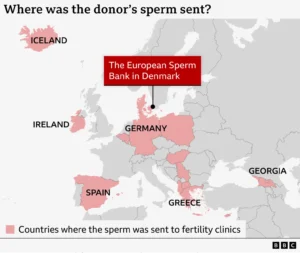
Some of the European Countries Where the Donor’s Sperm was Distributed. PHOTO/ BBC
You Might also Like