
Education Ministry Announces KJSEA 2025 Results: How to Check
Share
The Ministry of Education has officially released the Kenya Junior School Education Assessment (KJSEA) 2025 results, marking a major step in the transition of learners from junior to senior school under the Competency-Based Education (CBE) system.
Speaking during the announcement, CS Ogamba reiterated that “the government commenced the implementation of CBE in 2017. The CBE follows the structure of 2 years in pre-primary, 6 years in primary school, 3 years in junior school and another 3 years in senior school.”
They said the curriculum was introduced to equip the new generation with skills relevant to modern demands.
According to Ogamba, “the CBE is designed to equip learners with skills, values and attitudes necessary to thrive in the 21st century.”
The assessment is a key tool guiding learners into specialised senior school pathways.
The education Don added that “the KJSEA is meant to guide learners transition from junior school to senior schools. KJSEA goes beyond traditional examinations, it focuses on identifying learners’ strength, aptitudes and interest, ensuring every learner is placed where they can realise their full potential.”
Also Read: How to Check Your KJSEA Results Easily
Purpose and Structure of the Assessment
Highlighting the goals of the assessment, Ogamba noted that “the purpose of KJSEA is threefold; one is to evaluate the learners achievements of competencies acquired during junior school. The second one is to provide feedback for placement into senior school pathways, the STEM, arts and sports sciences, and social sciences and the third one is to support progression and planning aligned with learners strengths and interest.”
In this year’s examination, most subjects featured a single paper, while “languages, integrated sciences and other subjects had two papers due to the composition practical components.”
Ogamba stressed that this format aligns with the hands-on nature of the curriculum.
Transition Capacity and Gender Distribution
The Education CS confirmed readiness for full transition, stating that “today we’re ready to transition 1.13 million learners from junior school to senior school against the capacity of 1.5 million, equivalent to 100 percent transition.”
Of the more than one million candidates, “578,630 were male while 551,829 were females, representing 51.19% and 48.81% of the total learners,” Ogamba said.
Ogamba further noted that the counties with the highest candidature included “Nairobi 71,022, Kakamega 58,384, Nakuru 54,028.”
“Forty-one counties recorded higher male than female entries, while Mombasa is the only county that achieved a gender barrier of 50% proportion for both gender learners,” Ogamba added.
Also Read: Govt Moves to Enable KMTC Students Get HELB Loans
Age Distribution of Candidates
Age data showed a majority of candidates were within the recommended schooling age.
According to the ministry, “642,620 learners which translates to 56.48% were within the appropriate age range of 14–15 years.”
“However, there were also under age learners 13 years and below which stood at 35,270 equating to 3.21%, while learners 18 years and above were 37,638 which is 3.33% of the candidature,” Ogamba lamented.
Follow our WhatsApp Channel and WhatsApp Community for instant news updates
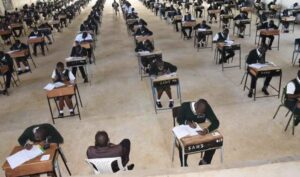
Image of candidates sitting exams. PHOTO/FILE.
You Might also Like