
JKUAT: Complete Guide to Courses Offered, Fees, Location & Campuses
Share
Jomo Kenyatta University of Agriculture and Technology (JKUAT) is situated in Juja, 36 kilometres North East of Nairobi, along the Nairobi-Thika Highway.
It is a leading Kenyan public university, known for strong programs in Engineering, Agriculture, Tech, and Innovation, focusing on national development, ranked among Kenya’s top universities, and features a motto emphasizing research, innovation, and entrepreneurship.
The institution’s origins trace back to 1978, when Kenya’s founding president, Mzee Jomo Kenyatta, donated 200 hectares of land for the college’s development.
Following the admission of its inaugural student cohort on May 4, 1981, the college (then JKCAT) was officially inaugurated by H.E. Daniel Arap Moi on March 17, 1982.
The first graduation followed in April 1984, where diplomas were awarded in the foundational fields of Agricultural Engineering, Horticulture, and Food Technology.
Core Values & Philosophy
Also Read: Maseno University: Courses Offered, Fees, Location and Campuses
University Core Values
Quality-The university shall always be quality-driven in all its activities and operations.
Teamwork– The university shall maintain a culture of teamwork to ensure synergy in the conduct of its activities.
Transparency-The university will maintain a culture of transparency in dealing with staff and students and all its stakeholders.
Accountability-The university shall continuously enhance its accountability systems and practices.
Professionalism -JKUAT shall put emphasis on expertise and professionalism in the conduct of its activities and provision of service to all stakeholders.
Innovation– The university shall endeavour to utilize the latest, up-to-date and most appropriate technology in achieving its objectives.
Integrity-The university shall be honest, truthful and reliable in the provision of services to its customers.
Dynamism– The university shall be responsive and adjust its programmes and services to the changing national and global development needs.
Food and Accommodation
Also Read: Maasai Mara University Acts Following Uproar Over Student Academic Transcript
The university offers accommodation to some of the students at subsidized rates.
Within the school grounds are six dorms for students, three of which are occupied by men and three by women. Males occupy Halls 3, 5, and 6, while females occupy Halls 1, 2, and 4.
The Candle in the Wind, Main Mess, and Hall Six dining mess are the three student dining cafeterias. The dining mess offers subsidized food prices. Breakfast is served from 6.30 to 8 a.m., lunch from 11 a.m. to 2 p.m., and dinner from 5 p.m. to 8 p.m.
Campus and Faculties
Also Read: Court Orders University Student to Pay Stolen Whisky
Jomo Kenyatta has the following campuses, schools, faculties, institutes and colleges:
Schools
School of Medicine (Main campus)
School of Pharmacy (Main campus)
School of Computing and Information Technology
School of Architecture & Building Sciences
School of Civil, Environmental and Geospatial Engineering
School of Electrical, Electronic and Information Engineering
School of Law (based at the Karen Campus)
School of Mechanical, Manufacturing and Materials Engineering
School of Biosystems and Environmental Engineering (SoBEE) – Main Campus
School of Business
School of Communication and Development Studies (SCDS)
School of Biomedical Sciences
School of Agriculture and Environmental Sciences.(SOAES)
School of Mathematics and Physical Sciences.
Institutes
Institute of Energy & Environment Technology
Institute for Biotechnology Research
Faculties, Campuses, Centres
Board of Postgraduate Studies
College of Engineering and Technology
College of Agriculture and Natural Resources
College of Pure and Applied Sciences
College of Health Sciences
College of Human Resource and Development
Main Campus – Juja
Karen Campus
Westlands Campus (formerly Nairobi Campus)[8]
Kigali Campus – (Kigali, Rwanda)
Nairobi CBD Centre
Mombasa CBD Centre
Nakuru CBD Centre
Kisii CBD Centre
Kitale CBD Centre
Kisumu CBD Centre
Kakamega CBD Centre
Eldoret CBD Centre
Arusha Centre
Library
Also Read: Open University of Kenya Announces Fully Sponsored Courses
The University Library provides a conducive study environment with a seating capacity for 600 students and a robust collection of over 80,000 volumes.
Beyond its physical archives, the library offers a comprehensive suite of academic services, including digital information resources, interlibrary loans, and specialized user education.
Students also have access to essential support facilities such as binding, photocopying, and repair services. The diverse collection features notable works ranging from technical academic texts to contemporary literature, such as Season of Vipers by Danis Tuti Odongo.
Follow our WhatsApp Channel and WhatsApp Community for instant news updates
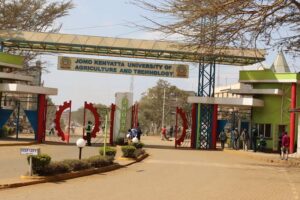
JKUAT, Main gate
You Might also Like