
What You Need to Know Before Going for an Endoscopy Procedure
Share

Endoscopy is a safe, nonsurgical procedure used to examine a person’s digestive tract from the inside.
The doctor uses a long flexible tube, called an endoscope, that has a light and a camera attached to it.
By sliding it down your throat, your doctor can get a close-up look at the inside of your gastrointestinal tract on a color TV monitor.
The camera relays live video images of your oesophagus to a screen in the room, helping your doctor assess and diagnose any problems or conditions.
What to Expect During an Endoscopy Procedure
An upper GI endoscopy can directly assess the duodenum (the first part of the small intestine), stomach and oesophagus. Together, these are also known as your upper GI tract.
Typically, surgeons perform an endoscopy without the patient having a general anaesthetic, so you’ll be awake.
However, they will numb your throat with a spray to prevent you from gagging. They can use mild sedation if you’re especially nervous.
The surgical team will also monitor your blood pressure, oxygen and heart rate throughout the procedure. An endoscopy generally takes up to 30 minutes to complete.
The importance of the endoscopy preparation process
It’s vital to follow the doctor’s preparations for your upper GI endoscopy. Failing to follow them can jeopardize your safety and prevent the procedure from proceeding.
Also Read: Autopsy Reveals What Caused Death of GSU Officer Killed Outside State House
Preparing for Endoscopy
The patient must stop eating and drinking at least six hours before the exercise.
Meanwhile, you can drink clear liquids, like water or broth, up to six hours before the endoscopy.
At the same time, avoiding anything red or orange is sensible, as the colouring can affect the view of your upper GI tract.
If you have any current or previous medical conditions or any health related problem, notify the doctor before the process.
Wear clothes that make you comfortable.
Also Read: Court Orders Exhumation of Orphan Girl’s Body for Repeat Autopsy
Types of Endoscopy
There are different types of Endoscopy which includes, upper endoscopy, also called esophagogastroduodenoscopy (EGD).
An EGD is used to evaluate the esophagus, stomach, and the upper part of your small intestine, making it useful for evaluating abdominal pain, acid reflux, difficulty swallowing, and other upper GI symptoms.
In addition to diagnosing certain gastrointestinal (GI) issues, endoscopy can be used to treat specific conditions. By passing thin devices through the endoscope, your doctor can take tissue samples, screen for cancer, remove polyps, or administer other treatments.
Other types include Colonoscopy and Sigmoidoscopy, among others.
Follow our WhatsApp Channel and WhatsApp Community for instant news updates
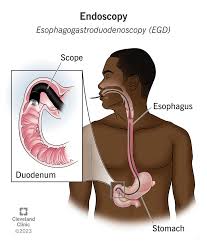
Endoscopy procedure illustration. PHOTO/pixels