
Win for Artists as Govt Moves to Raise Payouts
Share

Artists can now smile after the government moved to dismantle cartels within the music industry that have for years deprived Kenyan musicians of their rights especially the earnings.
This crackdown follows the release on Sunday December 21, 2025 of data detailing the financial operations of major CMOs including PRISK/PAVRISK, MCSK, and KAMP.
The release revealed the pattern of low distributions and missing financial records over the last years.
The “Rot” by the Numbers
Also Read: How Police Plan to Use Music to Reduce Road Accidents
The data highlighted a massive disparity between the money collected from the public and the amount actually reaching the artists.
PRISK/PAVRISK: In 2024, despite generating over KSH 86 million in distributable income, only 12.8% (KSH 11 million) was distributed to members.
The 2020 Mystery: For PRISK, the year 2020 remains a major red flag, with auditors noting that the report was not signed and the amounts collected and distributed are not verifiable.
MCSK Transparency Crisis: The Music Copyright Society of Kenya (MCSK) shows a startling lack of data, with “No information” available for 2023, 2021, 2020, and 2019. In 2022, while they collected over KSH 109 million, artists saw only 12.7% of that wealth.
KAMP: Similar trends appear for KAMP, where distributions have hovered around a meager 10% to 12% of total income over the last four years.
A Bold New Era
Also Read: Details of Ugandan Military Officials’ Visit to Kenya
Speaking on the cleanup, Dennis Itumbi stated that the era of “evil schemes” and the “rot” that has broken the spirits of Kenyan creatives is officially over.
“Today, we have dismantled the music cartels that for years have exploited and broken our musicians. We have boldly stopped their schemes. It was not easy, but the unwavering support of President William Ruto, DP Kithure Kindiki, and Head of Public Service Felix Koskei made it possible for us to deliver this justice to our artists.” Dennis Itumbi said on an X post.
What This Means for Musicians
Also Read: Cabinet Secretaries & Govt Officials to Spearhead Nationwide Tree Planting Campaign
The government’s intervention signals a shift toward complete transparency.
The state hopes to impose a system where the majority of royalties go to the creators rather than the administrators by revealing the “Audited books of account” versus the “No information” gaps.
Kenyan artists have long lamented getting “peanuts” while CMOs continGovernmentued to incur high administrative expenses.
The industry anticipates a new regulatory framework that puts the dignity and labor of musicians first as a result of this dismantling of the old guard.
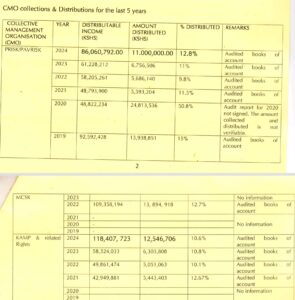
Report by Dennis Itumbi addressing the rates at which musicians are exploited