
Story of the Man Who Changed Singapore Into First World Country
Share

Lee Kuan Yew, born on September 16, 1923, and died March 23, 2015, was a politician and lawyer.
He was Singapore’s first prime minister and is widely known as the founding father of modern Singapore.
Serving from 1959 to 1990, he transformed Singapore from a poor, resource-scarce British Colony into one of the most prosperous and stable countries in the world.
Through his leadership, Singapore established a solid industrial foundation, foreign investment, and high GDP per capita ratings in Asia, and became one of the regional financial powerhouses.
His legacy was a blend of an authoritarian form of governance and visionary nation-building that suppressed political freedoms.
Early Life and Political Beginnings
Born into a long-established Chinese family in Singapore,Lee was educated locally before studying in the United Kingdom.
In 1949, he graduated with a law degree from Cambridge University, topping the honours list, and was admitted to the English bar in 1950.
Going back to Singapore, he practised law and joined trade unions closely, which introduced him to politics.
At a time when there was an increasing clamour to reform the constitution, in the early fifties, Lee co-established the People’s Action Party (PAP), initially with the encouragement of the communists to oppose the colonial political elite.
In 1955, Lee was elected to the Legislative Council after constitutional amendments that had increased the number of elected members.
Following a number of unsuccessful efforts to gain self-rule, Singapore gained internal self-government in 1959 when the PAP appeared victorious in a landslide electoral victory.
Lee was made the prime minister and made ambitious reforms that were aimed at public housing, education, women’s rights, and industrialization.
He had completely severed ties with the communists by 1961 and established control of the PAP.
Also Read: Why I Do Not Believe in Ruto’s “Singapore Narrative”
Nation Building
Singapore became part of the Federation of Malaysia in 1963; however, ethnic conflicts and political matters forced Singapore to be separated in 1965.
Lee then led the newly independent republic, prioritizing national survival, security, and economic growth.
He built a disciplined, efficient state, encouraged multiracialism, and created a powerful national defense while maintaining close ties with Western powers.
Also Read: Ruto Signs Deal with Singapore as He Plans to Make Kenya a First-World Country
Leadership
Lee’s government emphasized industrialization, export-led development, labour discipline, and social order.
His political dominance was reinforced by weak opposition and the use of measures such as press restrictions and detention laws.
Despite criticism over civil liberties, Singapore achieved remarkable economic growth, improved livelihood, and regional influence.
Lee also played a key role in founding ASEAN in 1967, strengthening Southeast Asian cooperation.
Lee stepped down in 1990 as prime minister after ensuring a smooth transfer of leadership to his successor, but remained influential as senior minister and subsequently as minister mentor.
He remained a member of parliament until the time of his demise.
The legacy of Lee Kuan Yew is that of transformative leadership -extraordinary development, excellent governance, and the persistence of discussion on the issue of prosperity and political freedom.
Follow our WhatsApp Channel and WhatsApp Community for instant news updates
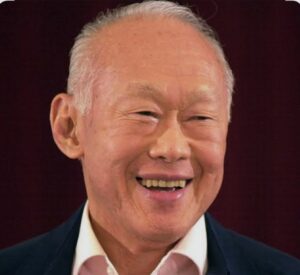
Lee Kuan Yew during a meeting on East Asia’s Economic Prospects
Image/Getty