
Share
By Nashon Oriang, Graduate of the Presbyterian University of East Africa
On a Sunday morning, the faithful might see only a pastor, imam, bishop, or apostle standing in the pulpit with authority. The words are inspired and carefully crafted, speaking to the anxieties of the week. What they don’t see, at least not yet, is the screen that may have helped form that message.
Amid churches, mosques, and ministries, the integration of artificial intelligence (AI) is gradually becoming an integral part of sermon preparation. Not as a replacement for faith or revelation per se, but as a tool, one more piece in the long tradition of commentaries, concordances, and theological guides. This moment is characterized by speed, scale, and subtlety. AI does not sit on a shelf. It responds.
Several clergy members I spoke with referred to AI as a “study companion.” Reverend Akama of the Anglican Church of Kenya, who pastors a parish under the Machakos Diocese, told me that he uses an AI tool called Spinbot to format and phrase the grammar in his sermon preparations, and he also uses ChatGPT for conducting in-depth research during his sermon preparation.
AI helps cross-reference Qur’anic verses with historical tafsir, an imam told me, when planning Friday khutbahs, particularly under time pressure. As a shepherd supervising many parishes, a bishop said, AI helps inform messages that are tailored to each congregation without sacrificing doctrinal rigor.
These are not spaces in which AI is cast as a spiritual authority. It is framed as efficiency.
Clergy today face pressures going beyond the theological. A lot of people manage congregations that have multiplied, the administration, social responses, and many are meant to engage contemporary problems, from artificial intelligence itself to climate change, mental health, and economic crisis. It takes time, research, and context to prepare the sermons week after week. AI, for example, analyzes tens of thousands of pages of text in a structured format and provides help in cases where one has little time.
How the Clergy Use AI
Pastors explain that they use AI to recommend topical sermons relevant to the church calendar. Apostles leading international ministries say it helps identify current instances that work for younger people.
Some clerics use it to translate sermons abroad or to simplify abstract theological concepts for a wider audience. And in each case, the ultimate message is still edited, prayed over, and delivered by a human.
However, the rising infiltration of AI into hallowed areas poses concerns that extend beyond efficiency.
Faith communities are built on authority, interpretation, and trust. When an algorithm recommends a sermon format or presents an interpretation, whose voice is being expanded? AI systems are trained on extensive datasets, which are largely based on digitized texts, most of which are Western, Christian, and English-language-dominant. This has implications for the ways scripture is framed, which interpretations get surfaced, and which traditions get pushed to the margins quietly.
Also Read: How Pastor Mackenzie Used Bible Verse To Justify Deadly Fasting
Challenges Face During Use of These Tools
An imam for whom I spoke was worried about theological flattening. “AI can summarize,” he said, “but it can’t struggle with meaning in the way a scholar does.” A pastor expressed the same concern, saying, Sermons that are too heavily influenced by AI run the risk of sounding polished but spiritually empty, ‘right, but not lived.”
Then there is the issue of transparency. Congregants are rarely informed when the church deploys AI tools to prepare sermons.
For some, it is no different from reading study Bibles or online commentaries. For others, it feels like a line of justification that might need to be explored with some effort eventually, particularly as AI-generated content begins to blur the lines between human-authored prose.
Transformation in Sermons
Regardless, the vast majority of religious leaders I met were pragmatic, not panicked. They perceive AI to be a tool that embodies the user’s ideals. When used properly, it can improve preparations. When used improperly, it can degrade authenticity.
What they do know is that AI is transforming how religious messages are created, even if they’re delivered the same way.
Once an institution of the encounter between divine and human, this pulpit has been indirectly turned into a machine learning environment, training in places that are far removed from sanctuaries and mosques. This isn’t to say faith is being automated. It means the mechanisms for communicating faith are changing.
Also Read: Dear Politicians, The Politics–Religion Cocktail Is Dangerous and Despicable
Embracing AI
In fact, religious leaders have traditionally embraced new technologies, such as printing presses, radio, television, and social media. AI might just be the next thing. The difference is that AI isn’t just transmitting messages; it is also helping to construct them.
As one bishop explained, “The message continues to be led by the Spirit. AI only organizes the notes.”
Whether congregations will embrace that distinction is an open question. For now, the AI presence on the pulpit is mostly invisible, affecting sermons while people quietly hold conversations behind the scenes.
However, as these tools grow in power and prevalence, faith communities may soon face a more fundamental question: not whether technology should be included in sacred spaces, but how much influence there should be over the words meant to guide belief, behavior, and hope.
The sermon is not merely about information, after all. It is formation.
Follow our WhatsApp Channel and WhatsApp Community for Instant News Updates
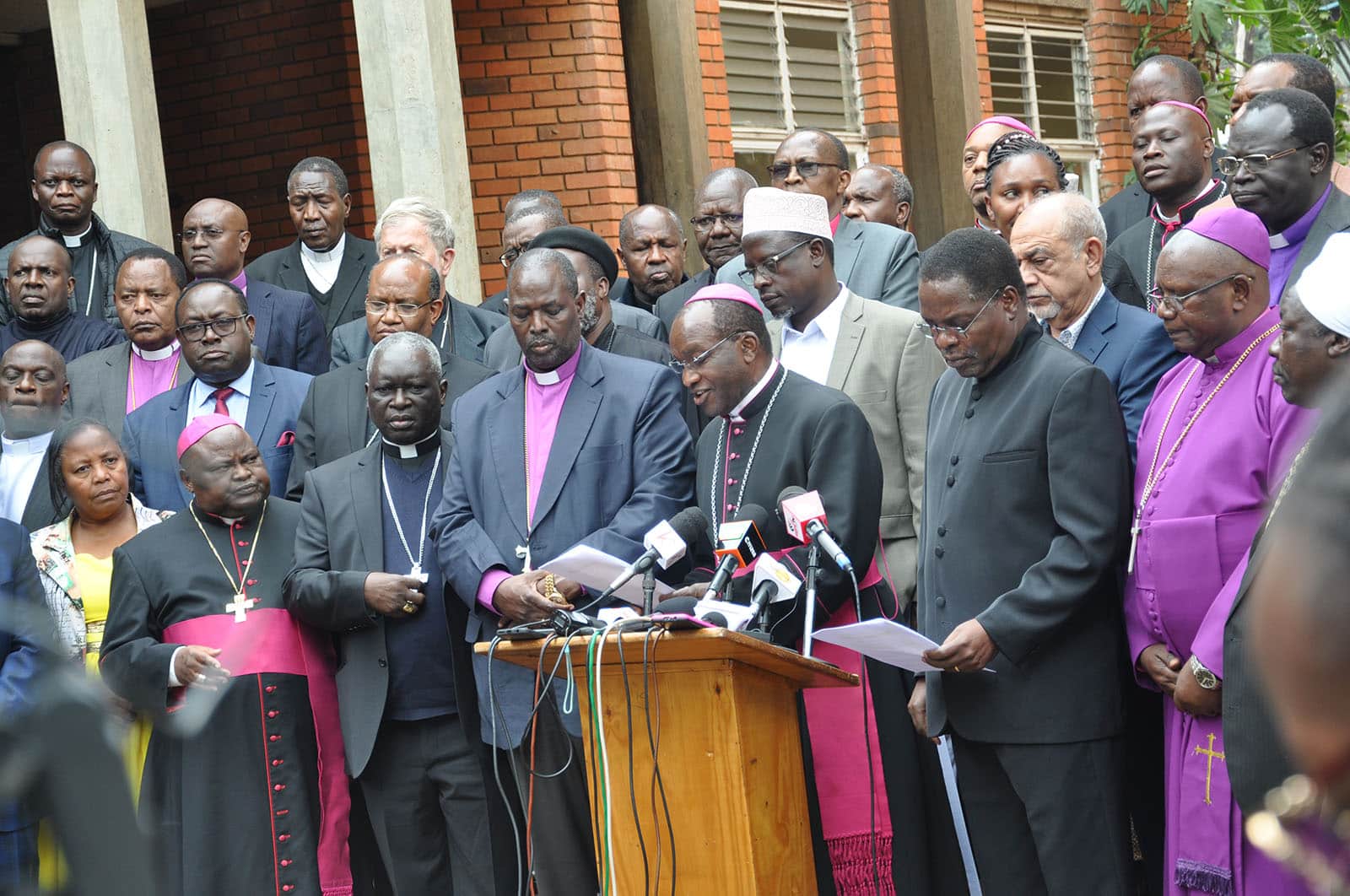
Catholic Archbishop Martin Kivuva Musonde of Mombasa, at podium, is joined by a variety of Kenyan religious leaders during a news conference in Nairobi, Dec. 3, 2024. PHOTO/Fredrick Nzwili.
You Might also Like
![List of Deregistered TVET Institutions as of 2026 [FULL LIST]](https://hivileo.co.ke/wp-content/uploads/2026/03/CS-Julius-Ogamba-183x96.png)



![List of Deregistered TVET Institutions as of 2026 [FULL LIST]](https://hivileo.co.ke/wp-content/uploads/2026/03/CS-Julius-Ogamba-80x80.png)


