Ruto & IMF Taken to Court Over Privatization of Kenya Pipeline Company
Share
A constitutional petition seeking to halt the proposed privatization of the Kenya Pipeline Company Limited (KPC) has been filed at the High Court in Nairobi, setting the stage for a major legal battle over Kenya’s public assets, debt management, and economic sovereignty.
The case, filed on January 2, 2026, questions the legality of the government’s plan to sell a controlling stake in one of the country’s most strategic and profitable state-owned corporations.
The petition, dated December 30, 2025, was lodged by activist Okiya Omtatah Okoiti alongside CFE Bernard Muchiri Muchere and Naomi Nyakerario Misati.
It is registered as Petition No. E001 of 2026 before the Constitutional and Human Rights Division at the Milimani Law Courts.
The respondents include the National Executive, the Attorney General, the Privatisation Commission and Authority, the Board of KPC, the International Monetary Fund (IMF), the National Assembly, and several individuals linked to the privatisation process.
In a press and public summary accompanying the filing, the petitioners state that the case “is a constitutional challenge brought against the proposed privatisation of the Kenya Pipeline Company Limited (KPC) and other state-owned corporations.”
They argue that the government’s intention to sell 65 per cent of KPC through an Initial Public Offering (IPO) by March 2026 is unlawful and externally driven.
IMF Pressure and Sovereignty Concerns
At the heart of the petition is the claim that the proposed sale of KPC is not a sovereign policy decision.
According to the petitioners, the move is “a direct condition imposed by the International Monetary Fund (IMF) under Kenya’s Extended Fund Facility (EFF) and Extended Credit Facility (ECF) loan programme.”
They argue that such conditionalities undermine Article 1 of the Constitution, which vests sovereignty in the people of Kenya.
The petition further contends that IMF debt targets, including maintaining public debt at “55±5% of GDP,” conflict with Kenya’s constitutional requirement for balanced annual budgets.
In their view, selling public assets to service debt amounts to using national wealth for recurrent expenditure, a practice they say is prohibited under public finance laws.
Also Read: Govt Gives Way Forward on Privatization of Kenya Pipeline Company
Allegations of Fraud and Financial Irregularities
The petition raises serious allegations of concealed fraud within KPC’s finances.
It notes that while the company reported a profit of KSh 6.87 billion in 2024 and paid dividends of KSh 7 billion, “over KSh.97 billion in retained earnings and depreciation funds are unaccounted for.”
The petitioners argue that rushing the privatisation process would effectively “cover up this theft” rather than address accountability concerns.
They also accuse the government of misrepresenting KPC’s financial position in official documents, including Sessional Paper No. 2 of 2025, to justify the sale.
The absence of any budget line for privatisation proceeds in the 2025/2026 estimates is cited as evidence that claims of budgetary necessity are misleading.
Also Read: MPs Approve Privatization of Kenya Pipeline Company
Legal and Procedural Flaws
Beyond financial concerns, the petition challenges the constitutionality of the Privatisation Acts of 2005 and 2025, arguing that they permit the sale of assets “built with taxpayer money,” in violation of principles of equity, collective ownership, and intergenerational justice under Articles 1, 10, and 201 of the Constitution.
It also questions the legitimacy of the Privatisation Commission, alleging that its chairperson and members were appointed and re-appointed “without competitive processes and without performance reviews,” and in some cases after vacancies had arisen that were never advertised.
National Interest and Relief Sought
KPC is described in the petition as a “crown jewel” of Kenya’s state-owned enterprises, critical to fuel transportation, storage, and regional energy security.
“Private control could expose the country to supply disruptions, higher fuel prices, job losses, and foreign influence over strategic infrastructure,” the petitioners argue.
Follow our WhatsApp Channel and WhatsApp Community for instant news updates
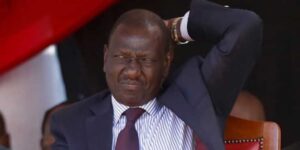
President William Ruto during a past event. PHOTO/Courtesy.
You Might also Like