Government Announces 2025 University Admission Cut-Off Points
Share
The Cabinet Secretary for Education, Julius Ogamba, on Friday, January 9, 2026, released the Kenya Certificate of Secondary Education (KCSE) results for 2025, marking the third-to-last cohort before the final KCSE exams in 2027.
A total of 993,226 candidates sat the national examination last year across centres in the country. Of these, 502,214 were female and 492,019 were male, reflecting continued progress toward gender parity in education.
Out of the candidates, 270,000 attained a C+ grade and above, qualifying for direct university entry, while 720,000 scored C plain and below. Only 1,932 candidates achieved an A grade.
The exams were marked by 30,980 teachers nationwide.
President William Ruto was briefed on the results at Eldoret State Lodge, Uasin Gishu County, ahead of their release. Education CS Julius Ogamba said.
“We are impressed that out of the 993,000 candidates, 50 per cent were girls, reflecting sustained progress in gender parity. Further, 270,000 candidates attained C+ and above, qualifying for direct university entry,” said Ruto.
Additionally, the CS confirmed that the C+ threshold which was introduced in 2016 still remains the same with more than 270,000 candidates to join the university.
University Admission Cut-Off Points
The threshold for university entry in Kenya, administered through the Kenya Universities and Colleges Central Placement Service (KUCCPS, formerly JAB), has required candidates to attain a minimum of C+ (46 points) since 2017.
The policy was introduced by then-Education CS Dr Fred Matiangi following the release of the 2016 KCSE results, aimed at expanding access to state-sponsored higher education.
Also Read: 2025 KCSE Results: 270,000 Students Score C+ and Above
Historically, the cut-off points have fluctuated based on university capacity and overall national performance:
- 71 points (B+): Early 2000s, when university slots were extremely limited.
- 66–65 points (B): Around 2008–2009, lowered to accommodate a record intake of 20,000 students.
- 63–60 points (B/B-): Early 2010s, with male cut-offs often higher; females benefited from Affirmative Action.
- 46 points (C+): After major exam reforms in 2016, the minimum entry grade was standardized to ensure wider access.
Also Read: How to Check 2025 KCSE Results Quickly
Gender-Based Entry Differences
To bridge historical gender gaps in higher education, Kenya implemented Affirmative Action policies starting in the 1990s.
- 1–2 Point Rule: Female candidates were historically admitted with cut-offs 1–2 points lower than male counterparts. For example, if the male cut-off was 63, females could be admitted at 61.
- Recent Uniformity: Since the introduction of the standardized C+ (46 points) threshold, the gender-based gap has largely been eliminated. Both male and female candidates now qualify for university on equal footing.
Follow our WhatsApp Channel and WhatsApp Community for instant news updates
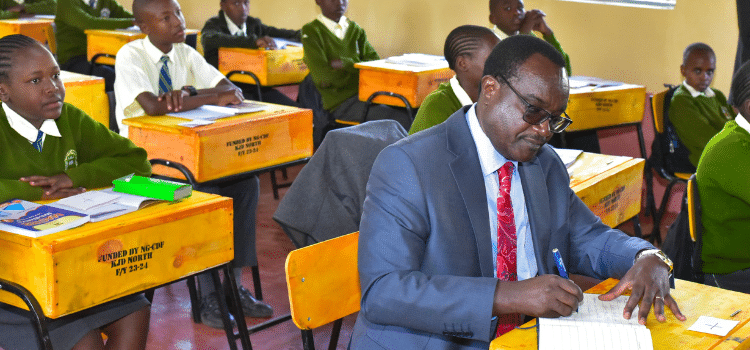
Education CS Julius Ogambo sitting in a classroom. PHOTO/MoE