
Education, Equity, and the Northern Question: Why Gachagua’s Sentiments Deserve National Attention
Share
Rigathi Gachagua’s sentiments on education and funding to Northern Kenya speak to a long-standing truth many Kenyans are often uncomfortable confronting: development in this country has never been even, and education has been one of the clearest mirrors of that inequality.
His remarks are not an attack on any region, but a challenge to the nation to be honest about how historical neglect, policy inertia, poor leadership, and skewed resource allocation have combined to disadvantage the North, if any.
For decades, counties in Northern Kenya—such as Turkana, Marsabit, Mandera, Wajir, Samburu, and parts of Isiolo—have lagged not because of lack of ambition or intelligence, but because the state invested late, weakly, or inconsistently.
While some regions benefited from mission schools, early infrastructure, and stable teacher deployment as far back as the 1960s and 1970s, large parts of the North were still grappling with insecurity, poor roads, and near-total absence of secondary schools well into the 1990s. That head start elsewhere continues to reproduce advantage today.
Imbalance in Education Funding
Education funding illustrates this imbalance clearly.
Capitation grants are theoretically equal per learner, but equality on paper is not equity in practice.
A child learning under a tree in a drought-prone, sparsely populated county does not need the same support as a child in an urban or agriculturally rich area—they need more.
Boarding facilities, school feeding programs, mobile schools for nomadic communities, teacher hardship allowances, and security support all cost money.
When these are underfunded or delayed, attendance drops and dropout rates rise. Gachagua’s emphasis on targeted funding acknowledges this reality.
Teacher Distribution
Teacher distribution offers another concrete example.
Northern Kenya has historically faced chronic shortages of trained teachers, particularly in STEM subjects.
Even when teachers are posted, high turnover is common due to harsh living conditions and insecurity.
Without deliberate incentives and sustained investment, these regions remain trapped in a cycle where poor results are used to justify continued underinvestment. Calling this out is not divisive; it is corrective.
Also Read: An Education System That Manufactures Failure: A National Indictment of KCSE Outcomes
Equalization Fund and Devolution
The Equalization Fund was constitutionally designed to address precisely this problem, yet years after its creation, its impact on education infrastructure in the North remains limited and slow.
Classrooms, laboratories, and hostels are still inadequate in many areas.
When leaders like Gachagua speak bluntly about funding disparities, they are forcing the country to confront the gap between constitutional promises and lived reality.
Another uncomfortable but necessary question that must be asked is why, despite devolution, many leaders from these frontier counties have failed to decisively invest in education and social infrastructure within their own regions.
Devolution was meant to bring decision-making closer to the people, yet in several northern counties it has instead exposed weak leadership, poor planning, and entrenched corruption.
Billions allocated through county budgets, equalization funds, and national transfers have too often been lost to inflated tenders, stalled projects, ghost schools, and politically connected contractors.
Also Read: Why Presidential Opinion Polls Are Analytically Premature and Politically Misleading
Personal Enrichment and Corruption
In some cases, leaders have prioritized personal enrichment, clan balancing, or short-term political survival over long-term investments in education.
Corruption has thus become the hallmark not because the regions are inherently flawed, but because accountability mechanisms are weak, civic oversight is limited, and voters—often constrained by poverty and insecurity—are repeatedly presented with poor leadership choices.
Until local leadership treats education as a strategic investment rather than a budget line to be exploited, increased funding alone will not translate into meaningful change for the children of Northern Kenya.
Supporting Northern Kenya
Importantly, supporting Northern Kenya’s education is not charity—it is nation-building.
A country cannot compete globally while leaving millions of its citizens behind due to geography and historical neglect.
Investing in education in the North strengthens national cohesion, reduces insecurity in the long run, and unlocks human capital that Kenya can no longer afford to waste.
Gachagua’s sentiments should therefore be read not as regional rhetoric, but as a call for honest prioritization.
Equity sometimes requires unequal input to achieve equal outcomes.
Until Northern Kenya has schools that match the basic standards found elsewhere—adequate teachers, safe facilities, reliable funding, and supportive social programs- the conversation on national unity and shared prosperity will remain incomplete.
Follow our WhatsApp Channel and WhatsApp Community for Instant News Updates
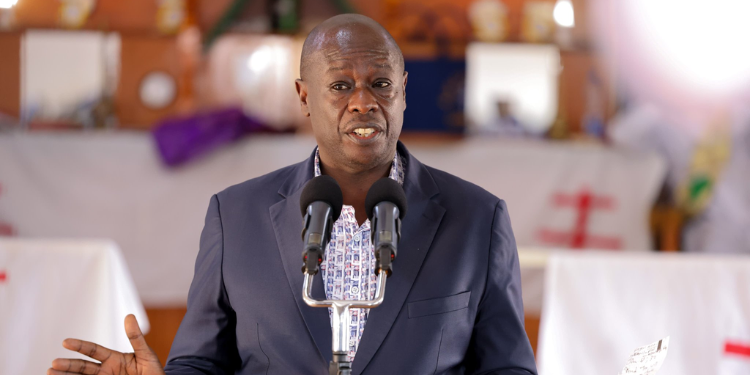
Photo of former Deputy President Rigathi Gachagua. PHOTO/Gachagua X