EXPLAINER: Why Global Oil Prices Dropped in Early 2026
Share
The Central Bank of Kenya (CBK) has explained why the international oil prices declined during the week ending on January 8, 2026.
In its weekly report, CBK said Murban crude oil traded at USD 61 (Ksh7868.83) per barrel on January 8, from USD 62.51 (Ksh8063.62) per barrel on December 31, 2025.
CBK said the decline was caused by easing supply-demand pressures, as global supply remained adequate while demand softened following the end-of-year period.
“International oil prices declined during the week. Murban crude oil traded at USD 61 per barrel on January 8, from USD 62.51 per barrel on December 31, due to easing supply-demand pressures, as global supply remained adequate while demand softened following the end-year period,” CBK said.
CBK Economic Growth
The economy grew by 4.9 percent in the third quarter of 2025 (Q3 2025), compared to 4.2 percent in Q3 2024.
The industrial sector continued to rebound strongly in Q3 2025, expanding by 4.8 percent compared to a contraction of -0.4 percent in the same quarter of 2024.
The services sector maintained robust growth of 5.5 percent, supported by strong growth in accommodation and food services, real estate, finance and insurance, and transport and storage sectors.
The agriculture sector grew by 3.2 percent compared to 4.0 percent in Q3 2024, on account of an increase in milk production and exports of cut flowers.
Exchange Rates
The Kenyan shilling remained stable against major international and regional currencies during the week ending January 8, 2026.
It exchanged at KSh 128.99 per U.S. dollar on January 8, compared to 129.01 per U.S. dollar on December 31.
Foreign Exchange Reserves
The foreign exchange reserves remained adequate at USD 12,384 million (5.3 months of import cover) as of January 8.
This meets CBK’s statutory requirement to endeavour to maintain at least 4 months of import cover.
Also Read: CBK Licences 42 More Digital Lending Platforms: Full List
Money Market
The money market remained liquid during the week ending January 8, 2026, with open market operations continuing to be active.
Commercial banks’ excess reserves averaged KSh 13.8 billion above the 3.25 percent Cash Reserve Ratio (CRR) requirement.
The Kenya Shilling Overnight Interbank Average Rate (KESONIA) remained relatively stable at 8.97 percent on January 8, 2026, compared with 8.99 percent on December 31.
During the week, the average number of interbank transactions declined to 10 from 14 in the previous week, while the average value traded declined to KSh 7.5 billion from KSh 9.4 billion.
Government Securities Market
The Treasury bill auction on January 8 received bids totaling KSh 31.3 billion, against an advertised amount of KSh 24.0 billion, representing a performance of 130.3 percent.
Interest rate on the 182-day Treasury bill remained stable while the interest rate on the 91-day and 364-day Treasury bills declined marginally.
During the Treasury bond auction of January 7, the reopened 20-year and 25-year treasury bonds received bids totaling KSh71.5 billion against an advertised amount of KSh 60.0 billion, representing a performance of 119.2 percent.
Also Read: Trump Govt Issues Fresh Update on Green Card Applications Affecting Kenyans and Other Countries
Equity Market
At the Nairobi Securities Exchange, the NASI, NSE 25, and NSE 20 share price indices increased by 2.95 percent, 3.29 percent, and 2.62 percent, respectively, during the week ending January 8.
Market capitalization, total shares traded, and equity turnover increased by 2.95 percent, 145.9 percent, and 186.0 percent, respectively.
Bond Market
Bond turnover in the domestic secondary market increased by 77.1 percent during the week ending January 8.
In the international market, yields on Kenya’s Eurobonds increased by an average of 24.3 basis points.
The yield on the 10-Year Eurobonds for Angola and Côte d’Ivoire also increased.
Global Trends
Inflation concerns in advanced economies eased with headline inflation in the Euro area falling to 2.0 percent in December from 2.1 percent in November due to a moderation in energy prices. Core inflation also fell to 2.3 percent from 2.4 percent.
The U.S. Dollar Index strengthened by 0.62 percent during the week ending January 8, 2026, largely due to safe-haven demand and thin market liquidity, as investors favoured the dollar amid subdued end-of-year trading conditions.
Follow our WhatsApp Channel and WhatsApp Community for Instant News Updates
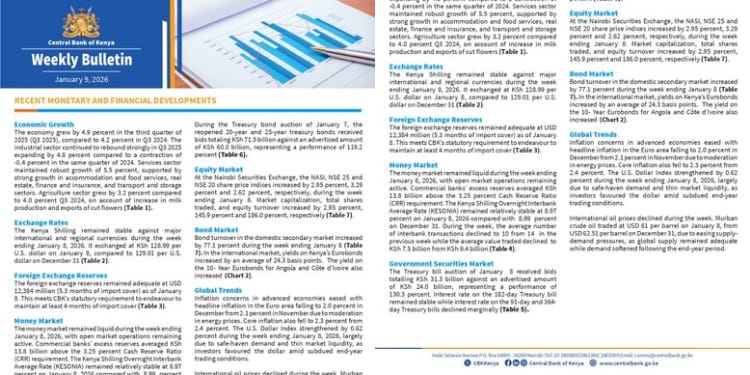
CBK weekly report published on January 9, 2026. PHOTO/CBK.
You Might also Like