
Govt Explains Why License of KOKO Won’t Be Renewed Amid Over 700 Job Losses
Share
The government has explained its reasons for not renewing KOKO Networks’ license, a decision that has allegedly resulted in the loss of around 700 jobs and has financially affected investors.
Speaking to NTV’s Fixing the Nation morning show on Wednesday, February 4, 2026, Trade and Investments Cabinet Secretary Lee Kinyanjui explained that the decision was not driven by government policy but by the structure of Koko Networks’ business model.
CS Kinyanjui said the company, which generates carbon credits by distributing clean-cooking bioethanol to households, was attempting to claim all of Kenya’s carbon credits on the international market.
“However, when it came to the tabulation of numbers, there was no concurrence. In the few meetings I personally attended, the numbers they were claiming were such that if Kenya had approved them, no other company in Kenya would have been able to claim anything. They would have effectively taken everything that Kenya could offer,” he noted.
CS Kinyanjui Explains Why the License of KOKO Won’t Be Renewed
He added that while the government applauds the innovation and the number of people the company was employing, KOKO’s business model did not align with what was feasible under Kenya’s carbon credit framework.
On whether the government attempted to help Koko Networks restructure its operations, CS Kinyanjui said there were discussions, but they did not bear the necessary outcomes.
Also Read: KOKO Networks Placed Under Administration Amid Dispute With Govt
He stressed that sometimes businesses need to rethink their models when they are not workable.
“But, like I said, when the business model is not workable, sometimes even if you push the journey, at some point it will stop. At some point, it just won’t work. Sometimes what it requires is a rethink, a reconfiguration of what went wrong. And I think that’s really what they should do,” said the Trade CS.
CS Argues Giving One Company All Carbon Credits Harms Market
The CS also highlighted that giving one company all available carbon credits could have affected other eligible companies in agriculture and manufacturing, as well as the credibility of Kenya’s carbon credit market on the global stage.
He further stated that the government remains committed to ensuring a smooth landing for affected employees and investors while protecting the broader integrity of the country’s carbon credit system.
CS Kinyanjui’s response comes amid a dispute between the firm and the government over regulatory approvals linked to the company’s business model.
Also Read: Cooking Fuel Firm KOKO to Officially Shut Down Operations in Kenya
Koko’s operations relied in part on carbon credits generated from the distribution of clean-cooking bioethanol to households, a revenue stream that required government authorisation. Delays and disagreements over these approvals have been cited as a major challenge to the firm’s sustainability, leading the company to commence insolvency proceedings.
Follow our WhatsApp channel for instant news updates
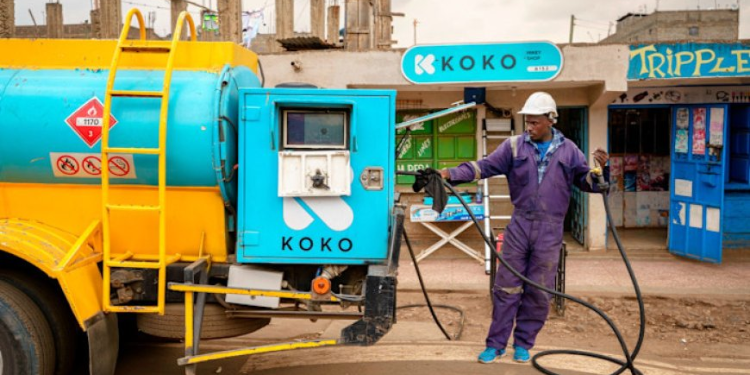
A technician refilling KOKO gas at a KOKO Point. PHOTO/FINANCIAL TIMES