Rising Militia Influence Fuels Anxiety Across Central Somalia
Share
Fear only strengthens its hold on Somalia’s central plains, where truckers driving on drought-stricken roads now face more than landmines and insurgents.
For Zakeriya Hersi, a 36-year-old truck driver plying his trade between the northern port city of Bosaso and the Hiiraan region, every trip is now a roll of the dice with his life.
The barren terrain is pockmarked by years of fighting, where unexploded ordnance and landmines are ever-present hazards.
Yet Hersi says a newer threat has eclipsed those long-standing perils.
Since 2022, when Somalia’s federal government armed local clan militias to fight Al-Shabaab, insecurity has taken on a different face.
The government-backed offensive initially drove the Islamist insurgents out of swathes of territory in central Somalia.
But residents now report that the militias who filled the vacuum have become predators themselves.
“We can’t even breathe because of the fear of the militias,” said Hersi, whose name has been changed for security reasons.
He described being stopped repeatedly at makeshift checkpoints.
“At every checkpoint, we are forced to stop at gunpoint, we are extorted, and we risk losing our lives even when we pay,” uttered Hersi.
He added bitterly: “These were the same ones we supported, but now we fear them more than anything.”
From Liberation to Lawlessness
For years, Al-Shabaab operated a parallel administration in parts of Hiiraan, collecting taxes and enforcing its own justice system.
The Hawadle clan, dominant in the region, threw its weight behind the government campaign in 2022 and 2023, helping recapture dozens of towns.
But some drivers say daily life under militia control has proved harsher.
“Under Al-Shabaab, we would pay taxes and be able to transport our goods without issue,” said another driver, Bashar Ali, also speaking under a pseudonym.
Ali now performs “wudu” before every trip, hoping for protection.
In December 2024, he said, a drunken militiaman opened fire near a checkpoint outside Mataban.
“He demanded $200(Ksh 25,800). I could smell the alcohol on his breath,” Ali recounted.
When he offered $20(Ksh 2,580) instead, the gunman smashed his phone and aimed an AK-47 at his chest.
“He raised the AK47 to my chest. When he pulled the trigger no shot came out. He lost his balance and collapsed to the floor because he was so drunk,” Bashar recounted.
Also Read: President Ruto Announces Opening of the Kenya-Somalia Border
Clan Power and Political Limits
The militia approach was similar to the “Sunni Awakening” in Iraq, which was supported by the U.S. government and relied on local clans to dismantle jihadist groups.
In Somalia, Hawadle militia members organized themselves into the Macwiisley militias, which are named after the sarongs they wear in traditional attire, and were armed and supported by the state.
While the approach yielded local intelligence and manpower, analysts warn it entrenched clan divisions.
“Clans are the essential currency of Somali politics and you cannot fight without them, but that doesn’t mean you can build a state through them either,” said Jethro Norman of the Danish Institute for International Studies.
In February 2025, the head of the military court in Mogadishu told reporters that alleged abuses by Macwiisley fighters, including killings and sexual violence, dominated court proceedings.
Also Read: Somalia Wins Strategic AU Peace and Security Council Seat
Al-Shabaab’s Strategic Return
As government forces shifted focus to other regions, Al-Shabaab launched a counter-offensive.
According to tallies by journalists on the ground, the group recaptured at least 14 towns and districts in Hiiraan and 28 more in neighbouring Middle Shebelle last year.
“The government exploited local resentment towards Al-Shabaab but left us when it was needed the most,” said Amina Hussein, a 23-year-old resident of Beledweyne.
Norman said the insurgents adopted subtler tactics during their resurgence.
“Rather than collectively punishing communities, the group contacted clan elders by phone before retaking areas, offered reconciliation, and let Macwiisley fighters keep their weapons in exchange for standing down.”
The result, he warned, is a potent message resonating across central Somalia: “The government cannot protect you, cannot hold territory, cannot deliver on its promises.”
Follow our WhatsApp channel for instant news updates
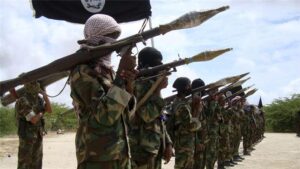
Al-Shabaab terrorist. PHOTO/South African History Online.
You Might also Like