
What Happens to Your Pension When Your Employer Fails to Remit
Share

Thousands of employees in Kenya risk losing part of their retirement savings because employers deduct pension contributions from salaries but fail to remit them to the respective pension schemes. While pay slips may show deductions, the money often never reaches the employee’s pension account, creating a potentially significant financial loss.
This malpractice occurs in both the private and public sectors, drawing the attention of regulators such as the Retirement Benefits Authority (RBA) and the National Social Security Fund (NSSF), who are cracking down on employers failing to meet their statutory obligations. Beyond violating the law, such failures undermine employees’ long-term financial security.
According to regulatory data, outstanding pension contributions owed by employers as of December 31, 2025, stood at Ksh 66.41 billion, a decline of 8.4 percent from Ksh 72.5 billion six months earlier.
However, as evidenced by 93 percent of all outstanding pension contributions owed to the employee’s pension scheme being from public agencies, the total of Ksh 66.41 billion outstanding is still significant.
Workers Financially Affected by Immediate Financial Consequences
Workers’ financial losses are the most immediate negative outcome from contributions made to a pension plan being taken from the employee’s paycheck, but not actually deposited into the pension fund.
The pension fund earns no interest when contributions are not invested.
As a result, the employee will lose compounding and long-term interest earnings on the money, ultimately lowering the total amount of money available upon retirement.
In defined contribution plans, retirement benefits are realized based on the total amount of employee and employer contributions to the plan and the plan’s investment performance.
Missing contributions will create a gap between the employee’s total contributions and the amount available in the pension plan at the time of retirement.
The longer these contribution gaps exist, the more they will reduce the employee’s monthly pension income or lump-sum distribution at retirement.
Employees may also have other difficulties. Workers can have difficulty accessing their pension benefits when they attempt to do so because of discrepancies in the number of deductions shown on their pay stub compared to the contributions shown on their pension plan statements.
Labourers will be forced to document that deductions were made from their paychecks, but weren’t remitted to the pension fund.
Also Read: NSSF Sends Notice to Employers as New Contribution Rates Take Effect
Consequences for Employers
The Kenyan law states that employers must pay NSSF contributions by the ninth day of the next month.
Otherwise, there will be a five percent penalty every month on the unpaid amount.
The RBA has the power to call for immediate payment of the principal amount, interest, or penalty, whichever is higher under the law.
There is also the possibility of criminal charges. There have been efforts to strengthen the penalty, including increasing fines and withholding funds for offenders.
The courts have issued conflicting decisions regarding the refund of contributions, with some decisions requiring employers to refund employees, while others require employees to wait for the law to take its course.
The matter is even more serious in public institutions such as county governments and public universities, where there have been delays in the payment of exchequer funds and poor expenditure control.
Also Read: NSSF Raises Monthly Deductions in 2026 as Year 4 Rates Take Effect – Full Details
What Workers Should Be Doing
Periodically, employees should review their retirement savings contributions in their pension plans through the websites of their respective plans or the NSSF, and compare them against applicable contribution limits.
Make sure that your account is current by checking periodically to see if your contributions are current.
If the issue is not resolved, employees should lodge a complaint with the RBA or complain directly to the NSSF for investigation and recovery.
The labor department and attorneys may also offer further recourse, especially in cases of long-term default.
In cases where an employer goes insolvent, pension schemes can be “frozen,” meaning that no new contributions are made.
But contributions already made are still invested and earning interest.
Employees can ask for benefit statements and see what options are available, such as leaving the money until retirement or transferring to other retirement schemes as may be available.
With pension funds continuing to swell to Sh2.8 trillion by December 2025, the pressure is high.
For employees, the watchword is vigilance to ensure that retirement savings are not surreptitiously depleted through default.
Follow our WhatsApp channel for instant news updates
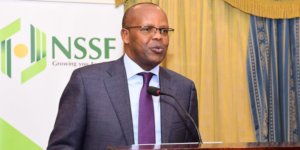
NSSF CEO David Koross speaking at a past NSSF function. PHOTO/NSSF