Mbadi Defends National Infrastructure Fund as Engine for Growth
Share
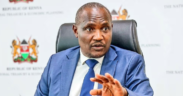
Treasury Cabinet Secretary (CS) John Mbadi has told lawmakers that the proposed National Infrastructure Fund (NIF) will focus exclusively on commercially viable projects aimed at accelerating Kenya’s economic growth.
Appearing before a joint sitting of the Departmental Committee on Finance and National Planning and the Select Committee on Public Debt and Privatization on February 24, Mbadi assured Members of Parliament that the Fund is structured to operate as a self-sustaining investment vehicle.
“Hon. Chair and Members, we intend to make this Fund an investment, such that any return on the investment from infrastructure projects is ploughed back to the Fund. Parliament could also make a decision that all future dividend pay out from be invested here so as to grow the Fund,” he stated.
The session was co-chaired by Hon. Kimani Kuria and Hon. Abdi Shurie.
Innovative Financing Model to Reduce Debt Dependence
Mbadi described the NIF Bill, currently under review, as an innovative financing framework designed to unlock large-scale private capital and reduce Kenya’s reliance on borrowing and increased taxation.
“Hon. Members we find NIF as an engine to scale up and accelerate development of catalytic national infrastructure, including national highway and railway networks, air and seaports, electricity generation, transmission and distribution, irrigation and agribusiness infrastructure,” he explained.
Among the projects cited as potential beneficiaries were the dualing of Thika Road, the expansion of the Athi River–Namanga Road, and the modernization of Jomo Kenyatta International Airport.
The CS revealed that the government aims to mobilize up to Ksh 5 trillion through strategic monetization of mature national assets, democratization of ownership via capital markets, and deployment of national savings.
“For every shilling invested in the NIF, Kenya will attract ten more shillings from long-term investors incluing pension funds, sovereign partners, private equity funds, and development institutions, allowing the country to develop without the constraints that come with debt and taxation,” Mbadi said.
Also Read: Kenya Met Issues Update on Long Rainy Season After Heavy Rains Hit Parts of the Country
Lawmakers Question Sustainability and Asset Sales
However, Members of Parliament raised concerns about the long-term sustainability of the Fund, particularly following the government’s move to divest from key assets such as Safaricom.
“After we have sold our two most performing assets and the proceeds are directed to this Fund, what next? We are now running away from debt, and it is not possible to divert funds from the exchequer to the NIF, and proceeds of our performing assets are in. How will we ensure sustainability with nothing else to sell?” Hon. Thuku Kwenya asked.
The session also turned heated over the decision to sell shares to Vodacom rather than prioritizing local investors.
Lawmakers noted that during public participation, concerns were raised about Vodacom potentially becoming the majority shareholder with a 55 per cent stake.
In response, Mbadi argued that listing the shares at the Nairobi Securities Exchange would likely have resulted in discounted pricing, denying the country an opportunity to secure a premium sale value.
Also Read: Opiyo Wandayi: CSs Have Constitutional Right to Engage in Politics
Proceeds Not for Social Spending
Lawmakers further pressed the CS on public demands that proceeds from the Safaricom divestiture be directed toward specific county projects.
Mbadi maintained that such proceeds cannot be diverted to social programmes, as those remain under the national budget framework.
However, he emphasized that transferring large-scale infrastructure financing to the NIF would ease pressure on the exchequer and create additional fiscal space for county allocations and social spending.
“The proposed National Infrastructure Fund, when established, will create room for us to allocate more funds to other priority programs across the country,” he noted.
Commitment to Global Standards and Feasibility
Concluding his presentation, Mbadi assured lawmakers that the Fund would adhere to global best practices, including conducting rigorous feasibility studies to ensure every project undertaken is commercially viable and sustainable.
He maintained that the NIF is designed not merely as a financing tool, but as a long-term investment platform to transform Kenya’s infrastructure landscape while safeguarding fiscal stability
Follow our WhatsApp channel for instant news updates
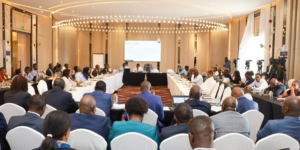
CS Mbadi, while appearing before MPs to talk about NIF. PHOTO/Parliament/FB
You Might also Like