Ghana Meteorological Agency Releases 2026 Major Rainy Season Forecast
Share
The Ghana Meteorological Agency has officially released the 2026 Major Rainy Season Forecast for Southern Ghana.
In a forecast published on February 26, the Agency said the outlook provides guidance on expected rainfall patterns, onset and cessation periods, and potential extreme weather events to support planning and preparedness across key sectors, including agriculture, water resources, disaster management, health, and infrastructure.
“We encourage institutions, businesses, farmers, and the general public to pay attention to the forecast and use it in their decision-making. Weather information saves lives. Climate information builds resilience,” warned the Agency.
Here is the full forecast:
Agriculture
The onset of the 2026 rainy season is expected to be normal to slightly early across most coastal and transition zones.
However, farmers in Sunyani, Dunkwa, Sefwi Bekwai, Abetifi, Akim Oda, Akuse, Asamankese, Ho, Kpando, Axim, and Saltpond should anticipate a late onset and wait for sustained rainfall before planting or committing to major seasonal investments.
Below-normal rainfall is expected in Dormaa, Sunyani, Mim, Goaso, Cape Coast, Accra, and Tema during March to May, increasing the risk of early-season moisture stress.
Two significant dry-spell periods are forecast: the first in March to April (6 to 15 days) and the second in May to June (9 to 19 days), which may disrupt crop performance and strain water sources, especially in forest-zone farming communities.
- Adopt early maturing and drought-tolerant crop varieties suited to this season’s conditions.
- Consult agricultural extension officers on optimal planting windows before committing to the land.
- Plan for supplementary irrigation or water conservation practices during dry spell periods.
- In Sefwi Bekwai and Half Assini, where a longer-than-normal season is projected, late planting may be feasible but should be carefully planned.
Note: Conditions vary significantly by district. Regularly consult GMet and your local extension officer throughout the season.
Disaster Risk Management
Pre-onset rains in January and February 2026, driven by the Madden-Julian Oscillation, Atlantic anomalies, and ITCZ movements, have already caused localised flooding and waterlogging across southern Ghana.
Above-normal rainfall is projected along the East Coast and adjoining inland areas, including Accra, Tema, Cape Coast, Saltpond,
Asamankese, Akim Oda, Koforidua, and Kade during April to June, significantly elevating the risk of flooding, flash flooding, and related disasters.
NADMO and all disaster management agencies are called upon to:
- Pre-position emergency response resources, including rescue equipment, relief supplies, and personnel in high-risk and flood-prone districts before the April to June peak period.
- Activate district-level Disaster Risk Reduction plans and place response teams on heightened alert ahead of anticipated peak rainfall.
- Coordinate proactive evacuations of communities in identified flood-prone and flash flood risk zones before flooding occurs.
- Establish and widely publicise community-level early warning communication channels for emergency alerts and hazard reporting throughout the season.
Communities in flood-prone areas are urged to engage with NADMO proactively: report emerging hazards early, heed evacuation directives without delay, and participate in local disaster preparedness activities.
Note: The risks of flooding and flash flooding are elevated this season. Early action and community cooperation are critical to saving lives.
Also Read: Brace for More Rain: Kenya Met Raises Heavy Rain Alert as Downpours Persist Into March
Local and District Authorities (MMDAs)
Metropolitan, Municipal, and District Assemblies have a critical frontline role in translating this forecast into community-level action. With above-normal rainfall projected across much of Southern Ghana from April and pre-onset flooding already recorded, immediate steps are required.
- Enforce environmental bylaws requiring households, businesses, and institutions to clear and maintain drainage systems. Drain clearance is a legal obligation, and MMDAs are expected to enforce compliance proactively before the peak season arrives.
- Conduct pre-season inspections of drainage and stormwater infrastructure and prioritise desilting of blocked drains in urban centres and low-lying areas.
- Map flood-prone communities within your jurisdiction in collaboration with NADMO and develop localised emergency response and evacuation plans before the onset of heavy rains.
- Disseminate GMet seasonal forecast information and sector advisories to communities through local radio, public address systems, community leaders, and unit committees.
- Review planning permits and construction approvals in low-lying or flood-risk zones, considering the elevated rainfall forecast.
Note: MMDAs are called upon to lead local coordination and ensure communities receive actionable guidance from this forecast before and during the season.
Water Resources
The 2026 season presents a mixed outlook for water resources. Below-normal rainfall in Dormaa, Sunyani, Mim, Goaso, Cape Coast, Accra, and Tema during March to May poses a risk of reduced reservoir inflows and early-season water stress.
From April onwards, above-normal rainfall across the East Coast and inland areas increases surface runoff, flood risk, and potential contamination of water sources.
- Monitor reservoir and dam levels closely during March to May and implement demand-side management measures in areas facing below-normal rainfall.
- Prepare water treatment facilities for increased turbidity and potential contamination of surface water sources during peak rainfall and flooding events in April to June.
- Ensure drainage and stormwater infrastructure is fully operational and maintained ahead of the high-rainfall period.
- Assess opportunities for improved water harvesting and storage in Sefwi Bekwai and Half Assini, where a longer-than-normal season is projected.
- Coordinate with MMDAs and NADMO to protect water supply infrastructure, pump stations, and treatment plants in flood-vulnerable locations.
Note: Proactive reservoir management and infrastructure protection are essential given the contrasting early-season dryness and later-season excess rainfall projected for 2026.
Health Sector
The 2026 rainy season is expected to increase the risk of malaria, cholera, typhoid, and other water-borne diseases, particularly during periods of heavy rainfall and in the aftermath of flooding events. Above-normal temperatures forecast from January through May will compound heat stress and may intensify vector breeding conditions. Health authorities at national, regional, and district levels should begin preparations immediately.
- Pre-stock health facilities with anti-malarial drugs, oral rehydration salts, water purification tablets, and vector control supplies ahead of the peak season.
- Intensify public health education campaigns on malaria prevention, safe drinking water, proper food handling, and environmental sanitation during the rainy season.
- Strengthen disease surveillance systems to detect and rapidly respond to outbreaks of cholera, typhoid, and water-borne illnesses, especially in flood-affected and low-lying communities.
- Coordinate with NADMO and MMDAs to position mobile health teams and emergency health response capacity in flood-prone areas during peak rainfall periods.
- Issue heat-health risk advisories alongside rainfall guidance, given the above-normal temperatures forecast for early 2026.
Note: Communities in flood-prone areas face compounded health risks from both flooding and disease. Rapid early warning and pre-positioned response capacity are critical.
Also Read: Kenya Met Issues Update on Long Rainy Season After Heavy Rains Hit Parts of the Country
Policy Makers
The 2026 Seasonal Forecast reinforces the urgent need for climate-responsive policy action across sectors. Produced in adherence to WMO standards and through a multi-stakeholder co-production process, this forecast provides a credible evidence base for timely policy and resource allocation decisions.
- Allocate emergency preparedness budgets at national and district levels ahead of the April to June high-risk period, covering flood response, agricultural support, health, and water management.
- Accelerate the full operationalisation of the Common Alerting Protocol (CAP) across all telecommunications networks in Ghana, ensuring verified, life-saving weather alerts reach every community without delay.
- Review and modernise environmental and land use by-laws to account for increasing climate variability and urban flood risk, including mandatory drainage maintenance and enforcement mechanisms.
- Support expansion of GMet’s observational and forecasting infrastructure to improve the spatial resolution and lead times of district-level advisories.
- Strengthen cross-sector coordination mechanisms so that seasonal forecast information is systematically translated into operational sector plans across agriculture, water, health, and disaster risk management.
- Invest in long-term climate resilience: support the transition to drought-tolerant agriculture, fund urban drainage upgrades, and extend early warning systems to underserved communities.
Note: This forecast is a national planning tool. Its value is only realised when policy action follows promptly. All Ministries, Departments, and Agencies are urged to integrate this forecast into 2026 operational and contingency plans without delay.
General Public
The 2026 Major Rainy Season is expected to begin from the third week of February across most of Southern Ghana, though some areas will experience a later start.
The season is projected to end between July and August, depending on your location.
Here is what you need to know and do:
- Do not mistake the early rains of January and February for the full rainy season. These are pre-onset transitional rains. Wait for sustained rainfall before making major decisions such as planting.
- Clear your drains and surroundings now. Blocked drains are a leading cause of urban flooding. This is your responsibility and, in many areas, a legal requirement under local by-laws.
- If you live in a flood-prone or low-lying area, identify safe evacuation routes and community shelter points in advance. Do not wait for floods before acting. Heed NADMO and local authority warnings promptly.
- Protect your health during the rainy season: sleep under treated mosquito nets, drink clean water, dispose of waste properly, and seek medical attention quickly if you develop fever, diarrhoea, or signs of illness.
- Farmers: consult your agricultural extension officer before planting, especially if you are in an area expecting a late onset or prolonged dry spell. Choose crop varieties suited to this season’s conditions.
- Follow official GMet updates throughout the season through GMet’s official channels, national radio, and your local assembly. Weather conditions can and will change.
Note: Weather hazards cannot be prevented, but their impacts can be greatly reduced through early information, preparedness, and responsible action. Stay informed. Stay safe.
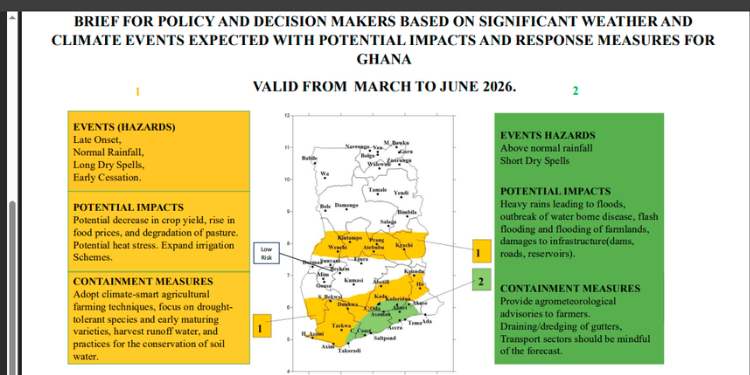
The Ghana Meteorological Agency has officially released the 2026 Major Rainy Season Forecast for Southern Ghana. PHOTO/The Ghana Meteorological Agency X.
You Might also Like