
Ballots Under Siege: Why Goonism and Voter Suppression Threaten Kenya’s Democracy
Share

By Peter Ongera
Kenya’s democracy does not collapse in a single dramatic moment. It erodes quietly through intimidation at rallies, missing names on voter registers, manipulated narratives, and a public left uncertain about its rights.
If we are honest, the threats to our electoral process are interconnected and mutually reinforcing. Goonism feeds voter suppression.
Voter suppression thrives where civic education is weak. And both flourish where accountability is absent.
Renowned constitutional lawyer Koki Muli has repeatedly warned that the real danger to our democracy is not just flawed elections, but a culture that normalizes intimidation and manipulation as political strategy. Her message deserves serious reflection.
Goonism-the use of hired muscle to intimidate, disrupt or silence opponents has become an ugly feature of our political theatre.
We see it at rallies, in party primaries, and increasingly in civic spaces where dissent should be protected.
These individuals do more than throw stones or disrupt meetings. They distort public participation.
A mother who fears violence at a rally will stay home. A young voter who witnesses chaos may conclude that politics is not worth the risk. Fear shrinks civic space.
We saw the devastating consequences of politically instigated violence during the 2007 Kenyan general election, when intimidation, ethnic incitement, and organized violence plunged the country into bloodshed.
Also Read: IEBC Clarifies on Collaborating With Ruto’s Govt
More than 1,000 lives were lost. While Kenya has made strides since then, the underlying incentives that reward political thuggery have not been fully dismantled.
Goonism persists because politics is heavily monetized.
When power is viewed primarily as a gateway to wealth, some actors will deploy any means necessary to secure it.
That includes weaponizing unemployed youth, exploiting poverty, and nurturing impunity.
Voter Suppression: The Quiet Manipulation
If goonism is loud and visible, voter suppression is subtle and systemic.
It does not always require violence. It operates through bureaucracy, misinformation, and structural inequality.
In Kenya, allegations of names missing from voter registers, uneven distribution of polling stations, delayed opening of polling centers, and misinformation campaigns have fueled suspicion and mistrust.
Whether perceived or proven, such irregularities weaken faith in the system.
The principle of “one person, one vote” is sacred in any democracy.
When administrative hurdles disproportionately affect women, youth, persons with disabilities, or marginalized communities, the system ceases to be inclusive.
Suppression does not always announce itself; sometimes it hides behind technicalities.
And in an era of digital disinformation, suppression can be psychological.
False claims about voting procedures, manipulated results shared online, or deliberate confusion about identification requirements can discourage turnout. A confused voter is an easier voter to silence.
The Electoral Umpire Matters
Kenya’s elections are administered by the Independent Electoral and Boundaries Commission (IEBC).
Its credibility rises or falls with the professionalism and impartiality of its officials.
Training is not a procedural afterthought-it is the backbone of electoral integrity.
Officials must be thoroughly grounded in electoral law, conflict management, technology use, and transparency protocols.
They must also understand that perception matters as much as procedure. A technically sound process that lacks public confidence is politically fragile.
When officials are well-trained and supported, they are better equipped to resist political pressure, manage tensions at polling stations, and ensure fairness.
But when recruitment appears partisan or training is inadequate, public trust suffers.
An election is not merely about ballots cast; it is about whether citizens believe the process reflects their will.
Civic Education: Democracy’s First Line of Defense
The most powerful antidote to intimidation and suppression is an informed citizenry.
Civic and voter education should not be rushed campaigns conducted weeks before an election. They should be continuous national conversations.
Citizens must understand how voter registration works, what their rights are at polling stations, how results are transmitted, and how disputes are resolved.
When voters know their rights, they are less vulnerable to manipulation. They can document irregularities, demand accountability, and resist coercion.
They can also reject political actors who rely on violence rather than ideas.
Kenya has seen promising grassroots efforts, particularly youth-led initiatives that encourage political participation and accountability.
But these programs require scaling up, sustained funding, and institutional support.
Democracy cannot survive on apathy. An uninformed electorate is fertile ground for both goonism and suppression.
The Interconnected Nature of the Crisis
We must resist the temptation to treat these problems as isolated incidents.
Goonism intimidates voters. Intimidated voters are less likely to participate.
Low participation can skew outcomes. When outcomes are disputed, mistrust grows. In a climate of mistrust, misinformation spreads more easily.
And when citizens feel powerless, civic disengagement becomes the norm.
The cycle feeds itself.
Breaking it requires coordinated action:
- Legal accountability for those who organize or finance political violence.
- Institutional reform and professional training within electoral bodies.
- Robust, year-round civic education that reaches rural and urban populations alike.
- Political party reform, ensuring internal democracy and discouraging violent mobilization.
Above all, it requires political will.
Democracy as Daily Work
Democracy is not secured on polling day. It is built every day in how institutions function, how leaders behave, and how citizens engage.
Kenya’s history shows both the fragility and resilience of our democratic experiment. We have endured crisis and negotiated reform.
We have held contentious elections and implemented constitutional change. The journey is unfinished.
Safeguarding the vote is not a partisan cause; it is a national one. When citizens lose faith in elections, they lose faith in peaceful change.
And when peaceful change seems impossible, instability follows.
The warning signs are visible. But so is the opportunity.
If we invest in civic education, professionalize electoral administration, and dismantle the culture of political impunity, Kenya can strengthen its democratic foundations. If we fail, goonism and suppression will continue to corrode the system from within.
The choice is ours.
In the end, democracy is not protected by institutions alone. It is protected by citizens who refuse to be intimidated, officials who refuse to be compromised, and leaders who understand that power without legitimacy is ultimately unstable.
Kenya deserves elections that are not only free and fair, but unquestionably credible. Anything less diminishes us all.
Follow our WhatsApp channel for instant news updates
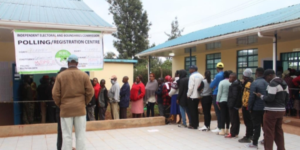
Voters in a queue waiting to vote in a polling station
PHOTO/File