From “Road Accidents” to “Road Carnage”: Why Words Matter — and What Must Change on Kenya’s Deadly Roads
Share
By Peter Ongera
Every long weekend, festive season, or rainy month, Kenyans are confronted with grim headlines: dozens dead on highways, families wiped out, buses mangled beyond recognition.
Almost instinctively, the media reaches for two familiar phrases, road accident and road carnage.
Many readers treat them as interchangeable. They are not. And the difference is more than semantics; it goes to the heart of how Kenya understands, reports, and responds to preventable deaths on its roads.
The term road accident sounds harmless enough.
It is neat, official, and widely used in police reports, court proceedings, insurance claims, and government statistics.
The Power of Language in Road Safety
An accident suggests misfortune, something unintended, perhaps unavoidable.
When crashes are framed this way, responsibility is subtly diluted.
The human decisions behind speeding, drunk driving, fatigue, poor vehicle maintenance, corruption in licensing, or weak enforcement fade into the background.
Language, after all, carries power. Words shape how societies assign blame, urgency, and accountability.
When deadly crashes are described as accidents, they are subconsciously filed under fate, tragic, yes, but somehow inevitable.
But are they?
By contrast, road carnage is a word that startles.
It is emotive, unsettling, and deliberately graphic. It speaks not of chance but of consequences, twisted metal, lifeless bodies, orphaned children, and communities plunged into grief.
When Kenyan headlines scream about “road carnage on the Nakuru–Eldoret highway” or “festive season road carnage,” they are not describing a single event.
They are indicting a system that repeatedly fails with lethal predictability.
Public Outrage and Policy Response
This distinction matters because language shapes public perception, and perception shapes policy.
Kenya loses thousands of people every year to road crashes. Yet the outrage rarely matches the scale of the loss.
If similar numbers died annually from collapsing buildings or repeated aviation disasters, the nation would grind to a halt.
There would be emergency inquiries, resignations, and sweeping reforms.
Instead, road deaths come and go with predictable regularity, generating brief outrage before fading from the national conversation.
In response to the crisis, the government has acknowledged the scale of the problem.
William Ruto recently launched the National Road Safety Action Plan 2024–2028, a strategy that aims to reduce road fatalities by 50 percent by 2028.
At the launch, the President was unequivocal: “The number of road accidents must come down. It is my expectation that we will be the administration that will deal with this challenge.”
He emphasized that solving the crisis requires a coordinated effort between institutions such as the National Transport and Safety Authority and the police traffic department.
“Our justice, law and order agencies must coordinate and sustain robust law enforcement by ensuring that offenders are detected, apprehended, prosecuted and punished swiftly and transparently,” the President said.
He also directed government agencies to deploy modern traffic monitoring technology, including speed cameras and surveillance systems, tools long overdue on Kenya’s highways.
In perhaps his most telling remark, the President acknowledged a truth many Kenyans already know: “Corruption is an enabler of impunity, and a significant contributor to road carnage.”
Also Read: 31 Kenyans Killed in Road Accident in First Six Days of 2026
Corruption and Systemic Failure
That statement deserves to be taken seriously, because corruption is indeed the invisible engine behind much of the bloodshed on Kenyan roads.
When unqualified drivers obtain licences through bribes, danger multiplies.
When overloaded trucks are waved through roadblocks after a quiet payment, brakes fail on steep hills.
When traffic officers treat enforcement as a negotiation rather than a duty, reckless drivers learn that rules are optional.
The result is predictable: more funerals.
Human Error and Mechanical Neglect
If we are honest, most of what we call “accidents” are anything but accidental.
Speeding remains the single biggest killer. Drivers routinely treat highways as racetracks, overtaking blindly and ignoring speed limits designed to save lives.
Drunk and drug-impaired driving continues to claim lives despite occasional police crackdowns.
Enforcement surges briefly after major tragedies, only to fade when public attention moves elsewhere.
Driver fatigue is another silent killer. Long-distance drivers often operate under intense economic pressure to make multiple trips in unrealistic time frames.
Exhaustion slows reaction time and impairs judgment, turning a heavy vehicle into a deadly weapon.
Vehicle condition also remains a major concern. Worn-out tyres, faulty brakes, and poorly maintained public service vehicles are a common sight on Kenyan roads.
Mechanical failure is not random, it is the predictable outcome of neglect.
Infrastructure and Environmental Risks
Unfamiliarity with roads contributes to crashes as well.
Drivers navigating steep escarpments, sharp bends, or poorly marked intersections may underestimate danger, particularly at night or during heavy rains.
And then there is the infrastructure problem. Many Kenyan roads were designed decades ago with little regard for modern traffic volumes.
Missing signage, poor lighting, dangerous intersections, and lack of pedestrian infrastructure create a perfect storm for disaster.
These are not acts of fate. They are systemic failures.
Insurance Gaps and Post-Crash Vulnerability
Another troubling dimension of road safety has recently emerged through concerns about insurance coverage for passengers on school buses.
Many Kenyans assume that hiring a school bus automatically means everyone on board is insured.
In reality, that assumption can be dangerously wrong.
Legal interpretations of insurance policies suggest that coverage may apply only to students and teachers, excluding parents, sponsors, board members, and other passengers.
In the aftermath of a crash, such technicalities can turn tragedy into financial catastrophe.
Families grieving the loss of loved ones may suddenly face hospital bills, legal costs, and funeral expenses without compensation, simply because they were unaware of the limits of the insurance policy.
The lesson is clear: road safety does not end with the crash. It includes how society protects victims and their families afterwards.
Also Read:Drivers and Conductors Issue Four Demands to NTSA, Transport Ministry Over Rising Road Accidents
From Policy Promises to Accountability
The government’s new road safety plan identifies several priority areas: stronger enforcement, improved vehicle standards, better road infrastructure, increased safety funding, and expanded public education.
These goals are commendable. But Kenyans have heard ambitious road safety promises before.
What matters now is implementation.
Will speed cameras actually be installed and maintained?
Will corrupt officers be punished rather than transferred?
Will unroadworthy vehicles finally be removed from the roads?
Will powerful transport cartels be forced to obey the law?
These are the questions that will determine whether the National Road Safety Action Plan becomes a turning point — or just another policy document gathering dust on government shelves.
The truth is uncomfortable: Kenya does not have a road safety crisis because solutions are unknown.
The crisis persists because accountability is weak.
Words alone will not make Kenyan roads safer.
But words can expose the truth.
Calling deadly crashes “accidents” softens the reality of preventable death.
Calling them road carnage forces society to confront the scale of the tragedy, and the failures behind it.
And until those failures are addressed, in enforcement, infrastructure, licensing, insurance, and governance, the headlines will continue.
Another bus overturned.Another family destroyed.Another roadside memorial.
Kenya cannot continue normalising this level of loss.
If the government truly intends to halve road deaths by 2028, the time for speeches is over. Enforcement must be relentless.
Corruption must be punished. Unsafe vehicles must disappear from the roads.
Otherwise, the phrase road carnage will remain exactly what it is today, not just a headline, but a national indictment.
Follow our WhatsApp channel for instant news updates
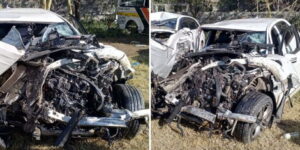
The Mercedes-Benz Wreckage of the Late Lugari MP Cyrus Jirongo who Succumbed in a Road Accident Along Nairobi-Nakuru Highway. PHOTO/ Kenyans.
You Might also Like