
US Submarine Sinks Iranian Warship IRIS Dena Near Sri Lanka
Share

The United States has confirmed that one of its submarines torpedoed and sank the Iranian naval warship IRIS Dena in the Indian Ocean, marking a dramatic escalation in the widening regional conflict involving Washington, Tehran, and Tel Aviv.
The strike occurred in the early hours of Wednesday, March 4, roughly 40 nautical miles (about 40 kilometres) off the southern coast of Sri Lanka near the port city of Galle.
Sri Lankan authorities say dozens have been confirmed dead, with many more still missing.
A Pentagon briefing described the attack as the first time since World War II that a US submarine has sunk an enemy warship using a torpedo.
Speaking in Washington, US Defence Secretary Pete Hegseth confirmed the strike.
“An American submarine sunk an Iranian warship that thought it was safe in international waters,” Hegseth said. “Instead, it was sunk by a torpedo. Quiet death.”
In a separate statement, he added:
“Yesterday, in the Indian Ocean, an American submarine sank an Iranian warship that thought it was safe in international waters. Instead, it was sunk by a torpedo. Quiet death.”
He further described the moment as historically significant, saying it was the first sinking of an enemy ship by a torpedo since World War II.
General Dan Caine, Chairman of the Joint Chiefs of Staff, said that for the first time since 1945, a US Navy fast-attack submarine had sunk an enemy combatant ship using a single Mk 48 torpedo, achieving “immediate effect” and sending the vessel to the bottom of the sea.
Also Read: Iran Won’t Strike US Bases in Kenya, Ambassador Assures
How the IRIS Dena Sank
According to US officials, the submarine-launched torpedo struck the stern of the frigate, triggering a massive explosion that blew apart the rear section of the ship.
Video footage released by the Pentagon shows a torpedo speeding toward the vessel before impact.
Seconds later, a powerful blast erupts, lifting parts of the ship from the water as thick smoke rises into the sky.
The warship begins listing heavily before sinking stern-first beneath the waves.
The IRIS Dena, a Moudge-class frigate belonging to the Iranian Navy’s Southern Fleet, had reportedly issued a distress call around 5:30 am local time while operating in international waters within Sri Lanka’s designated search-and-rescue zone.
Casualties and Rescue Efforts in Sri Lanka
Hospital authorities in Galle said 87 bodies were brought in by military rescuers responding to the early-morning distress call.
Another 32 sailors were rescued and taken for treatment, many in critical condition due to severe injuries and prolonged time in the water.
Approximately 60 people remain unaccounted for among an estimated 180 crew members on board.
Earlier rescue updates indicated that around 30 crew members had been pulled from the sea.
Sri Lanka’s Foreign Minister Vijitha Herath confirmed in Parliament that the country had launched a rescue mission after receiving the distress signal.
“We responded to the distress call under our international obligations,” Sri Lankan Navy spokesman Commander Buddhika Sampath told the media.
Two naval ships and a surveillance aircraft were dispatched to assist with the search-and-rescue operation.
The wounded were transported to Karapitiya Teaching Hospital in Galle, where emergency wards were placed on high alert.
An Indian defence source noted that the incident fell within Sri Lanka’s assigned area of operation, stating: “Any other Navy can only get involved if they seek assistance for the operation.”
A Sri Lankan official also said, “The US Navy Ohio-class submarines routinely patrol the Indian Ocean from the American military base on Diego Garcia (a strategic island facility used for operations across the Middle East and Asia).”
“We are examining sightings and maritime tracking data.”
Also Read: WADA Removes Kenya from Compliance Watchlist
Returning from Indian Naval Exercises
The Iranian frigate had recently participated in the International Fleet Review and the multilateral naval exercise MILAN-2026, organised by the Indian Navy in Visakhapatnam.
The ship had docked alongside vessels from several countries and was returning from diplomatic engagements when it was struck.
Congress leader Pawan Khera reacted strongly on social media, posting:
“Today, an Iranian naval vessel returning from the Milan 2026 International Fleet Review, where it had been invited by India was sunk by a US submarine at the edge of Indian waters near Sri Lanka.”
“Does India have no influence left in its own neighbourhood? Or has that space also been quietly ceded to Washington and Tel Aviv?”
Operation Epic Fury Intensifies
The sinking comes amid rapidly escalating hostilities under Operation Epic Fury. US and Israeli strikes launched on February 28 reportedly killed Iran’s Supreme Leader Ali Khamenei and several senior officials.
Hegseth signalled further military action, stating:
“We are just getting started. We are accelerating, not decelerating. Iran’s capabilities are evaporating by the hour, while American strength grows fiercer, smarter, and utterly dominant.”
US officials confirmed that additional bombers and fighter jets entered the theatre of operations on Wednesday as air and naval deployments expanded across the region.
Why the Strike Matters
Military analysts say torpedo-based sinkings of enemy warships have become rare in modern naval warfare, making this incident historically notable.
The waters south of Sri Lanka sit near some of the world’s busiest maritime corridors linking Asia, the Middle East, and Europe.
Naval vessels from the United States, China, and India regularly patrol or transit through the region.
As rescue operations continue off Sri Lanka’s coast, concerns are mounting over maritime security in the Indian Ocean and the potential for further escalation in an already volatile regional conflict.
Follow our WhatsApp channel for instant news updates
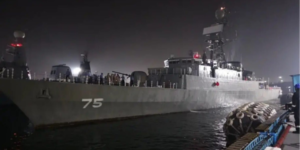
The Iranian Warship before the Torpedo strike
PHOTO/Reuters