
African PR Enters the AI Era as Report Shows Rapid Adoption
Share

Artificial intelligence (AI) is fundamentally disrupting the public relations profession, creating both new opportunities and new risks for reputation management, according to remarks by Ambassador Phillip Thigo, Special Envoy on Technology for the Republic of Kenya, during the launch of the State of PR in Africa 2026 Report by Glass House PP in Nairobi.
Ambassador Thigo noted that the rapid rise of conversational technologies and AI-driven communication tools is forcing the PR industry to rethink how it safeguards information, credibility and public trust.
“AI is fundamentally disruptive, especially in an era where conversational technologies have become highly precise,” said Amb. Thigo.
AI’s Dual Role in Reputation Management
“The field is still grappling with the potential of how AI creates intelligence, but also how it can be used as an opportunity to ensure reputations are protected as the technology continues to develop.”
He noted that public relations, which revolves around information and knowledge management, now sits at the centre of debates about responsible AI use.
“In this era where AI is pervasive in how we work and communicate, the field, like many others, is being challenged,” he said.
“People are using artificial intelligence to enhance reputations, whether through online presence or digital engagement with communities. But there is also a challenge around misinformation and the misuse of AI-generated information that can damage reputations.”
Amb. Thigo added that the growing influence of AI means PR professionals must remain vigilant about how technology is applied.
“Like any other sector, public relations must understand the trends, the challenges and the opportunities presented by AI. The question is how professionals use these tools to enhance their work while also helping shape the future of responsible communication.”
AI Adoption Across African PR Agencies
His remarks came as new research revealed that artificial intelligence is already deeply embedded in the daily work of communications professionals across Africa.
The State of PR in Africa 2026 Report, published by Glass House PR, draws insights from 54 agencies across 16 African countries, representing between 6,500 and 7,800 communications professionals.
The study also includes interviews with senior industry leaders and a survey of university students pursuing public relations and communication studies.
According to the report, 81.5 percent of senior PR professionals describe themselves as “very familiar” with artificial intelligence tools and actively use them in their daily work.
More than 90 percent use AI writing assistants such as ChatGPT and Microsoft Copilot, while over 80 percent rely on AI-powered design tools.
Content creation has seen the most dramatic transformation. About 85.2 percent of respondents say AI has significantly changed how they develop messaging, press materials and campaign assets.
Campaign planning, media monitoring and crisis management are also increasingly supported by AI technologies.
Also Read: NMG Leads the Way as Media Council Praises New AI Journalism Framework
Ethical Considerations and Professional Oversight
However, the industry remains cautious about the risks. Seven in ten respondents believe AI poses ethical threats to public relations, particularly around misinformation, authorship and bias.
More than half say algorithm changes by major technology platforms have affected campaign performance in the past year, underscoring the risks of heavy reliance on social media distribution.
Glass House PR Founder and CEO, Mary Njoki, noted that the transformation goes beyond efficiency gains.
“AI is not replacing public relations professionals. It is amplifying them,” she said.
“What will differentiate African PR in this new era is not who uses AI fastest, but who uses it responsibly, creatively and with sound judgment.”
The report also finds that 74.1 percent of professionals believe AI enhances rather than replaces human creativity and emotional intelligence.
Nearly half of the organisations surveyed have introduced mandatory human oversight policies to review AI-generated content before publication, while 42.6 percent have adopted transparency guidelines on AI use.
Digital Transformation and Community Engagement
Beyond artificial intelligence, the research highlights a broader shift in how stories are told.
Digital platforms have transformed PR from one-way messaging to participatory engagement.
Practitioners say they are moving beyond traditional press releases to build online communities through short-form video, interactive content and real-time audience feedback.
Platforms such as LinkedIn, Instagram, YouTube and TikTok now dominate campaign strategies, while Facebook plays a smaller role than in previous years.
Trust is also emerging as the industry’s most important currency. Instead of focusing solely on impressions and reach, PR professionals say they are increasingly measuring sentiment, quality of engagement, direct audience feedback and organic advocacy.
Also Read: Sage Intacct Launches in Kenya with AI-Driven Financial Automation
Preparing the Next Generation of AI-Native PR Professionals
The report suggests the next generation of African PR professionals is already AI-native.
Among students surveyed, 97.5 percent report using AI tools for brainstorming, drafting press releases and refining tone.
However, many also expressed concerns about authenticity, over-reliance on AI and plagiarism.
Looking ahead three to five years, respondents expect AI to automate routine tasks such as media monitoring and reporting, freeing professionals to focus more on strategy and relationship-building.
There is also optimism that AI could support hyper-localised storytelling across Africa’s diverse languages and cultural contexts.
At the same time, concerns remain about deepfakes, cultural bias in Western-trained AI models, data privacy gaps and the risk of widening the continent’s digital divide.
“The future of African PR will belong to professionals who can combine technology with human insight,” noted Njoki.
“Our stories are deeply cultural and community-driven. AI must serve that reality, not erase it.”
The State of PR in Africa 2026 Report offers one of the most comprehensive snapshots yet of how artificial intelligence and digital-first media are reshaping the communications landscape across the continent, signalling that the transformation is already well underway.
Follow our WhatsApp channel for instant news updates
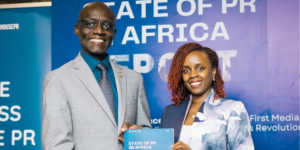
Ambassador Phillip Thigo, Special Envoy on Technology for the Republic of Kenya, with Glass House PR Founder and CEO, Mary Njoki during the launch of the State of PR in Africa 2026 Report by Glass House PP in Nairobi. PHOTO/ Glass House PP