Naivasha–Kisumu–Malaba SGR: Full Route, Stations and What to Expect
Share
President William Ruto has announced key developments ahead of the planned launch of the extension of the Standard Gauge Railway (SGR) from Narok to Kisumu and onward to Malaba, positioning the project as a cornerstone of Kenya’s regional economic strategy.
Speaking after a high-level meeting at State House, Nairobi, the President revealed he had engaged leadership from China Communications Construction Company, including Chairman Song Hailiang, in preparation for the upcoming commissioning events.
He noted that the infrastructure expansion is expected to enhance connectivity across East and Central Africa.
“The SGR extension will position Kenya as the regional trade and logistics hub,” Ruto said, emphasizing that the project will link multiple landlocked countries to the Port of Mombasa while unlocking the economic potential of Western Kenya.
The President further highlighted the logistical advantages of the railway, stating that the project will “ease road congestion by shifting bulk cargo to rail, cutting costs, saving time, and improving safety across our highways.”
Senior officials present during the meeting included Vice-President Chen Zhong and China Road and Bridge Corporation Chairman Du Fei.
Historical Context and Early Skepticism
Ruto traced the origins of the SGR project back to 2014, when Kenya embarked on replacing the aging colonial railway system.
“In 2014, we embarked on the bold task of replacing the 130-year-old colonial railway line from Mombasa to Kisumu, infamously called the ‘Lunatic Express’, with a modern Standard Gauge Railway,” he said.
He acknowledged that the initial phase of the railway, running from Mombasa to Naivasha, faced criticism at its inception.
“The first phase of the SGR was initially dismissed by skeptics as a ‘railway to nowhere’. But today, it stands vindicated as a transformative backbone of our national transport system,” Ruto added, pointing to improved efficiency in both passenger and cargo transport.
Also Read: How to Book SGR Train Ticket to Mombasa
Scope and Strategic Reach of the Extension
The new extension will significantly expand the railway network into Western Kenya and beyond.
According to the President, “The Naivasha-Kisumu main line will span 264km, complemented by an 8.69km line branching to the proposed new Kisumu Port, while the Kisumu-Malaba section will cover 107km, seamlessly linking Kenya to Uganda and the wider region.”
The project is expected to traverse nine counties, including Narok, Bomet, Nyamira, Kericho, Kisumu, Siaya, Vihiga, Kakamega, and Busia.
This corridor is seen as critical in enhancing both domestic and cross-border trade flows.
Also Read: Another Win for Kenyans as Ruto Hands Over Affordable Homes at Milimani, Kakamega
Economic Impact and Regional Integration
On the economic impact and regional integration, Ruto emphasized that:
“Traversing nine counties, this strategic corridor will significantly ease the movement of people, goods, and services.”
He further emphasized that the infrastructural development will:
“catalyse regional economic growth, and firmly position Kenya as a leading transport and logistics hub in Eastern and Central Africa.”
It is worth noting that the government has all along emphasized that the SGR is a long-term development aimed at improving trade competitiveness.
SGR extension is a pivotal link in connecting Kenya to neighboring economies including Uganda, Rwanda, Burundi, South Sudan, and the Democratic Republic of Congo, all of which rely heavily on access to the Port of Mombasa for imports and exports.
Follow our WhatsApp channel for instant news updates
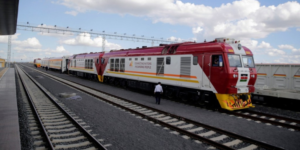
Photo shows SGR
Image/Kenya Railways/File
You Might also Like