Share
As artificial intelligence (AI) continues to reshape industries and redefine the future of work, Kenya’s Technical and Vocational Education and Training (TVET) institutions stand at a critical crossroads.
The growing demand for tech-driven skills presents both a challenge and an opportunity for the government to reimagine how TVET programs are designed, delivered, and supported.
Empowering TVET institutions in the age of AI will require deliberate investment in modern infrastructure, digital curricula, and industry partnerships to ensure learners are equipped with relevant, future-ready competencies.
TVET students have adjusted to the new norm and started integrating AI as a new learning tool.
The majority of these students either learnt about AI from the internet, social media, or friends.
“I first learned about AI through the internet and social media, where people were talking about tools that can answer questions, generate content, and help with learning. I became more curious and started exploring how AI works and how it can assist people in everyday tasks such as studying, researching information, and solving problems,” said Elsy Joy, a student at Kenya Institute of Development Studies (K.I.D.S).
Elsy, who is pursuing a diploma in Human Resource Management, said she uses AI to support her learning.
“I use AI to help me understand some of the topics I learn in my Human Resource Management course,” she explained.
When a concept feels difficult, AI provides simpler explanations that make it easier for her to grasp the material.
She also relies on AI when conducting research for her assignments. It helps her organize her notes efficiently and provides relevant examples related to workplace management, employee relations, and other HR topics. This support allows her to work more effectively and saves time during her studies.
According to Elsy, integrating AI into her learning routine has made studying less stressful and more productive.
“It makes studying easier and helps me understand my course better,” she said, emphasizing how technology has enhanced her ability to learn and apply HR concepts.
Raskin Amala, a student at Eldoret National Polytechnic, expressed similar sentiments.
Amala said she has been using AI in her studies mainly to summarize her units and improve her understanding of the coursework.
He added that AI also enhances connection and interaction with people by enabling easier communication and information sharing.
However, the students said they encounter different challenges while using AI in their various areas of specialization.
Reagan Omondi, a student at Bondo Technical Training Institute, cited issues such as lack of electricity, poor internet, and insufficient devices like laptops that hinder their studies.
“Unreliable power supply, which interrupts access to AI tools. Poor internet connectivity and lack of proper devices such as laptops or smartphones make it hard to use online platforms,” he said.
Similar concerns were raised by Elsy, who narrated how she struggles to keep her phone battery charged to use it in her studies since she does not own a laptop.
“I also use my phone instead of a laptop, which makes it a bit harder to do some tasks or type longer work. These can sometimes slow me down when I want to use AI for studying,” Elsy said.
Additionally, Jenga said most of the TVETs also lack digital skills and cannot afford the money to constantly purchase data bundles.
“These challenges limit consistent and effective use of AI in studies,” Jenga said.
TVET Students Outline Solutions
Elsy said the government should improve access to reliable electricity and support TVET institutions with better learning equipment, like computers.
She also suggested that schools be provided with more digital resources and training to help students use AI and other technologies effectively in their studies.
Besides, the students said the government should ensure that at least one Information, Communication and Technology (ICT) hub is established in every TVET institution.
Amala explained that this can be done in partnership with the TVET institutions to ensure students are not left behind in technological advancements like AI.
“To solve these challenges, the government and TVET institutions can help by setting up ICT labs so that students can access the equipment and internet needed to use AI,” Amala said.
Further, Omondi said the government should expand affordable and reliable internet access across the country.
Alternatively, he said the government can partner with telecommunication companies like Safaricom and subsidize the cost of internet bundles for students.
He added that the Technical and Vocational Education and Training Authority (TVETA) should incorporate AI in the curriculum.
“These measures would make AI more accessible and beneficial for students,” Omondi added.

The Eldoret National Polytechnic main gate. PHOTO/ Eldoret Polytechnic FB.
Experts’ Opinion on How to Support TVETs
Dr. Luchetu Likaka, a researcher and Director at Alma Consultant, said TVETs cannot ignore AI to remain competitive in the evolving labour market.
He stated that AI is a permanent feature of how societies operate, rather than a futuristic concept as it was once perceived.
“We are already living through the Fourth Industrial Revolution, where intelligent technologies are transforming production, services, and workforce skills. Any country or institution that fails to adapt risks widening inequality and being left behind in global competitiveness,” Likaka said.
Likaka explained that government policies and initiatives should align TVET with AI-driven labour markets.
He said the government must urgently move beyond rhetoric and anchor TVET transformation in three core enablers: policy harmonization, incentivizing industry-TVET collaboration, and a national digital skills framework that is tiered to recognize evolving AI competencies.
Likaka pointed out that TVET curricula are currently not aligned with market forecasts, especially around automation and data-driven work.
He asked the government to enforce dynamic curriculum review cycles tied directly to labour market intelligence and technology adoption trends.
The researcher noted that private-sector uptake of AI is far ahead of that of training institutions.
Therefore, structured apprenticeship pipelines, industrial mentorship, and tax incentives for companies co-investing in TVET labs would provide a viable bridge.
He stated that the government should safeguard the ecosystem with a national digital skills framework that is tiered to recognize evolving AI competencies, from basic literacy to advanced machine learning.
“This helps avoid fragmented training that produces graduates who are still mismatched with employer needs,” he said.
Also Read: TVETA Cracks Down on Institutions Issuing Fake Certificates in Kenya
Similarly, Samuel Ghedamu, Growth Strategist and Founder, Safi Flow Venture Group, said AI is already embedded in every sector globally.
Ghedamu explained that Kenya’s TVET challenge is not teaching students to build AI, but ensuring graduates understand how AI transforms their specific trades—whether in welding, managing business networks, or running small enterprises.
The experts also directed how TVET institutions can integrate AI without leaving behind students and trainers.
Likaka said institutions should adopt phased digital inclusion strategies to ensure AI does not become a new gatekeeper to opportunity.
He said TVETs can start with foundational digital skills for both trainers and learners, delivered through low-cost tools before advancing to specialized AI modules.
“Trainer capacity strengthening is non-negotiable. You cannot modernize learning if the instructors themselves are left behind. Government can accelerate this by funding continuous professional development and knowledge-sharing hubs among TVETs,” Likaka said.
Similarly, Ghedamu said the government should use a tiered approach, starting with the Foundation level for everyone (” What is AI?).
This then moves to the Application level for trades (how does it affect my work?) and lastly the Innovation level for advanced learners (how do I build solutions?).
“Prioritize offline-capable tools, solar-powered labs, and community tech hubs where students share resources. Make TVETs problem-solving centers—not just classrooms—where students apply AI to real local challenges,” he said.
Hybrid Learning and Local Opportunities
Likaka said hybrid learning models are also key.
He stated that practical, hands-on teaching must remain central so that students who struggle with technology are not sidelined.
Most importantly, Likaka said AI integration must be contextualized around local opportunities.
“Teaching machine vision for agriculture or predictive analytics for logistics makes technology feel relevant and accessible to young people who have never interacted with advanced tools,” he said.
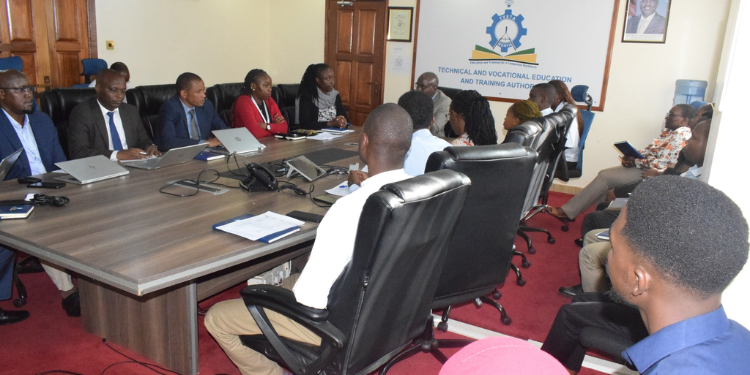
TVET Authority (TVETA) Director General, Timothy Nyongesa Katiambo, officiating at the opening of a two-day induction programme for 10 interns placed at the Authority by the Public Service Commission (PSC) on February 10, 2026. PHOTO/TVETA.
Investing in Trainers and Infrastructure
On the other hand, Ghedamu said the government must invest in trainers first and infrastructure.
TVETA’s 2023 survey shows that only 30% of TVET trainers have formal digital teaching credentials.
Continuous Professional Development reaches less than 10% of trainers annually—mostly in urban centers.
He stated that many rural TVETs face unreliable electricity and limited internet.
“You cannot teach AI if educators don’t understand it themselves,” Ghedamu said.
However, he warned that the AI transition is not just about smarter machines but about smarter systems that include everyone.
Ghedamu said Kenya can create a two-tier system where elite institutions access AI while others fall behind, or build an inclusive ecosystem where every TVET becomes an innovation engine.
“If the government invests in trainers first, demands binding industry partnerships, and leverages shared infrastructure, Kenya’s TVET sector will not just adapt to the AI age—it will lead Africa’s next industrial transformation,” he added.
Also Read: KUCCPS Lists Cluster and Subject Requirements for TVET Courses
Examples of Successful Inclusive AI Integration
Ghedamu gave an example of Ethiopia’s national ToT program.
Before touching student curricula, they trained nearly 24,000 TVET instructors on digital pedagogy and AI fundamentals.
Teachers became confident AI mentors for their peers, creating a multiplier effect across the country.
He also talked of the M-Shule’s offline-first mobile learning in Kenya.
The platform provides adaptive learning through SMS and offline apps that sync periodically.
Ghedamu stated that M-Shule is proof that technology can adapt to infrastructure reality—not vice versa.
He also asked the Kenyan government to learn from Jamaica’s Labour Market Intelligence Platform (UNESCO partnership).
The platform uses AI to collect real-time data from job postings and employer surveys, then informs curriculum reform.
It ensures training stays relevant to actual market needs.
Besides, Ghedamu said TVETs can pick lessons from Canada, Singapore, and Belgium’s smart employment platforms.
This is an AI-powered systems which provides job seekers with personalized vacancy alerts, skill-gap diagnostics, and relevant training recommendations, making career guidance accessible to everyone.
He also highlighted Maji Safi’s decentralized water model, where local water technicians are trained to deploy IoT sensors for leak detection and quality monitoring.
“They don’t need computer science degrees—they need to understand what the data means and how to act on it. That’s AI literacy in practice,” he said.
He stated that Kenya should launch a National AI Upskilling Program targeting 10,000 TVET trainers over two years.
Based on Ethiopia’s model, this is estimated to cost Ksh 2-3 billion.
Follow our WhatsApp channel for instant news updates
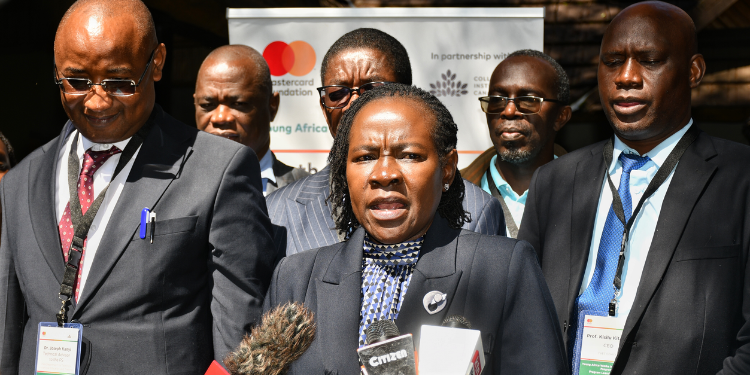
TVET PS Dr. Esther Muoria during a past press conference. PHOTO/My Gov.
You Might also Like