Why More Kenyans Need to Register Under SHA, Report
Share
Counties have a significant opportunity to strengthen their healthcare systems through the expansion of registration under the Social Health Authority.
This is according to the latest data on Primary Healthcare Impact Report of 2026, which shows that half of the Kenyan population (29.8 million Kenyans) have already registered under the national insurer, highlighting that while the current PHC budget stands at Sh21.6 billion, with a similar amount being lost as the facilities receive fewer drugs, slower UHC progress and limited outreach programs.
This is because under the SHA model, healthcare funding is directly tied to the number of registered individuals, meaning that counties with higher registration levels receive more resources to support service delivery at health facilities.
Also Read: Raphael Tuju is Missing, Family Says
What Analysis Indicates
The analysis indicates that counties could unlock up to Sh29.4 billion annually if registration is expanded further, reflecting the scale of opportunity within a system designed to ensure that funding follows people and supports care at the frontline.
With over 20 million outpatient visits recorded and more than 15 million patients already served, the data shows that the system is not only expanding but is actively being used.
This is even as data from the report shows a higher uptake in urban counties, which seem to be leading the PHC revolution, with Nairobi leading with 732,000 patients served, as over 1.7 million facility visits were recorded, and the city county also leads in the highest number of claims payout at Sh1.34 billion.
Mombasa, Bomet, Kisumu, Nyeri, and Kirinyaga have also emerged as strong performers of PHC, as Western counties like Kakamega and Bungoma have also shown strong utilization despite being less urban, as they are converting registration into actual care.
On the contrary, ASAL Counties, including Turkana, Mandera, Wajir, Marsabit and Isiolo, are still recording low registration with few of the available facilities being SHA compliant, hence a lower utilization creating a cycle of underfunding and under-service.
Also Read: $360 Billion at Stake as Africa Faces Critical Construction Skills Shortage
Respiratory diseases lead in the number of patients
The report also shows that respiratory diseases, i.e., colds, pneumonia, asthma and Acute upper respiratory infections were the leading cause of patients visiting centres for Primary Health Care, as other health factors such as malnutrition, environment and social conditions came second.
This is because digestive diseases (Diarrhea, gastritis) accounted for 12 per cent of why Kenyans visit PHC, while infectious diseases (Malaria, TB) had an 11 per cent, with all four accounting for 80 per cent of the total PHC visits.
Follow our WhatsApp channel for instant news updates
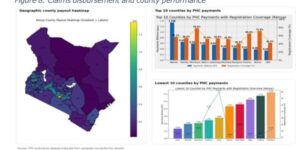
The analysis indicates that counties could unlock up to Sh29.4 billion annually if registration is expanded further
PHOTO/SHA
You Might also Like