
Goods & Services Whose Prices Increased in March
Share

Prices of several essential commodities increased in March 2026, with food items leading the rise as households faced a slightly higher cost of living.
The latest data from the Kenya National Bureau of Statistics (KNBS) shows clear shifts when compared to February prices.
To begin with, tomatoes recorded the sharpest increase, rising from Ksh 87.90 in February to Ksh 99.60 in March, a 13.3 percent jump.
Similarly, Irish potatoes increased from Ksh 102.16 to Ksh 107.16, while beef with bones moved up from Ksh 724.40 to Ksh 737.30.
At the same time, onions (leeks and bulbs) edged up slightly from Ksh 114.37 to Ksh 115.37, reinforcing pressure on household food budgets. These increases show how fresh produce and protein items continue to drive food inflation.
Shift from January and February Trends
However, the March data also signals a shift from earlier trends reported in January and February.
Previously, reports highlighted rising prices of items such as cabbage. Now, some of those commodities have started to decline.
For instance, cabbages dropped from Ksh 74.33 in February to Ksh 71.52 in March.
In addition, maize grain (loose) fell from Ksh 72.19 to Ksh 70.44, while spinach declined slightly from Ksh 113.11 to KSlsh 111.58. Likewise, sugar reduced from Ksh 166.56 to Ksh 164.37.
Consequently, the data reflects a mixed pricing environment, where increases in some items offset declines in others.
This pattern aligns with earlier coverage that showed fluctuating food prices driven by supply and seasonal changes.
Also Read: Kenyans Feel the Pinch as Food Costs Rise 7.3% Amid 4.3% Inflation
Rising Utility Costs Add Pressure
Beyond food, utility costs also increased and added pressure on consumers. For example, electricity prices rose across different usage levels.
Households consuming 200 kilowatts paid KSh 5,689.98 in March, up from Ksh 5,564.78 in February. Similarly, those using 50 kilowatts paid Ksh 1,297.26, compared to Ksh 1,265.96 the previous month.
Meanwhile, fuel prices remained stable. Petrol stayed at Ksh 179.35, while diesel held at Ksh 167.72, limiting additional pressure from transport costs.
Overall, the Consumer Price Index (CPI) increased from 149.20 in February 2026 to 150.00 in March 2026, resulting in a 0.5 percent monthly inflation rate.
“The month-to-month inflation rate was 0.5 per cent in March 2026,” KNBS stated.
Also Read: Cabbage Among Goods Whose Prices Increased in January
Overview
Annual consumer price inflation as measured by the CPI was 4.4 per cent in March 2026. This means the general price level was 4.4 per cent higher than in March 2025.
The increase mainly came from higher prices in Food and Non-Alcoholic Beverages (7.7%), Transport (3.8%), and Housing, Water, Electricity, Gas and other fuels (2.0%), which together account for over 57 per cent of total household spending.
The CPI tracks the cost of a fixed basket of goods and services over time, using February 2019 as the base period.
KNBS collects this data monthly from retail outlets across 50 urban areas.
In summary, March data shows that while some food prices eased, key commodities and utilities still pushed the cost of living upward, maintaining moderate but steady inflation.
Follow our WhatsApp channel for instant news updates
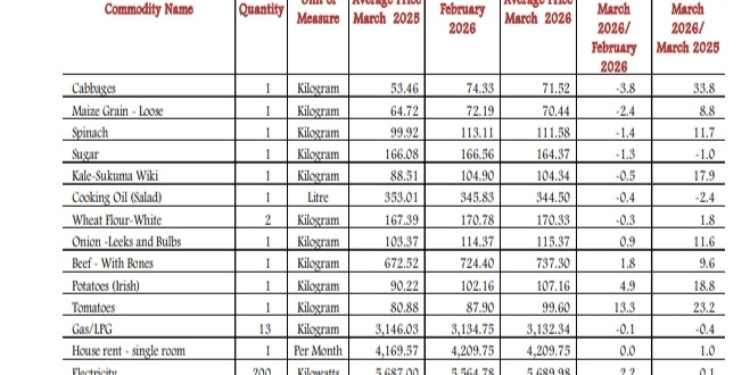
National Average Retail Prices of Selected Commodities. PHOTO/ KNBS.