Global Oil Prices Remain High Despite Drop as Strait of Hormuz Closure Fuels Supply Concerns
Share
The Central Bank of Kenya (CBK) has identified the persistent global oil price pressures as a key factor affecting the economic environment in the country, while most economic indicators in the country remained steady in the week to April 2, 2026.
In its latest bulletin, the regulator identified the high energy cost environment in the globe as a factor affecting the inflation rate in the country and in the rest of the world.
The Central Bank indicated in its latest bulletin that the annual inflation rate rose slightly to 4.4 percent in March 2026 compared to 4.3 percent in February 2026, attributed to the rise in non-core inflation.
While the non-core inflation rate rose to 10.8 percent in March 2026 compared to 10.1 percent in February 2026, the core inflation rate remained steady at 2.1 percent over the same period.
The Central Bank indicated that the persistent external shocks affecting the country’s macroeconomic environment emanate from the energy markets.
“The increase in non-core inflation was mainly on account of higher in food and energy prices,” the Central Bank said in its latest bulletin.
Global Oil Prices and Inflation Pressures
Across the world, the prices of oil continued to be high due to the closure of the Strait of Hormuz.
However, the prices of Murban crude oil were seen to dip slightly.
The prices were recorded at USD 89.45(Ksh 11,549) per barrel on April 1 compared to the USD 97.99(Ksh 12,640) recorded on the 26th of March.
CBK noted in its bulletin that, “inflation pressures across the world remained elevated due to energy prices. The inflation rate in the Euro Area rose to 2.5 percent in March from 1.9 percent in February.”
“Inflation concerns persisted during the week amid ongoing geopolitical risks and rising energy prices,” the bulletin said.
The bulletin further noted the fluctuations in the currencies across the world due to the general uncertainty.
The U.S. dollar was seen to dip marginally by 0.25 percent.
Stability in Currency and Reserves
The Kenyan Shilling has remained stable in relation to other notable international and regional currencies in the face of economic challenges in the world.
On April 2, the Shilling traded at Ksh 129.99 for every unit of the U.S. dollar compared to Ksh 129.72 on March 26.
Foreign exchange reserves were satisfactory at USD 13,655.70 million as of April 1.
This represents 5.8 months of import cover compared to the statutory requirement for the CBK to maintain at least four months’ import cover.
Also Read:Kenya Tightens Mobile Money Privacy as CBK Approves M-Pesa Masking
Financial Markets Show Mixed Performance
Activity in the financial sector recorded positive performance on the Nairobi Securities Exchange (NSE).
The NASI, NSE 25, and NSE 20 indices appreciated by 1.45 percent, 2.52 percent, and 0.96 percent respectively.
There were increases in market capitalization and shares traded as well.
However, there were significant declines in equity turnover.
In terms of bond market activity, turnover in the domestic secondary market increased by 11.87 percent during the review period.
With regard to international bond market activity, yields on Kenya’s Eurobonds increased by an average of 48.69 percent.
This is consistent with upward trends observed in Côte d’Ivoire and Angola.
Also Read:CBK Reveals Banks Offering Cheap Loans to Kenyans in 2026 [FULL LIST]
Liquidity and Government Securities
The money market was liquid during the week ending April 1, 2026.
This was due to the active open market operations.
Commercial banks maintained excess reserves of Ksh 6.2 billion on average, which was above the statutory cash reserve ratio.
In addition, the interbank rate was stable at 8.74 percent.
“The money market remained liquid during the week ending April 1, 2026, with open market operations remaining active,” CBK noted.
In addition, interbank transactions increased in terms of both number and value during the week compared to the previous week.
The auction for Treasury bills held on April 2 recorded a mixed outcome.
For instance, the auction attracted bids worth Ksh 17.0 billion against an amount of Ksh 24.0 billion, representing 70.9 percent.
In addition, interest rate yields fell for the 91-day and 364-day bills but rose slightly for the 182-day paper.
On the other hand, the reopened 15-year and 25-year bonds recorded high demand from investors.
For instance, they attracted bids worth Ksh 74.9 billion against an amount of Ksh 40.0 billion, representing 187.2 percent oversubscription.
Follow our WhatsApp channel for instant news updates
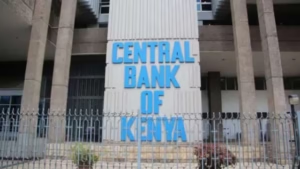
Central Bank of Kenya. PHOTO/CBK