
Kenya and Uganda Launch First Climate Camera into Space
Share

Kenya and Uganda are marking a major leap in space science and environmental technology with the upcoming launch of the Climate Camera (ClimCam) Payload.
This collaborative mission aims to revolutionize climate monitoring across Eastern Africa.
The ClimCam is set to lift off on Wednesday, April 8, 2026, at 3:51 p.m. East African Time, aboard a SpaceX Falcon 9 rocket under the Cygnus NG-42 Mission from the Cape Canaveral Space Force Station in Florida.
The project represents a rare and powerful blend of scientific collaboration. It brings together the Kenya Space Agency (KSA), the Uganda National Space Program, and the Egyptian Space Agency (EgSA).
The initiative is coordinated by the United Nations Office of Outer Space Affairs (UNOOSA) and Airbus Defence and Space.
The payload will operate on the Airbus Bartolomeo platform aboard the International Space Station (ISS) throughout the mission.
Dr. Cosmas Mwikirize of Uganda’s Science, Technology, and Innovation Secretariat described the launch as a defining moment in Africa’s journey toward technological self-reliance.
“ClimCam gives our region eyes in the sky not just for pride, but for survival in the face of climate change,” he added.
AI-Powered Imaging to Transform Climate Monitoring
The state-of-the-art camera integrates AI-powered imaging systems that deliver near real-time weather and climate data.
These insights will support disaster management and protect natural resources. They will also boost climate resilience efforts across Eastern Africa.
Additionally, the data will improve precision agriculture. It will monitor changes in natural resources and strengthen early warning systems for floods and droughts.
By doing so, the mission ensures practical benefits for communities across the region.
Also Read: Kenya and Uganda Start Talks on Multinational Expressway Project
East African Collaboration Drives Innovation
According to KSA Director General Col. Hillary Kipkosgey, the mission emerged from a shared need to apply space-based technologies to sustainable development.
“When East African nations collaborate, we multiply our impact. ClimCam is proof that African innovation can operate and compete at a global scale,” Hillary Kipkosgey said.
Rigorous Testing Ensures Space Readiness
Engineers assembled, integrated, and tested the ClimCam project in Cairo at EgSA’s advanced space facilities.
They then conducted final validation at Airbus facilities in Houston, Texas. These steps guarantee full readiness for spaceflight and highlight Africa’s growing technical capacity in aerospace engineering.
Also Read: Old Mutual Partners With Paystack To Simplify Digital Payments Across East Africa
Access to Space for Developing Nations
UNOOSA and Airbus selected the ClimCam consortium through the Access to Space for All Initiative. This program allows developing nations to participate in global space exploration by providing access to commercial and international infrastructure.
Dr. Mohamed ElKoosy, Executive Director of the Egyptian Space Agency, highlighted the continental symbolism of the mission.
“ClimCam is more than a payload; it’s a statement. Africa is not watching from the sidelines anymore,” he said.
Public anticipation continues to grow across the region as the countdown proceeds. Viewers can follow the launch live on the Cygnus NG-42 Launch Live Stream.
With ClimCam soon orbiting the Earth, East Africa positions itself as a rising player in the global space sector.
This mission demonstrates that science can safeguard people and the environment while advancing exploration.
Follow our WhatsApp channel for instant news updates
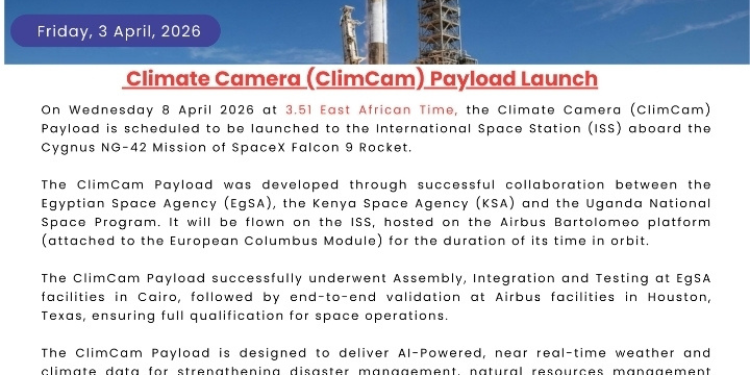
The Climcam to be Launched on Wednesday, April 8, 2026, at 3:51 p.m. East African Time. PHOTO/ Kenya Space Agency X.