Moon and Back: NASA’s Artemis II Crew Safely Returns After 10-Day Space Journey
Share
The NASA Artemis II mission has concluded successfully after a 10-day journey around the Moon, with the crew safely returning to Earth in a splashdown off the coast of San Diego.
The mission marks a major step in the United States’ renewed efforts toward human deep space exploration.
Launched on April 1, 2026, from Kennedy Space Centre, the mission carried four astronauts aboard the Orion spacecraft using NASA’s Space Launch System rocket.
The crew included Commander Reid Wiseman, Pilot Victor Glover, and mission specialists Christina Koch and Jeremy Hansen.
Artemis II is the first crewed mission to travel around the Moon in more than 50 years, reviving human spaceflight beyond low Earth orbit for the first time since the Apollo era.
The astronauts travelled hundreds of thousands of miles into deep space, conducted system checks, and completed a successful lunar flyby before returning to Earth.
Re-entry and Splashdown in the Pacific
During re-entry, the Orion spacecraft faced extreme heat and pressure as it passed through the Earth’s atmosphere.
A temporary communications blackout occurred for several minutes, a standard phase of high-speed atmospheric re-entry. The capsule later deployed parachutes and splashed down in the Pacific Ocean, where recovery teams were already positioned.
US Navy vessels quickly secured the spacecraft and ensured stability before recovery teams began their operations.
In a coordinated effort, teams extracted the astronauts from the capsule, placed them on inflatable rafts for preliminary medical checks, and then airlifted them by helicopter.
Also Read: How to Watch the Artemis II Mission Live Until It Reaches the Moon
Crew Recovery and Medical Checks
They then transported the crew to the USS John P. Murtha, the primary recovery vessel, where medical teams carried out further evaluations. Images from the scene showed the astronauts smiling and giving thumbs up as they arrived aboard the ship, indicating their stable condition after the mission.
“The landing was exceptionally precise, with the spacecraft touching down near its intended target point in the ocean,” NASA officials described the mission.
The crew is expected to remain aboard the recovery ship overnight before travelling to Houston, where they will reunite with their families and begin post-mission recovery.
Also Read: Larry Madowo Faces Backlash After Praising Luxembourg’s Free Public Transport
Mission Significance for Future Exploration
The successful completion of Artemis II strengthens NASA’s broader ambitions under the Artemis programme, which aims to return humans to the lunar surface and establish a sustainable presence. It also builds momentum for future deep-space missions.
“The mission was a defining moment for human spaceflight, calling Artemis II a crucial step toward establishing a long-term presence on the Moon and advancing preparations for future missions to Mars,” the agency hailed the mission.
Overall, the mission sets the stage for upcoming Artemis operations, including future crewed landings and long-term exploration plans that could eventually take humans to Mars.
Follow our WhatsApp channel for instant news updates
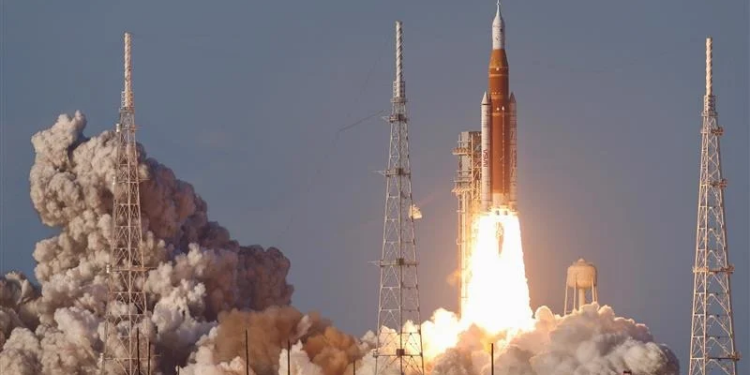
Space Launch System launches with the Artemis II crew aboard the Orion Spacecraft at NASA’s Kennedy Space Center
PHOTO/NASA/ Bill Ingalls