
Kenya’s Drylands Show Signs of Recovery as Rains Improve Conditions
Share
The National Drought Management Authority (NDMA) has reported a gradual improvement in drought conditions across Kenya’s Arid and Semi-Arid Lands (ASALs), following the onset of the March–April–May long rains.
According to the advisory released on April 13, 2026, most ASAL counties recorded near to above-average rainfall in March.
“The onset of the March-April-May long rains has led to notable improvement in drought conditions across the ASAL counties,” the authority stated.
As a result, several key indicators have improved.
“Improved recharge of water sources and the regeneration of pasture and browse, in addition, communities are experiencing reduced trekking distances, while livestock conditions have also improved, with better livestock body condition and increased milk production,” the NDMA noted.
At the same time, farmers in marginal agricultural areas have begun land preparation and planting, signaling a potential boost in food production.
Counties Gradually Shift Status
However, despite these gains, some counties remain in critical phases. Mandera and Wajir are still under the “Alarm” category, though conditions are improving.
Similarly, Garissa, Isiolo, Kitui, Lamu, Marsabit, Turkana, and West Pokot remain under the “Alert” phase, but are also showing progress.
Meanwhile, Kilifi and Kwale are in the “Recovery” phase with stable conditions. On the other hand, 12 counties, including Samburu, Kajiado, Embu, and Narok, are classified as “Normal,” with trends continuing to improve.
“Overall, drought conditions are improving across the 23 ASAL counties,” the agency emphasized.
Nevertheless, it warned that recovery remains fragile and continued vigilance and early action remain critical.
Also Read: Kenya Met Lists Areas to Receive Rainfall as Mid-April Approaches
Priority Actions Outlined
Consequently, the NDMA has outlined priority interventions across several sectors. In livestock and rangeland management, the advisory calls for disease surveillance, vaccination, deworming and treatment, as well as the establishment of feed reserves and pasture rehabilitation.
In addition, the water and sanitation sector will focus on rehabilitation and drilling of boreholes and expansion of rainwater harvesting systems.
Similarly, health and nutrition programmes are expected to scale up outreach services, including mass nutrition screening and the provision of treatment commodities.
Furthermore, in agriculture, the authority recommends the distribution of drought-tolerant seeds and farm inputs and strengthening climate-smart practices.
The education sector is also expected to sustain school feeding programmes and improve water access in learning institutions.
At the community level, residents have been advised to take precautionary measures. Specifically, the NDMA urged them to conserve water and use safe treated water and to plant early using certified drought-tolerant seed.
Additionally, communities should report livestock diseases and crop pests promptly and seek early treatment for vulnerable children.
Also Read: Court Strips Esther Musila of Control Over Late Husband’s Estate in Landmark Ruling
Government Maintains Oversight
Finally, the authority reaffirmed the government’s commitment to monitoring the situation.
“The Government, through the established coordination structures, continues to monitor the negative impacts of drought in ASAL counties and coordinate recovery efforts to protect lives, livelihoods, and resilience gains,” the advisory concluded.
Even so, while the improving conditions offer hope, sustained efforts will be necessary to secure long-term recovery and resilience across the affected regions.
Follow our WhatsApp channel for instant news updates
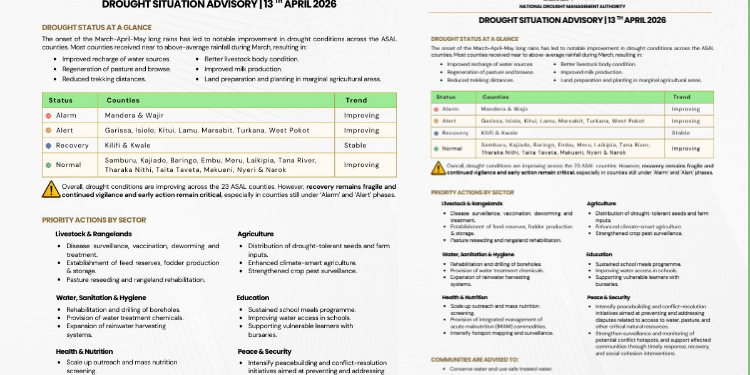
NDMA says drought conditions are improving across 23 ASAL counties after long rains, but warns recovery remains fragile and calls for continued action. PHOTO/ NDMA X.
You Might also Like