CS Mbadi Clarifies on Government Selling Safaricom Shares
Share
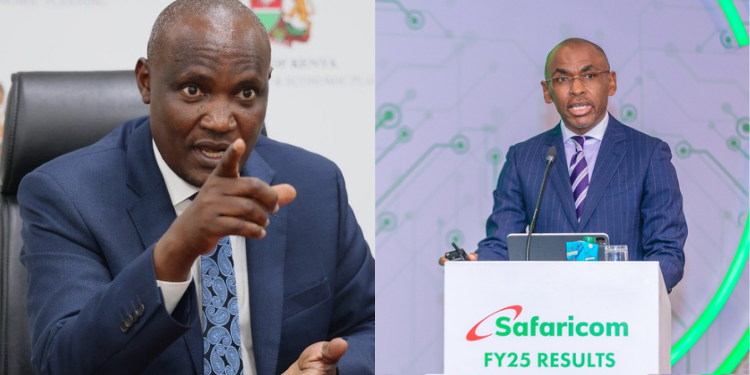
Treasury Cabinet Secretary, John Mbadi, has defended the government’s plan to sell part of its Safaricom shares, saying the move is aimed at unlocking resources for long-term national infrastructure projects rather than filling budget gaps.
“We are at a point in this country where we still need infrastructural development. That’s a fact,” Mbadi said, insisting that Kenya must invest more aggressively to sustain economic growth.
He noted that Kenya’s economic performance remains below target, emphasizing the urgency of investing in areas that will stimulate growth.
“We need at least 7% economic growth. We are growing at 5%. Maybe next year it will be 5.3%. So we are still struggling,” he stated.
According to the CS, infrastructure constraints continue to hold back productivity and regional trade.
“You cannot grow an economy where you have a lot of infrastructural challenges,” he added.
Also Read: CBK Reopens Window for Long-Term Treasury Bond Purchases
Infrastructure Gaps Hindering Growth
Mbadi cited major roads linking Kenya to its key trading partners as some of the most affected.
“Our largest trading partner is Uganda. The road leading to Uganda has challenges. You sometimes take a day before you move from Nairobi to the border,” he explained.
He added that access to Tanzania through the Namanga route also poses challenges due to poor road quality.
“It is not the class of road that you’d want to connect you to your major trading partners,” he said, noting that several other commercially significant roads require urgent upgrades.
The CS also raised concerns over Kenya’s dependence on rain-fed agriculture, calling for a shift to irrigation.
“We need to move to irrigated agriculture. This will require investment in major dams. We have mapped out about 50 of them across the country,” he said.
Energy, Airports and New Funding Options
On energy, Mbadi said the high cost of power remains a turn-off for foreign investors.
“One of the reasons why investors find it hard to come to Kenya is because of the cost of energy,” he noted, adding that energy generation and transmission must be expanded.
He also said Kenya’s main airport lags behind global standards.
“Our airport looks like that of the 1950s compared to other countries. And we have attempted through PPP, it didn’t work,” he observed.
The challenge, he added, is financing. “Either by raising taxes, which is not an option, or by borrowing. Is there space for that? There is no space,” said Mbadi, ruling out both options.
Also Read: Safaricom Confirms Vodafone’s Plans to Acquire Government Stake
Why the Government Is Selling Safaricom Shares
Mbadi said this reality pushed the government to consider innovative, non-debt financing mechanisms, including leveraging state-owned assets.
“We have this mature asset. What we are trying to do is unlock the value of a mature asset,” he explained.
The government plans to channel the proceeds into a newly established National Infrastructure Fund.
“This fund will be tasked with the responsibility to implement major infrastructure projects by crowding in the private sector,” he said.
He added that institutions, including pension funds, are willing to invest if risks are reduced.
“You must de-risk that by having a fund that would invest and then crowd in the private sector,” he noted, linking this to the creation of both the National Infrastructure Fund and a Sovereign Wealth Fund.
15% Safaricom Shares to Be Converted Into Infrastructure Assets
Mbadi clarified that the government will convert part of its Safaricom stake into infrastructure investments.
“We are shedding off 15%, converting that asset in Safaricom to public infrastructure assets,” he said, adding that these assets will be income-generating.
He stressed that the sale will not be used for short-term budgetary needs.
“We are not offloading these shares to meet short-term budget deficits as that would amount to selling an asset and consuming it,” he said.
Instead, the CS said the plan ensures sustainability and fairness across generations.
“We must also maintain what we call intergenerational wealth. We invest this for the future generations as well,” Mbadi affirmed.
Follow our WhatsApp Channel and WhatsApp Community for instant news updates

Safaricom PLC Headquarters in Nairobi. PHOTO/ NMG.