Why Oil Prices Increased on Christmas Eve
Share

The Central Bank of Kenya (CBK) has explained why global oil prices increased on December 24, 2025.
In it’s weekly bulletin on December 24, CBK said global oil prices increased during the week, partly due to heightened geopolitical tensions in some key oil-producing regions and concerns over potential supply disruptions.
Murban crude oil traded at USD 62.90 (Ksh8110.95) per barrel on December 23, up from USD 60.71 (Ksh7828.55) per barrel on December 18.
“International oil prices increased during the week, partly due to heightened geopolitical tensions in some key oil-producing regions and concerns over potential supply disruptions. Consequently, murban crude oil traded at USD 62.90 per barrel on December 23, up from USD 60.71 per barrel on December 18,” CBK said.
CBK Exchange Rates
The Kenya Shilling remained stable against major international and regional currencies during the week ending December 24, 2025. It exchanged at Ksh129.00 per U.S. dollar on December 24, compared to Ksh128.94 per U.S. dollar on December 18.
Foreign Exchange Reserves
The foreign exchange reserves remained adequate at USD 12,168 million (5.3 months of import cover) as of December 23. This meets CBK’s statutory requirement to endeavour to maintain at least 4 months of import cover.
Money Market
The money market remained liquid during the week ending December 23, with open market operations remaining active. Commercial banks’ excess reserves averaged KSh 16.5 billion above the 3.25 percent Cash Reserve Ratio (CRR) requirement.
The Kenya Shilling Overnight Interbank Average Rate (KESONIA) increased marginally to 9.01 percent on December 23 from 8.98 percent on December 18.
During the week, the average number of interbank transactions increased to 20 from 15 in the previous week, while the average value traded increased slightly to Ksh10.1 billion from Ksh11.3 billion.
Also Read: CBK Explains How Securities Unlock Affordable Bank Loans
Government Securities Market
The Treasury bill auction of December 24 received bids totalling KSh 5.4 billion against an advertised amount of KSh 24.0 billion, representing a performance of 22.6 percent. Interest rates on the 91-day and 364-day Treasury bills declined, while interest rate on the 182-day Treasury bill remained stable.
Equity Market
At the Nairobi Securities Exchange, the NASI and NSE 25 share price indices decreased by 0.14 percent and 0.59 percent respectively, while the NSE 20 increased by 0.64 percent during the week ending December 23. Market capitalization decreased by 0.13 percent, while equity turnover and total shares traded increased by 66.80 percent and 53.58 percent respectively.
Also Read: CBK Lowers Central Bank Rate by 25 Basis Points
Bond Market
Bond turnover in the domestic secondary market decreased by 40.18 percent during the week ending December 23. In the international market, yields on Kenya’s Eurobonds decreased by 8.34 basis points on average. Yields for Angola and Côte d’Ivoire also decreased.
Global Trends
Inflation concerns in advanced economies eased during the week.
Euro area headline inflation was confirmed at 2.1 percent in November 2025, unchanged from October, while core inflation also remained stable at 2.4 percent over the same period.
The U.S. Dollar Index weakened during the week, partly reflecting the narrowing of interest rate differentials following recent interest rate cuts.
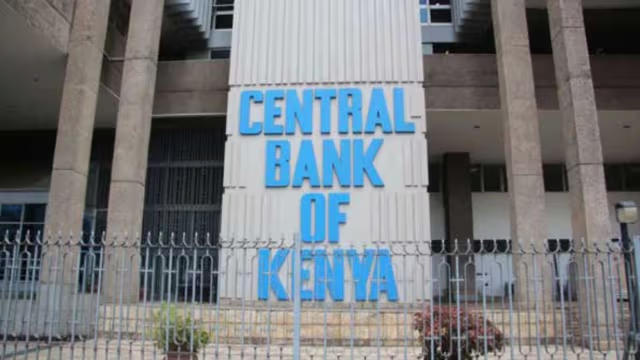
Central Bank of Kenya. PHOTO/CBK