

Raila’s Silence Is a Test and Kenya Is Being Watched
Share

By Clifford Derrick – Journalist, Filmmaker, Lecturer in Decolonial Studies
South Africa
Raila Odinga’s passing did not arrive quietly. It arrived as exposure. It revealed how swiftly unfinished struggles attract scavengers, how easily grief becomes a site of contest, and how quickly old power formations attempt to repossess what they never built. As the soil settled in Bondo, the political temperature shifted. Familiar urgencies resurfaced. Calls for speed, confrontation, spectacle, and street drama returned, not from conviction, but from panic.
That panic has a history. It is structural.
As Frantz Fanon warned, liberation movements denied material victory are often converted into performance. They are praised for passion while being denied power. Raila understood this trap in its Kenyan form. He did not wander into strategic accommodation by accident. He arrived there after a lifetime of observing how power actually circulates in this country. How some communities inherit the state while others are locked into permanent opposition. How resistance is celebrated only when it remains symbolic. How protest is encouraged when it exhausts the poor but discouraged when it threatens accumulation.
He understood that opposition, when curated by elite interests, becomes containment. Loud enough to be seen. Harmless enough to be ignored.
What many still refuse to name is that the small but entrenched ethnic elite networks that have dominated Kenya’s political economy since independence did not merely exclude certain communities from executive power. They colonised them politically. This is what Walter Mignolo describes as the persistence of the colonial matrix of power long after formal independence. Certain communities were confined to agitation, branded unruly, relied upon to destabilise regimes, then discarded when rewards were distributed. Their courage was useful. Their liberation was not.
Over time, this arrangement hardened into normality. As Achille Mbembe reminds us, domination survives not only through violence but through habituation. Sacrifice became ritual instead of leverage. Suffering became identity instead of strategy. Political energy was converted into spectacle rather than power.
Raila Interrupting the Trend
Raila chose to interrupt that cycle.
He recognised that elections alone had failed to break this historical pattern. He saw the possibility of rupture not in noise but in repositioning. Not in moral posturing but in material transformation.
The future he was working toward was economic, infrastructural, and spatial. It was grounded in transport corridors, energy systems, industrial zones, and regional production networks. These were not conveniences. They were instruments of dignity.
The aim was to end forced migration disguised as opportunity. To allow a young person in Kisumu, Siaya, Homa Bay, Migori, Vihiga, Kakamega, Busia, Kisii, Machakos, Kitui, Makueni, Kajiado, Narok, Kilifi, Mombasa, Lamu, Garissa, Wajir, Mandera, and Lodwar, to imagine a future without first abandoning home. To reduce dependency on Nairobi. To shorten supply chains. To unclog borders. To transform western Kenya, the lower eastern corridor, the coast, and the north from labour reserves into interconnected economic corridors.
Had this vision matured fully, it would have restructured Kenyan power more profoundly than any election ever could. That is precisely why it provoked hostility. That is why there is now a coordinated attempt to either rupture alliances or provoke unrest. Not out of fear of dictatorship, but out of fear of redistribution. Not out of love for protest, but out of terror that development erodes leverage.
Also Read: The “Baba Cult”:Why I Believe Raila’s Soul Rests in Divine Mercy and Eternal Peace
Who are Raila’s People?
This is where the deliberate misreading begins. The question “who are Raila’s people?” is not new; it is recycled whenever inclusion threatens the gatekeepers. Raila’s people have never been an ethnic enclosure. They have always been those locked out of power by geography, history, and inherited hierarchies. That is why his politics consistently unsettled ethnic arithmetic.
When Raila negotiated entry into the current government, he was given space to nominate five cabinet positions. His own community received one. One. Opiyo Wandayi took Energy. The rest were deliberately distributed beyond Luo constituencies: John Mbadi from Suba was nominated to Finance; Wycliffe Oparanya from the Luhya community took Cooperatives and MSMEs; Hon. Ali Hassan Joho from the Coast was appointed to Mining and the Blue Economy; and Beatrice Askul Moe became the first woman from Turkana to enter the Cabinet, anchoring regional development and EAC affairs.
This is not symbolism. It is a record.
Contrast this with the same courtesy extended later to Uhuru Kenyatta, whose nominees to the cabinet came entirely from a single ethnic bloc. No national outrage followed. No lectures about inclusion were offered, including the fact that it had no gender consideration. All male. Silence reigned—because silence is easy when power circulates among familiar hands. Had it been Raila, wololo!
As for the Kamba question, it is on record that Raila approached Kalonzo Musyoka for inclusion. He declined. Firmly. That choice was his. Raila cannot be held hostage by refusals and then accused of exclusion by the same refusal. Responsibility must sit where decisions are made.
Also Read: ODM Deputy Party Leader Hints at Party’s Position in 2027
What is Unfolding Now
What is unfolding now is not critique; it is legacy erasure. A coordinated attempt to collapse a 50-year politics of national inclusion into a caricature of ethnic ownership, so that the coalition he built can be broken apart after him. It will not work. The grief that poured in from every corner of Kenya, from Africa, from the diaspora, was not choreographed. It was recognition. Raila was never merely a man. He was a political spirit—and spirits do not die.
From here, the record speaks.
It is not paranoia but historical literacy.
From secret oaths designed to block certain communities from leadership, to the calculated isolation of Jaramogi Oginga Odinga, to the assassination of Tom Mboya in broad daylight, to the massacre of unarmed civilians in 1969 near Kisumu, to the murders of Pio Gama Pinto and JM Kariuki, to the silencing of Dr Robert Ouko, Chris Musando, and baby Pendo, the pattern repeats with chilling consistency.
As Nelson Maldonado-Torres argues, coloniality survives through selective violence and selective memory. Mobilisation is tolerated when it serves elite ambition and crushed when it threatens autonomy.
No apology has ever been issued for this history. And yet restraint persisted. Discipline held. Strategy survived.
That survival is not weakness. It is political maturity.
It is also necessary to remind ourselves of this truth: ODM was built by Raila, rooted in the struggles of his community, but designed for the forgotten Kenyans across the republic. To destroy it is to extinguish the aspirations of those who have never been allowed a seat at the table.
There is no vacuum now, despite deliberate attempts to manufacture one. The movement did not collapse with grief. Continuity has been honoured. Direction remains intact. Attempts to manufacture chaos are not a concern. They are sabotaged.

ODM top officials at past event for representation. PHOTO/Courtesy
Warning to ODM Leadership & Youth
To leadership within the ODM movement, this moment is a warning. Noise is not a strategy. Public theatrics reveal only two possibilities. Either one has been compromised and is working with forces that celebrated Raila’s stolen elections, sabotaged his continental ambitions, and mocked him even in loss, or one is manufacturing outrage as a survival tactic after years of delivering nothing tangible to the people who elected them.
To the youth, this must be said without romance. You are being courted, not empowered. Provoked, not protected. Those urging constant agitation without a clear economic horizon are not revolutionaries. They are recyclers of politics. Protest is a tool, not a religion. Detached from strategy, it becomes labour for other people’s ambitions.
Raila understood this. That is why he chose embedded presence over endless confrontation. Economic anchoring over permanent protest. Institutional infiltration over moral exhibition. He was not abandoning resistance. He was relocating it.
Those encouraging internal bickering while others quietly organise are the true enemies of his legacy. History is unforgiving to such actors. Many who failed repeatedly while he lived blamed him for their inadequacy. Without him, that excuse evaporates. Their emptiness will stand exposed.
Raila was never a throne to inherit. He was a direction to sustain. A discipline. A refusal to be hurried into traps disguised as courage.
He is now in memory. And memory is power. Handled carelessly, it curses. Handled wisely, it builds.
The choice is already before you!
Follow our WhatsApp Channel and WhatsApp Community for instant news updates
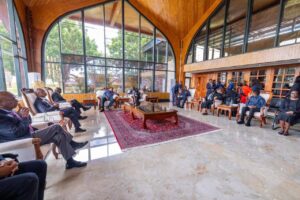
President William Ruto, Former President Uhuru Kenyatta, DP Kithure Kindiki and the Odinga Family. PHOTO /JKIA