Why Ethiopia Is Still Seven Years Behind On The Calendar
Share
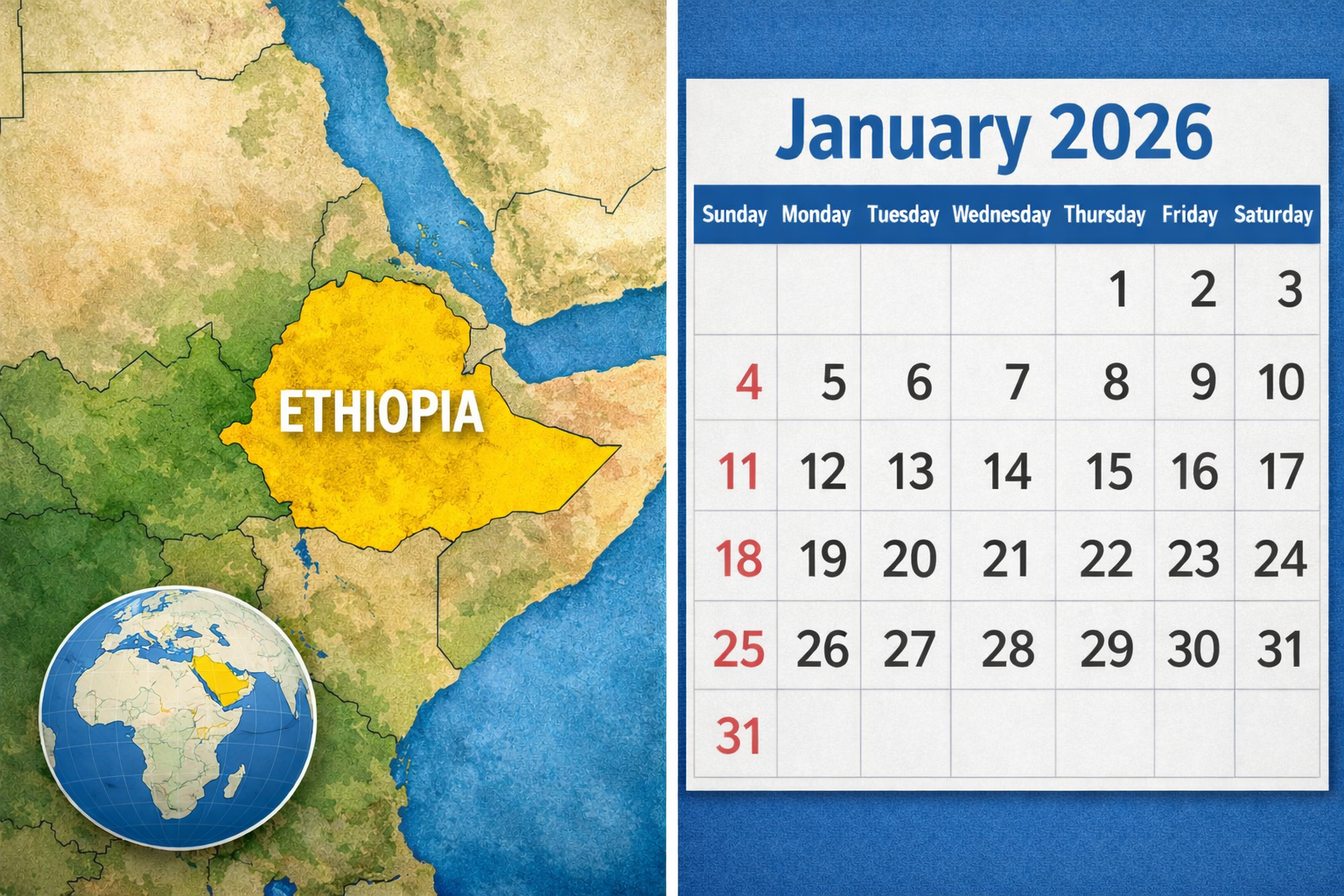
Ethiopia continues to puzzle visitors and global observers by living in a different year from much of the world, remaining about seven to eight years behind the widely used Gregorian calendar.
While many outsiders describe this as being “late,” Ethiopians insist it is not a delay but a deliberate preservation of a centuries-old system rooted in faith, history, and national identity.
As most countries approach the end of the Gregorian year, Ethiopia often marks a new beginning.
The divergence stems from the calendar the country follows, which is closely linked to the Ethiopian Orthodox Church and ancient Coptic traditions.
Unlike the Gregorian calendar introduced by Pope Gregory XIII in 1582, Ethiopia retained its own method of calculating time, one that predates many modern global systems.
At the heart of the difference is the calculation of the birth of Jesus Christ.
While the Western church fixed the birth year at 1 AD, Ethiopian scholars and clerics, following older Alexandrian and Coptic calculations, placed it several years later.
This single theological decision created a gap that has persisted for centuries and still defines Ethiopia’s timeline today.
Roman Church revised its dating methods around the sixth century, but the Ethiopian Orthodox Church chose continuity over adjustment.
As a result, Ethiopia’s year count remained intact even as much of the world transitioned to the Gregorian calendar.
For Ethiopia, being seven years behind is not about time lost, but history preserved.
A Calendar Shaped by Faith and History
Ethiopia’s calendar is believed to be more than 1,500 years old and bears a strong resemblance to the Coptic calendar used by the Coptic Orthodox Church of Alexandria.
It operates on a solar-lunar system and is structured into 13 months rather than 12 months.
Twelve months have exactly 30 days, while the final month, known as Pagumē, has five days in a regular year and six in a leap year.
This structure alone sets Ethiopia apart.
The leap-year cycle is also unique, following a four-year pattern associated with the four biblical evangelists.
For many Ethiopians, this system is not merely functional but symbolic, blending timekeeping with religious meaning.
“We are unique,” says tourism executive Eshetu Getachew, pointing to Ethiopia’s long history of independence and cultural continuity.
“We were never colonized. We have our own calendar, our own alphabet, and our own traditions,” Getachew adds.
Also Read: Why Some Countries Celebrate New Year Twice
Living Between Two Timelines
Despite its deep roots, the Ethiopian calendar coexists with the Gregorian system in everyday life.
International businesses, schools, airlines, and diplomatic institutions operating in Ethiopia rely largely on the Western calendar.
This forces many Ethiopians, particularly in urban areas, to constantly convert dates and years.
Archaeologist Goitom W. Tekle describes the process as, “mentally exhausting,” noting that switching between systems can affect everything from official paperwork to personal milestones.
“Simple tasks such as registering births or scheduling exams can become complicated if conversions are miscalculated, sometimes resulting in conflicting records,” Goitom W. Tekle says.
Historians explain that while this dual-calendar reality may seem chaotic to outsiders, Ethiopians gradually adapt.
“You just switch from one to the other,” says medieval historian Verena Krebs, adding that over time the difference becomes routine rather than disruptive.
Also Read: Best Holiday Escapes in Nairobi For Every Budget
New Year in September
One of the most visible results of Ethiopia’s calendar is its New Year, Enkutatash, celebrated on September 11 or September 12 during a leap year.
The holiday coincides with the end of the rainy season, when landscapes turn green and flowers bloom, symbolizing renewal and abundance.
Photographer Abel Gashaw describes the timing as practical and meaningful.
He calls the Ethiopian calendar “more logical,” noting that “beginning the year during a season of growth makes more sense than January 1, which falls in Ethiopia’s dry season.”
Enkutatash is also tied to oral tradition, believed to commemorate the return of Queen Sheba from Jerusalem, when she was welcomed with gifts of jewels.
Tradition in a Globalized World
As Ethiopia becomes more connected through technology and globalization, questions occasionally arise about whether the country should adopt a single international system.
However, practicality alone is not a strong enough reason to abandon a deeply meaningful tradition.
Ethiopia’s case is not unique.
Other societies continue to use distinct calendars, including the Hijri calendar in Muslim communities and the Hebrew calendar in Israel.
For many Ethiopians, maintaining their calendar is an assertion of identity rather than resistance to modernity.
“There is no real reason, other than convenience, that a country should lose its own system,” medieval historian Verena Krebs observes.
Follow our WhatsApp Channel and WhatsApp Community for instant news updates

Happy New Year Post. PHOTO/ Courtesy