Why Religion and Churches Must Be Regulated: When the Shepherds Devour the Flock
Share

By Dr. Luchetu Likaka – Researcher and Political Analyst
Religion, at its best, should be a moral compass; at its worst, it becomes a profitable enterprise that thrives on fear, ignorance, and blind loyalty.
In Kenya today, the church has increasingly drifted from being a sanctuary of conscience to a marketplace of miracles.
Like a river that has burst its banks, unregulated religion has flooded society with deception, exploitation, and moral hypocrisy.
The question is no longer whether religion should be regulated, but why it has taken so long.
Moral Responsibility
The Kenyan church has largely failed in its moral responsibility.
Instead of speaking truth to power, it has chosen proximity to power.
Many church leaders have mastered the art of sanctifying corruption, blessing stolen wealth, and laundering reputations from the pulpit.
Politicians accused of plunder find instant redemption once they kneel publicly, drop a fat envelope on the altar, and quote a verse or two.
The church, which should be a watchdog, has become a lapdog. As the proverb goes, he who eats with the hyena must learn to howl.
Faith for Sale
Worse still is the commercialization of faith.
The rise of prosperity gospel churches has turned poverty into a business model.
Desperation is milked, not healed. Kenyans are promised instant riches, miracle jobs, miracle visas, miracle marriages—everything except accountability and hard work.
Congregants are told to “sow seeds” while pastors harvest mansions, private jets, and political influence.
It is a cruel irony that the poorest give the most, while those who preach sacrifice live like kings.
Here, religion becomes less about salvation and more about survival—of the preacher’s lifestyle.
Also Read: AI On The Pulpit: When Algorithms Shape Sermons
Religion Fails to Protect Vulnerable
The church has also failed spectacularly in protecting the vulnerable.
Scandals involving sexual abuse, cult-like control, psychological manipulation, and financial fraud are quietly swept under the carpet in the name of “not tarnishing the body of Christ.”
Victims are silenced with scripture, told to forgive without justice, to pray instead of report.
In such moments, the church resembles a house built on sand—impressive from afar, but hollow and dangerous within.
How Churches Function in Kenya
Karl Marx’s description of religion as the “opium of the masses” rings painfully true in this context.
Religion in Kenya often functions as a sedative, numbing people into passive acceptance of suffering.
Instead of mobilizing citizens to demand justice, good governance, and dignity, some churches preach endurance, submission, and blind hope.
People are taught to wait for heaven while hell is constructed around them through corruption, inequality, and bad leadership.
Faith becomes a sleeping pill administered weekly to keep the masses calm while the elite feast.
Also Read: Dear Politicians, The Politics–Religion Cocktail Is Dangerous and Despicable
Why Govt Should Regulate Religion
Regulation, therefore, is not an attack on faith; it is a defense of society.
No institution that handles massive amounts of money, commands unquestioned loyalty, and influences political behavior should operate in a vacuum.
Banks are regulated. NGOs are regulated. Even small businesses are regulated.
Why should churches—some richer and more powerful than corporations—be exempt? When left unchecked, power corrupts, and absolute religious power corrupts absolutely.
The argument that regulation infringes on freedom of worship is a red herring.
Regulation is not about doctrine; it is about transparency, accountability, and protection of citizens.
Faith should be free, but exploitation should not. Belief should be sacred, but abuse should be punishable. Otherwise, we allow wolves to dress in clerical collars and call it freedom.
In the final analysis, the Kenyan church must look itself in the mirror.
It cannot continue to preach morality while practicing impunity, condemn sin while dining with thieves, or promise salvation while selling illusions.
Until then, regulation is not just necessary—it is overdue. Because when religion becomes a refuge for conmen and a cage for critical thought, society pays the price.
And as the saying goes, when the drums of religion beat too loudly, reason is the first to dance out of step.
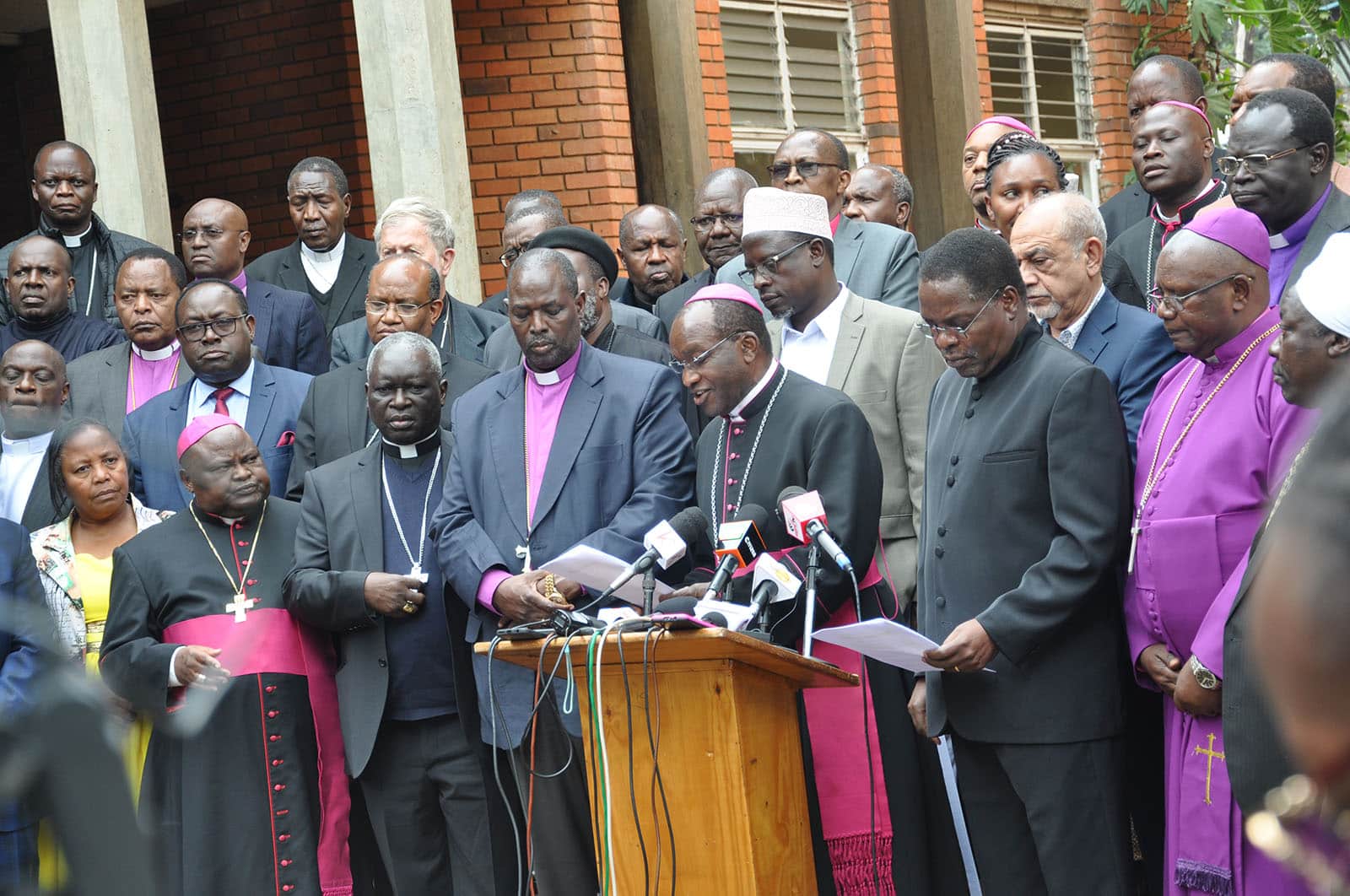
Catholic Archbishop Martin Kivuva Musonde of Mombasa, at podium, is joined by a variety of Kenyan religious leaders during a news conference in Nairobi, Dec. 3, 2024. PHOTO/Fredrick Nzwili.