
Leaders Overthrown by the US: A History of Forceful Deposition
Share
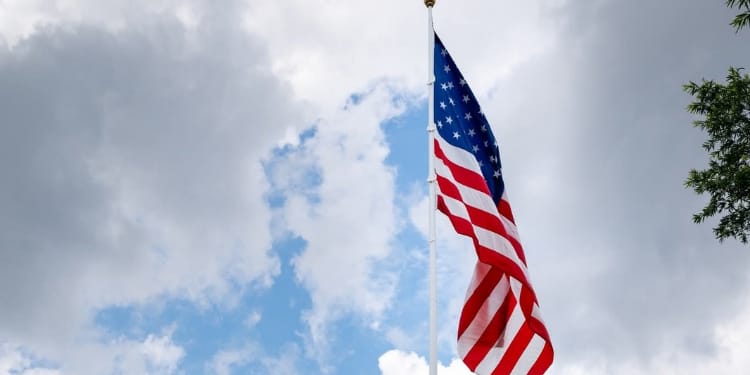
Throughout its history, the United States has been repeatedly linked to the forceful removal of foreign leaders, using both overt military power and covert intelligence operations to influence political outcomes abroad.
From the late 19th century through the Cold War and into the 21st century, Washington justified many of these actions as necessary to protect strategic interests, prevent ideological rivals from gaining ground, or combat emerging security threats.
These interventions, often left lasting scars on the affected countries, including prolonged instability, authoritarian rule, and deep-seated anti-American sentiment.
While U.S. officials have defended such actions as essential to global security, their legality, morality, and long-term effectiveness.
The pattern of intervention began well before the Cold War, rooted in expansionist policies and economic interests, and later evolved into sophisticated intelligence-led regime change operations.
As one historian, Stephen Kinzer, a senior fellow at the Watson Institute for International and Public Affairs at Brown University, observed, “During the early 20th century, the United States intervened relentlessly in the Caribbean Basin,” highlighting a legacy that would later expand across the globe.
Early Imperial Interventions
One of the earliest examples occurred in 1893 in Hawaii, when a small group of white business and plantation owners, backed by a U.S. envoy, overthrew Queen Liliʻuokalani.
The coup paved the way for U.S. annexation in 1898.
A century later, Washington formally acknowledged wrongdoing, apologizing for overthrowing the monarchy and annexing land “without the consent of or compensation to the Native Hawaiian people, or their sovereign government.”
In Mexico, U.S. diplomatic involvement also proved consequential.
The American ambassador supported the 1913 coup against President Francisco I. Madero, a democratically elected leader, whose removal plunged the country into years of turmoil and revolutionary violence.
Also Read: Countries That Have Experienced Coups in Recent Years
Cold War Coups and Covert Operations
Following World War II, the establishment of the Central Intelligence Agency marked a turning point.
Interventions became more secretive, driven by fears of communist expansion.
Historian Stephen Kinzer noted that in the 1950s, “it was a priority for President Eisenhower and CIA Director, Allen Dulles to assure that America always had plausible deniability.”
In Iran in 1953, the CIA and Britain’s MI6 orchestrated a coup against Prime Minister Mohammad Mosaddegh after he nationalized the oil industry.
Though framed as a defense against “Soviet aggression,” critics argue economic interests were central.
The coup restored Shah Mohammad Reza Pahlavi, whose authoritarian rule later fueled revolutionary backlash.
A year later, Guatemala’s President Jacobo Árbenz was removed in Operation PBSuccess, a CIA-backed coup linked to land reforms threatening the United Fruit Company.
The intervention ushered in decades of civil war and repression.
Similar Cold War logic guided U.S. actions in the Congo, where the CIA supported efforts leading to the capture and assassination of Prime Minister Patrice Lumumba in 1961, helping clear the path for Mobutu Sese Seko’s long dictatorship.
Also Read: Benin Soldiers Seize Control, Remove President From Power
Asia and Latin America in Turmoil
In South Vietnam, U.S. backing of a 1963 military coup resulted in the assassination of President Ngo Dinh Diem.
The political chaos that followed weakened the state and deepened American involvement in the Vietnam War.
Latin America saw repeated interventions.
A 1964 U.S.-backed coup in Brazil installed a military dictatorship, while in Chile, Washington worked to destabilize President Salvador Allende’s socialist government.
After the 1973 coup by General Augusto Pinochet, then, National Security Adviser Henry Kissinger remarked privately, “I mean, we helped them, created the conditions as great as possible.”
Post–Cold War Regime Change
The pattern continued into the late 20th and early 21st centuries.
In Panama in 1989, U.S. forces invaded to remove Manuel Noriega, a former ally accused of drug trafficking, an intervention often cited as producing a relatively stable democratic outcome.
After the September 11 attacks, regime change was framed as counterterrorism.
The 2001 invasion of Afghanistan installed a U.S.-backed government, while the 2003 invasion of Iraq toppled Saddam Hussein over claims of weapons of mass destruction that were never found.
In Libya in 2011, U.S. and NATO intervention led to the fall of Muammar Gaddafi, plunging the country into prolonged conflict.
Follow our WhatsApp Channel and WhatsApp Community for instant news updates
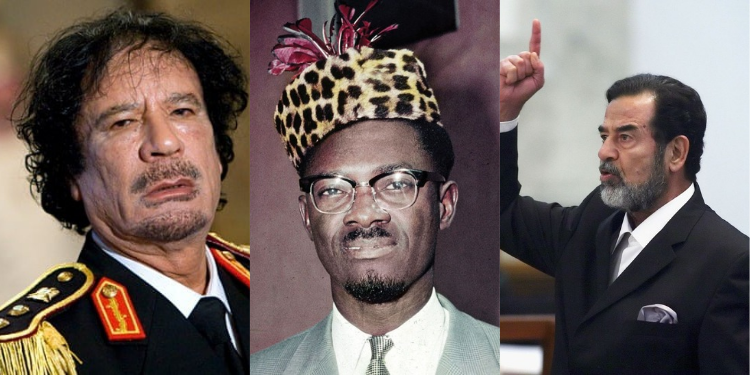
Some of the Notable President’s Overthrown From Power by The United States of America from Left Muammar Gaddafi of Libya, Center Patrice Lumumba, and Right Saddam Hussein of Afghanistan. PHOTO/ File