

‘Nyash and ‘Abeg’ Added to Oxford English Dictionary
Share


The Oxford English Dictionary has added several African words in its latest update, reflecting the growing global influence of the continent’s language, culture and cuisine.
The December 2025 update, released on the OED website on Wednesday, January 7, 2026, features more than 500 new words and phrases .
Author and OED Head of Pronunciations, Catherine Sangster, said the update marked an important development in how pronunciations are documented across different varieties of English.
“With this update we introduce a new model for the transcription of Maltese English pronunciations; this is the nineteenth World English pronunciation model in our collection. We also celebrate a decade of OED having spoken pronunciations, which were first added in December 2015,” Sangster said.
Below is a clear, item-by-item breakdown of some of the words giving their history, country/cultural origin, and meaning:
1. Abeg
Country/Cultural Origin: Nigeria (Nigerian Pidgin)
History: Derived from “I beg,” used widely in everyday speech across Nigeria for emphasis rather than literal begging.
Meaning: A polite or emphatic way to ask, plead, or soften a statement.
Example: Abeg help me.
Also Read: Kenya Set to Host Landmark Africa–France Summit
2. Afrobeats
Country/Cultural Origin: Nigeria (with Ghanaian influence)
History: Emerged in the early 2000s to describe contemporary West African pop music blending hip-hop, highlife, dancehall, and R&B.
Meaning: A genre of modern African popular music (distinct from Fela Kuti’s Afrobeat).
3. Amala
Country/Cultural Origin: Nigeria (Yoruba)
History: A traditional Yoruba meal made from yam flour, cassava, or plantain flour.
Meaning: A Nigerian swallow food usually eaten with soup such as ewedu or gbegiri.
4. Bend down (and) select
Country/Cultural Origin: Nigeria
History: Popularized in Nigerian markets and pop culture, especially in the 1990s.
Meaning: Refers to cheaply priced second-hand clothes laid out on the ground for customers to pick through.
5. Biafran
Country/Cultural Origin: Nigeria
History: Linked to the secessionist state of Biafra during the Nigerian Civil War (1967–1970).
Meaning: Relating to Biafra or people who support or identify with the Biafran cause.
6. Biko
Country/Cultural Origin: Nigeria (Igbo)
History: An Igbo expression that crossed into wider Nigerian usage.
Meaning: “Please” or “I beg,” often used for emphasis or politeness.
7. Coco
Country/Cultural Origin: Nigeria (Yoruba usage)
History: Used in Nigerian English to refer to coconut or coconut-based products.
Meaning: Coconut or something made from coconut.
8. Cocoyam
Country/Cultural Origin: Nigeria / West Africa
History: A staple crop cultivated for centuries in West Africa.
Meaning: A starchy root vegetable used in soups and traditional dishes.
9. Fufu
Country/Cultural Origin: West Africa (Nigeria, Ghana, others)
History: One of the oldest West African staple foods.
Meaning: A dough-like swallow made from cassava, yam, or plantain.
Also Read:Ruto Speaks After Casting His Vote In UDA Election
10. Ghana Must Go
Country/Cultural Origin: Nigeria / Ghana
History: Named after the 1983 expulsion of undocumented migrants from Nigeria, many of whom used checkered bags to pack belongings.
Meaning: A large, zippered plastic bag used for travel or storage.
11. Hype man
Country/Cultural Origin: Nigeria (global hip-hop roots)
History: Entered Nigerian pop culture through music and entertainment scenes.
Meaning: A performer who energizes a crowd or promotes an artist during performances.
12. Ijaw
Country/Cultural Origin: Nigeria
History: One of Nigeria’s oldest ethnic groups, located mainly in the Niger Delta.
Meaning: Relating to the Ijaw people, language, or culture.
13. Iroko
Country/Cultural Origin: Nigeria / West Africa
History: A sacred and economically valuable hardwood tree in Yoruba and Igbo traditions.
Meaning: A large tropical hardwood tree, often symbolic of strength and longevity.
14. Mammy market
Country/Cultural Origin: Nigeria
History: Originated in military barracks during colonial times.
Meaning: A market found within or near military or police barracks selling food and essentials.
15. Moi Moi
Country/Cultural Origin: Nigeria (Yoruba)
History: A traditional dish prepared for generations.
Meaning: A steamed bean pudding made from peeled beans, peppers, and spices.
16. Nyash
Country/Cultural Origin: Nigeria (urban slang)
History: Popularized through youth culture and social media.
Meaning: Slang for buttocks or a curvy backside.
17. Swallow
Country/Cultural Origin: Nigeria
History: Nigerian English term describing how certain foods are eaten.
Meaning: Any starchy food (fufu, amala, eba) eaten by swallowing rather than chewing.
18. Talk less of
Country/Cultural Origin: Nigeria
History: A direct translation influenced by local speech patterns.
Meaning: “Let alone” or “not to mention.”
Example: I can’t afford rice, talk less of chicken.
19. Trolling
Country/Cultural Origin: Global term with Nigerian digital usage
History: Adopted into Nigerian English through social media culture.
Meaning: Posting provocative or abusive messages online to annoy or upset others.
20. Wear and tear
Country/Cultural Origin: Nigerian English (broadened usage)
History: Existing English phrase with expanded everyday Nigerian usage.
Meaning: Damage or deterioration caused by continuous use over time.
Follow our WhatsApp Channel and WhatsApp Community for instant news updates
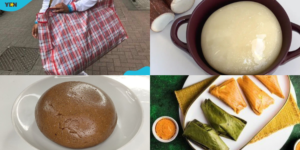
The image shows a collage of Ghana Must Go Bag, Nigerian cuisines like Amala, pounded yam and Moi Moi
Image/Pulse Nigeria/X