

Win for Kenyans as Moody’s Upgrades Kenya’s Credit Rating
Share

Global ratings agency Moody’s has upgraded Kenya’s sovereign credit rating from Caa1 to B3, providing a boost to President William Ruto’s economic agenda and signaling a marked decline in the country’s default risk.
The agency revised Kenya’s outlook to stable from positive, a move that analysts say confirms the effectiveness of recent fiscal and monetary reforms.
According to the report released on January 27, 2026, the upgrade reflects a marked strengthening of Kenya’s external liquidity.
“Moody’s Ratings (Moody’s) has today upgraded the Government of Kenya’s (Kenya) local and foreign currency long term issuer ratings and foreign currency senior unsecured debt ratings to B3 from Caa1 and changed the outlook to stable from positive,” Moody Ratings Agency stated.
It adds, “The upgrade to B3 reflects our view that Kenya’s near-term default risk has declined. External liquidity has strengthened, reflected in higher foreign-exchange reserves, a narrower current account deficit, and more stable exchange rate.”
The report further stated that the country has returned to external bond markets and used the proceeds to execute liability management operations that smooth the external maturity profile and reduce near-term refinancing risks.
Also Read: HELB Announces 32 Job Vacancies: How to Apply
RATINGS RATIONALE
The report further said Kenya’s external liquidity has significantly increased, lowering the risk of a short-term default and bolstering its ability to fulfill its external debt-service commitments over the coming years.
International reserves increased from $9.2 billion at the end of 2024 to $12.2 billion at the end of 2025, or 5.3 months’ worth of import coverage.
Increased reserves reduce external liquidity pressures and improve the sovereign’s ability to withstand shocks.
“Reserve accumulation has been supported by the central bank’s net foreign currency purchases alongside stronger foreign-exchange inflows. The current account deficit narrowed to 1.3 percent of GDP in 2024 from 5.2 percent in 2021, driven by a larger services surplus, higher remittances, and stronger goods exports,” Moody’s stated.
Cautious Optimism
Moody’s cautioned that “weak debt affordability” and high interest costs remain a constraint. The government continues to navigate a delicate balance between fiscal consolidation and social pressures.
Also Read: Eyebrows Raised as SHA Names 47 County Operations Managers [FULL LIST]
However, with GDP growth projected to hit 4.9% – 5.0% in 2026, the data suggests that the “economic stabilization” phase of the Ruto administration is yielding tangible results for the first time since the 2024 shocks.
“Recent revenue shortfalls reinforce our expectation that deficits will remain elevated in our baseline and that durable fiscal consolidation will be difficult to sustain, particularly as the 2027 election cycle approaches. We expect the fiscal deficit to remain close to 6% of GDP in our baseline, with roughly three-quarters financed domestically, implying net domestic financing above 4.5% of GDP. This is elevated by Kenya’s historical standards,” Moody’s Ratings stated.
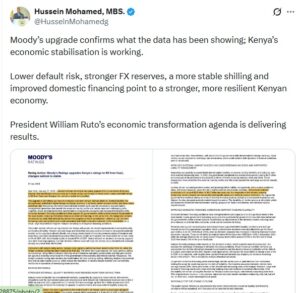
Kenya’s economic stabilisation ratings by Moody’s Global ratings agency. PHOTO/
Hussein Mohamed, MBS/X