
When the Rooster Sleeps in the Henhouse: History’s Revenge in City Hall
Share
By Dr. Luchetu Likaka – Researcher and Political Analyst
There is a Kikuyu proverb that says, “The one who laughs at a funeral will soon dig his own grave.” In Nairobi today, that proverb is walking in a suit and tie.
Yesterday’s agreement between President William Ruto and Nairobi Governor Johnson Sakaja, where key county services are once again to be implemented by the national government, is being sold as cooperation.
But Kenyans with memory know better.This is not innovation.
It is repetition and repetition in Kenyan politics is usually a tragedy disguised as reform.
We have seen this film before.The cast has changed, but the script is the same.
The Echo of NMS
When President Uhuru Kenyatta entered into a similar agreement with then-Governor Mike Sonko through the Nairobi Metropolitan Services (NMS), Senator Johnson Sakaja was among the loudest critics.
He thundered in the Senate that Nairobi had been “mortgaged.”
He accused Uhuru of strangling devolution.
He wrapped himself in the Constitution and shouted that NMS was a betrayal of county autonomy.
Sakaja was not whispering.
He was singing.
Yet when he became governor, one of his first political acts was to terminate NMS contracts and dismantle the very structure he had politically feasted on.
He framed himself as the liberator of Nairobi from “national government occupation.”
He assured residents that City Hall had returned to rightful owners.
The rooster had chased the fox from the coop.
The Return of the Same Script
Now, barely two years later, the same Sakaja is shaking hands with President Ruto over an agreement that mirrors the Uhuru-Sonko arrangement he once condemned.
Services are again drifting back to the national government.
The henhouse is again under outside management. Only the sermon has changed.
This is what the elders call “chicken coming home to rooster.”
The words used to kill others have come back to roost on the speaker.
Also Read: When Security Wears a Ballot Mask: Reading the Politics Behind NGAPU
Political Optics and 2027
And let us not pretend this is only about Sakaja.
President Ruto’s fingerprints are all over this deal.The President is a man under political pressure.
His government is bleeding popularity from taxes, housing levies, health chaos, and broken promises.
Nairobi is the political billboard of Kenya. If it looks dirty, chaotic, and ungovernable, the President’s image suffers nationally.
Ruto needs Nairobi to look functional, not because he loves devolution, but because 2027 is closer than his speeches suggest.
So the national government steps in again, not as a saviour of the Constitution, but as a mechanic of political optics.
As the Luhya say, “When the roof leaks, the owner blames the rain, not the builder.”
Sakaja will blame inherited problems.Ruto will blame inefficiency at City Hall.
But the truth is simpler: both are trying to manage political survival, not public service.
The Cost of Hypocrisy
What is tragic is not the agreement itself. What is tragic is the hypocrisy wrapped around it.
Sakaja built a Senate career opposing Uhuru’s Nairobi deal. He built a governorship brand on dismantling NMS.
Now he is reproducing the very architecture he once called unconstitutional. The same mouth that shouted “No!” is now whispering “Yes, but…”
History is not kind to political acrobats. It records the jump, not the excuse.
And Nairobians are the ones who pay for this ideological gymnastics. Water shortages, broken roads, garbage mountains, and collapsing health services are not cured by agreements signed at State House.
They are cured by competence, accountability, and political honesty, things that cannot be borrowed from the national government like a fire engine.
Also Read: Governors Must Appear Before the Public Accounts Committee: Accountability Is Not Optional
Devolution in Question
There is a Swahili saying: “Aliyekula nyama ya haramu hawezi kufunga Ramadhan kwa amani.” He who eats forbidden meat cannot fast in peace.
Sakaja cannot condemn Uhuru’s agreement and then replicate it without losing moral authority.
Ruto cannot preach devolution while centralising service delivery without exposing the contradiction.
This agreement is not a policy breakthrough. It is a political confession: that Nairobi is too important to fail and too useful to be left alone.
The rooster has finally realised why the chicken built fences. And now, both are pretending the fox is not in the compound.
Warning, Not a Blessing
In Kenyan politics, history does not repeat itself by accident. It repeats itself because leaders refuse to learn.
And when leaders refuse to learn, the people are forced to remember.
Yesterday’s agreement is not cooperation. It is déjà vu. And déjà vu in Kenyan governance is usually a warning, not a blessing.
The chicken has come home to the rooster. And the henhouse is watching.
Follow our WhatsApp channel for instant news updates

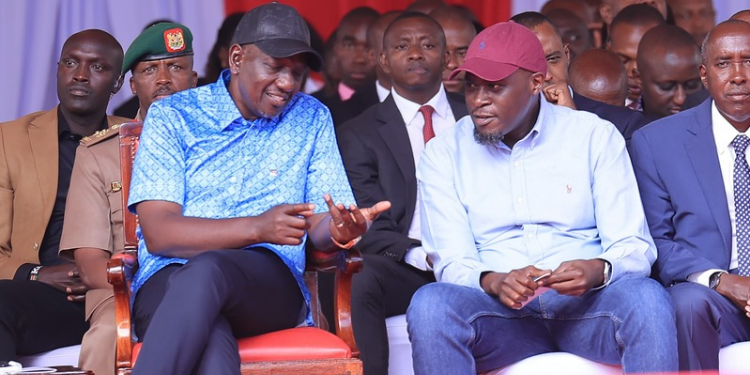
Nairobi Governor Johnson Sakaja speaking at past event. PHOTO/File