‘I Will Not Betray Nairobi’ Sakaja Dismisses Power Transfer Claims
Share
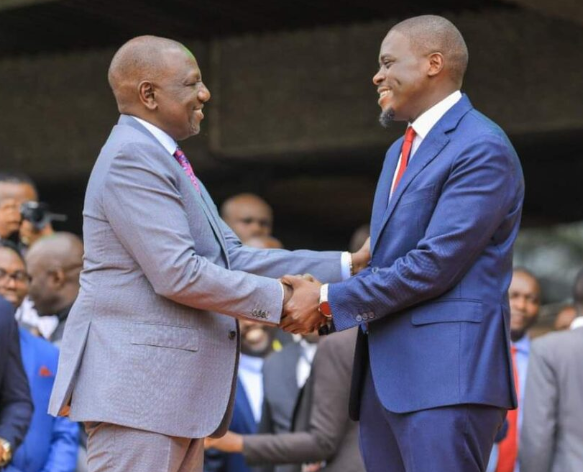
Nairobi Governor Sakaja Johnson has responded to rumors that his recent meeting with President William Ruto signaled a transfer of county functions to the National Government.
Sakaja said he would “not betray” the constitutional mandate that the city’s citizens had entrusted to him.
Sakaja referred to the claims as a “misadventure” in his State of the County Address to the Assembly, making a clear distinction between intergovernmental cooperation and the ceding of devolved powers.
He insisted that Nairobi’s essential operations would continue to be firmly under county control, even as collaboration with the National Government continued.
Blame on Nairobi Metropolitan Services (NMS)
The governor blamed the Nairobi Metropolitan Services (NMS) period for leaving the county with roughly KSh 16 billion in outstanding bills, calling it expensive, disruptive, and detrimental to employee morale.
Also Read: Why Mosquitoes Are Swarming Nairobi and Its Surroundings
According to him, the experience made it clear that devolution must be preserved while still pursuing organized collaborations that benefit locals.
“The functions bestowed upon us by the Constitution will remain county functions. We shall not transfer them. Nairobi’s position as the capital city makes intergovernmental collaboration both inevitable and necessary, but not at the expense of devolution,” Sakaja said.
Sakaja acknowledged that consistent collaboration with the National Government over the previous two years has resulted in noticeable development gains, despite his denials of concerns about a change of power.
Among the highlighted accomplishments are the building of additional classrooms as well as larger road construction and recarpeting projects throughout the city, which were partially funded by national organizations like KeRRA and KURA.
Also Read: Fire Erupts in Kibra, Nairobi County
State-of-the-art waste-processing facility
County officials claim that money has already been set aside, a contractor has been chosen, and land in Ruai has been acquired for a state-of-the-art waste-processing facility that, when fully operational, will turn garbage into energy and fertilizer.
Additional national support is also expected in urban roads, sewerage expansion, water-supply projects, and public lighting, with several stalled infrastructure projects initiated under the defunct NMS earmarked for completion through relevant national agencies.
Sakaja maintained that the cooperation model preserves Nairobi’s constitutional mandate while enabling faster delivery of large-scale projects, reiterating that partnership with the National Government is strategic but the county’s functions are not up for transfer.
Follow our WhatsApp channel for instant news updates

Nairobi City Skyline
PHOTO/Pinterest