Kenya Met Issues Update on Long Rainy Season After Heavy Rains Hit Parts of the Country
Share
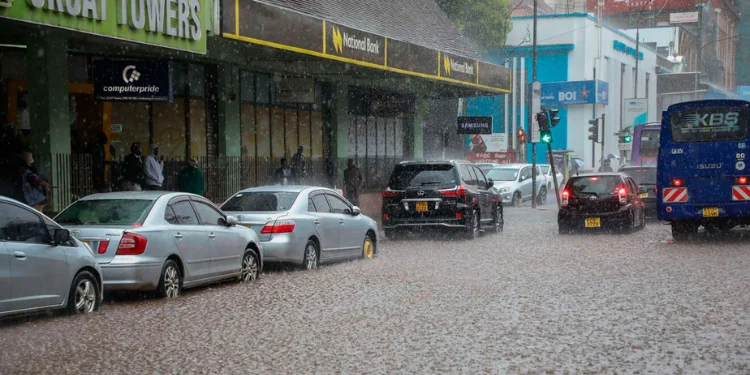
The Kenya Meteorological Department (KMD) has issued an update on the long rains season as several parts of the country are currently experiencing heavy rainfall.
In a statement dated 24 February 2026, Kenya Met Acting Director Edward Muriuki noted that the rainfall observed is likely to continue into early March and is expected to meet the onset criteria in several regions.
“Rainfall currently being experienced is likely to continue into early March 2026 and is expected to meet the onset criteria over several regions. The onset criteria is defined as the receipt of at least 20 mm of rainfall within three consecutive days, with no dry spell exceeding seven days thereafter,” read part of the statement.
Kenya Met Confirms Early Long Rains Across Key Regions
According to KMD, the March–May period constitutes the major rainfall season (Long Rains) across most parts of Kenya and much of equatorial Eastern Africa. Regions that typically receive the highest seasonal rainfall amounts (over 300 mm) include the Lake Victoria Basin, the Highlands west of the Rift Valley, the Central and South Rift Valley, the Highlands east of the Rift Valley, including Nairobi County, and the coastal strip.
The Weatherman stated that early-season rainfall is associated with favorable mesoscale and large-scale atmospheric systems, including enhanced convective activity linked to the Madden–Julian Oscillation (MJO). These systems temporarily enhance moisture convergence and rainfall amounts in several parts of the country from late February to early March.
Also Read: Kenya Met Forecasts Heavy Rainfall in Several Regions Over the Next Seven Days
However, Kenya Met has warned that rainfall in some parts of the country may reduce from mid-March, as the Madden–Julian Oscillation (MJO) transitions to less favourable phases. This shift could increase the likelihood of dry spells in certain regions.
KMD has advised stakeholders to consider this outlook alongside its 24-hour, 5-day, 7-day, monthly, and special forecasts, as well as updates and advisories issued by County Meteorological Offices. Farmers are encouraged to consult Agricultural Extension Officers to guide their planning and agricultural activities.
According to KMD, the March–May (MAM) 2026 Long Rains have already begun in western, central, and highland regions, including Nairobi, from mid-February. The southeastern lowlands and south coast experienced the onset in the fourth week of February.
Weather Forecast for Northwestern and Northeastern Regions
Meanwhile, northwestern and northeastern regions are expected to see the rains between late March and early April, with the north coast likely experiencing a delayed onset in mid-April despite occasional early-season rainfall.
Also Read: Kenya Met Issues 24-Hour Heavy Rain Warning for Nairobi and Surrounding Areas
The expected onset dates for the various counties are outlined in the table below:
| Region | Onset Dates |
| Counties in Highlands West of the Rift Valley, Lake Victoria Basin, Central, and South Rift Valley: (Bungoma, Trans Nzoia, Uasin Gishu, West Pokot, Elgeyo-Marakwet, Nandi, Kakamega, Vihiga, Bomet, Kericho, Kisii, Nyamira, Homa Bay, Migori, Kisumu and Busia, Baringo, Nakuru, Western Laikipia and Narok). | Onset criteria met in mid-February |
| Highlands East of the Rift Valley including Nairobi County: (Nyeri, Kirinyaga, Murang’a, Embu, Meru, Kiambu, Nyandarua, Nairobi and Eastern Laikipia) | Onset criteria met in mid-February |
| Southeastern Lowlands: (Kajiado, Kitui, Makueni, Machakos, Tana River and Taita Taveta) | Onset criteria met in the fourth week of February but a slight reduction is expected from mid-March to 1st week of April |
| North Coast: (Lamu, Malindi, Coastal parts of Tana River, and Kilifi) | 4th week of March to 1st week of April (Intermittent rainfall in Feb/March) |
| South Coast: (Mombasa, Kwale) | Onset criteria met in the fourth week of February but a slight reduction is expected from mid-March to 1st week of April |
| The Northwest: (Turkana, Samburu) | 1st to 2nd week April (Intermittent rainfall in Feb/early March) |
| The Northeastern (Wajir, Isiolo, Garissa, Mandera and Marsabit) | 1st to 2nd week April (Intermittent rainfall in Feb/early March) |
KMD further stated that regular updates on seasonal performance and key climate drivers, including the Madden–Julian Oscillation and tropical cyclones, will be provided. These updates will offer detailed insights into evolving rainfall patterns, helping stakeholders make timely and informed decisions.
Follow our WhatsApp channel for instant news updates

KMD Director Edward Muriuki speaking during the opening of the 72nd Greater Horn of Africa Climate Outlook Forum (GHACOF 72) in Nairobi on Monday, January 26, 2026. PHOTO/IGAD X