Sakaja Reveals How He Will Stop Nairobi From Flooding
Share

Johnson Sakaja has admitted that Nairobi’s drainage system is overwhelmed by the intensity of current rains, warning that the city’s persistent flooding has no quick fix after decades of neglected infrastructure.
Speaking during an interview on Citizen Sunday Live, the governor said the drainage network was built for a much smaller city and far lower rainfall levels than Nairobi now experiences.
“The drainage that we have is not built for this amount of rain… The capital city cannot be organised based on the share of revenue that it gets, like other counties,” Sakaja said.
He noted that Nairobi’s flooding crisis stems from rapid urban growth, outdated planning systems, and years of underinvestment in critical infrastructure.
Nairobi Facing Generational Infrastructure Deficit
According to Sakaja, the county government is currently trying to catch up after years of underinvestment in infrastructure.
“There is no quick fix for this city; it is not possible… We are dealing with a generational infrastructure deficit, drainage built for 500,000 people, planning and development control for a smaller city than we have today,” he said.
Also Read:10 Buildings You Should Take Shelter in When Nairobi CBD Floods
The governor noted that most of the work being done by the county government involves repairing and expanding infrastructure that was built decades ago when Nairobi’s population was far smaller.
County Needs Ksh 60 Billion Annually
Sakaja said the capital requires far more funding than it currently receives to function properly.
According to him, Nairobi needs at least Ksh 60 billion every year to effectively run the city and address infrastructure gaps.
“You must have a collaborative effort for the city; there is no other formula,” he said.
He added that there is a legal provision that allows Nairobi to access additional funding, but it has remained unused for nearly 13 years.
The governor also revealed that his administration has secured a major cooperation agreement with the national government aimed at improving infrastructure and addressing flooding.
“I have understood the problem, I know it, and we have found the solutions; we’ve gotten our framework to implement it.”
“We have gotten a deal that no other leader in this county has ever gotten for the people of Nairobi, which is the Ksh 80 billion cooperation agreement, and the results will be visible,” Sakaja said.
He said the partnership will support improvements in roads, drainage systems and waterways, some of which fall under the national government’s mandate.
Expansion of Drainage System Planned
Sakaja also revealed that the county plans to expand drainage channels in flood-prone areas to reduce the frequency of flooding.
According to him, the drainage infrastructure needs to be widened significantly.
He said the expansion could increase the capacity of drainage systems from 0.6 to about 1.2, allowing them to carry more stormwater during heavy rains.
The governor warned that buildings constructed near rivers and waterways will also have to be removed.
He said those who have built close to rivers will be forced to relocate to allow proper drainage expansion.
Residents Also Responsible for Flooding
While acknowledging the city’s infrastructure challenges, Sakaja said poor waste disposal by residents also contributes significantly to flooding.
“Who dumps in those drains? Who is littering in those drains? We have provided bins. There is a responsibility all of us must bear,” he said.
He urged residents to stop littering and participate in community clean-up exercises organised by the county.
“You will see someone in a very big car, throwing banana peels outside, and then you will say Sakaja… When we do clean-ups in the area, come out and join us. It is our environment, and it will affect you personally when you don’t do it,” he added.
Evictions Along Riparian Land to Continue
The governor defended the county’s actions in removing structures built along rivers and in flood-prone zones, saying such measures are necessary to protect lives and improve drainage.
Also Read:Kenya Met Issues Fresh Update as Heavy Rains Continue Nationwide
He criticised some politicians for allegedly politicising evacuation efforts and encouraging residents to remain in dangerous areas.
“My friends in Grogan were really affected, but they know they were supposed to move… I’ve seen politicians politicising these, yet they are the same ones… telling people not to move when they need to move,” Sakaja said.
Governor Vows to Act Despite Political Pressure
Sakaja insisted that his administration will continue implementing necessary measures to address Nairobi’s flooding problem regardless of political backlash.
“Leadership is to provide solutions; it is not about blaming,” he said.
“I will just close my ears and do what must be done for this city; I do not care about the political ramifications. What must be done will be done.”
He also sent condolences to families affected by flooding, noting that some parts of Nairobi were historically built on swampy land, which continues to complicate drainage and infrastructure planning.
Follow our WhatsApp channel for Instant News Updates
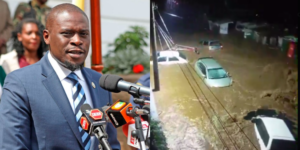
Collage photo of Nairobi Governor Johnson Sakaja and a section of Nairobi affected by floods. PHOTO/Sakaja/The Alpha House