

Commission Reveals Causes of Tanzania 2025 Protests,Blames Opposition and Says Suluhu’s Election Was Not a Factor
Share
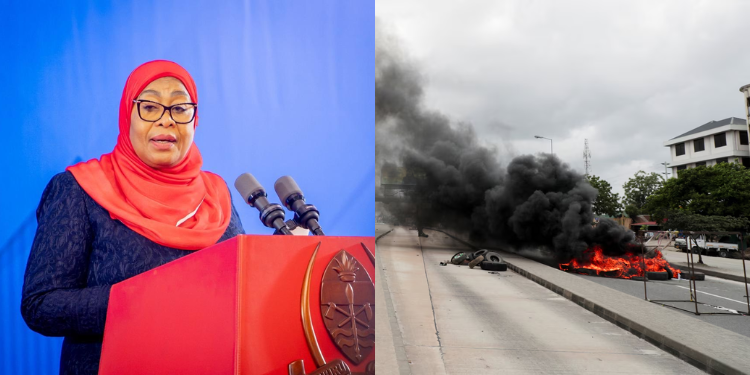
The Commission of Inquiry into the 2025 Tanzania protests has concluded that the violent demonstrations during and after Tanzania’s October 2025 General Election were highly orchestrated and well-funded, while stopping short of identifying those directly responsible for the deaths recorded.
In a report, the Commission’s Chairperson, Retired Justice Mohamed Chande Othman, did not cite the re-election of President Samia Suluhu as one of the causes of the unrest.
“The report found that the violent demonstrations at last year’s elections were highly orchestrated and well-funded. We still do not know who was behind all the deaths,” the findings state.
The commission, however, pointed to opposition figures as playing a key role in escalating tensions.
“We saw that opposition leaders were whipping citizens up into a frenzy,” the report adds.
Tanzania Protests Declared Unlawful
According to the findings, the demonstrations did not meet the threshold of peaceful or lawful protest, justifying the government’s response.
“These protests were found to be neither peaceful nor lawful. Government had to act in the interests of public safety and national security,” the report notes.
The Commission explained that it was not conducting a criminal investigation but said the government will ensure that those who carried out the violence face the full force of the law.
“Government will make sure those who carried out violence face the full force of the law.”
Also Read: DCI Nets Tanzanian Suspect in Murder of Kisauni Schoolgirl After Month-Long Search
Commission Identifies Five Root Causes
The Commission reviewed 31 issues raised by witnesses and narrowed them down to five major underlying causes of the unrest.
- Political Grievances
Key concerns included demands for a new constitution, electoral reforms, and internal party disputes.
- Economic Pressures
Citizens cited the high cost of living, unemployment, unequal access to opportunities, and an unfavorable business environment marked by multiple taxes and levies.
- Social Challenges
The report highlights “the erosion of morals and the decline of patriotism” alongside unresolved grievances such as corruption, embezzlement, and alleged abductions.
Police data presented to the Commission revealed that between 2023 and 2025, a total of 758 people were reported missing, abducted, or staged their disappearance.
Of these, 245 remain unaccounted for.
“These figures reflect the complaints raised by citizens concerning abductions and disappearances,” the report states.
- Public Sector Failures
The Commission faulted local government authorities for failing to address citizen grievances effectively and for weak implementation of previous recommendations.
- International Influence
It also cited global geopolitical dynamics, noting that foreign interests in resource-rich developing nations may contribute to internal instability.
Triggering Factors and Key Catalysts
Beyond root causes, the Commission identified eight triggering factors that ignited the violence, grouped into three main categories.
- Social Media Mobilisation
Social media played a central role in organising and amplifying unrest on an unprecedented scale.
“Social media was used to organise discussion forums, devise strategies, and direct those who had agreed to participate in the violence,” the report states.
Some participants admitted to being equipped with devices to document and spread provocative content.
“They had been given special mobile phones and all those photographs and videos were then uploaded directly to social media in order to provoke public anger.”
Also Read: Auditor-General Exposes Ksh 30 Billion Eurobond Breach as Government Defaults on Security Loans
- Political Slogans and Incitement
Statements by politicians reportedly evolved into rallying slogans used during the protests. These included:
- “No Reforms, No Election”
- “In October, we take to the streets.”
- “Samia Must Go”
- “We are determined that the election will not take place.”
- “This Government has lost the legitimacy to govern the country.”
The Commission noted that such messaging intensified public sentiment and encouraged participation in unrest.
- Internal Party Disputes
The report also links the violence to frustrations among aspiring political candidates whose nominations were rejected within party structures.
These individuals allegedly saw the unrest as an opportunity to push for internal reforms and mobilised supporters behind the scenes.
Follow our WhatsApp channel for instant news updates
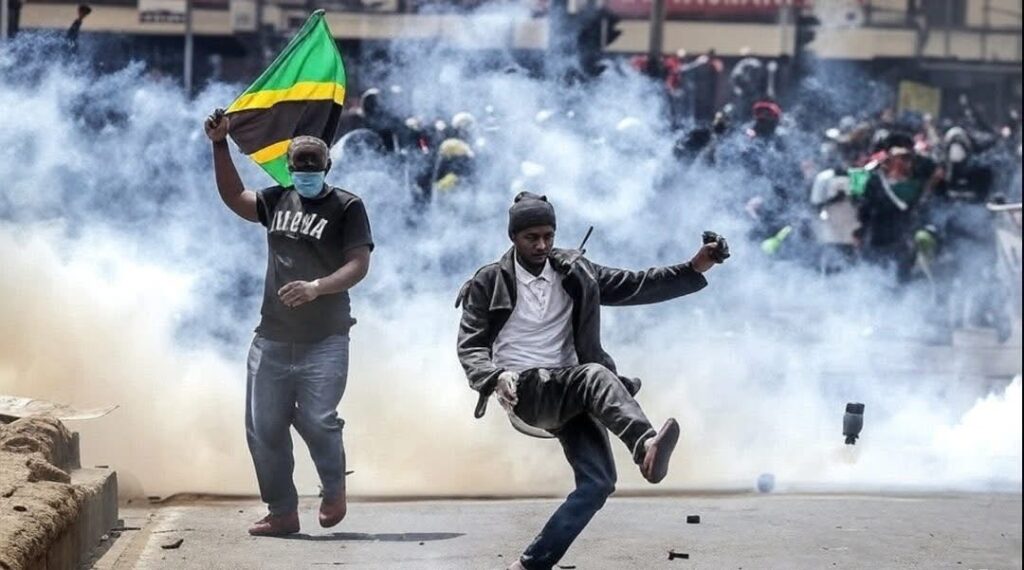
A picture captured during demo’s in Tanzania following the presidential elections. Image/BBC/X


