

Macron and Ruto Unveil Africa Forward 2026 Summit Declaration
Share

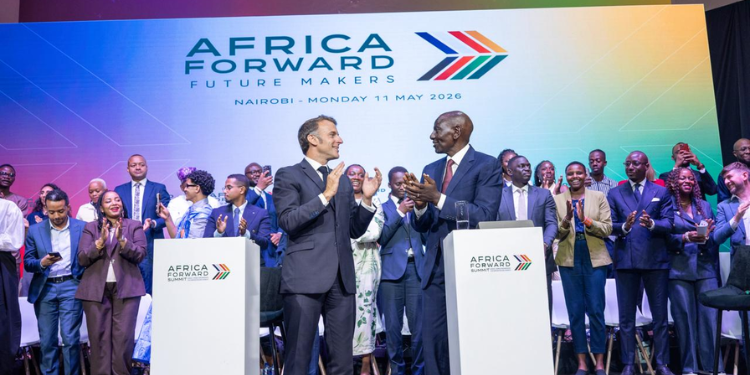
French President Emmanuel Macron and Kenyan President William Ruto on Tuesday, May 12, unveiled the Africa Forward 2026 Summit Declaration at the close of the two-day Africa Forward Summit held in Nairobi from May 11 to May 12, 2026.
The declaration, adopted under the theme “Africa-France Partnership for Growth and Innovation,” outlines a new framework for cooperation between African nations and France focusing on peace and security, agriculture, healthcare, green industrialisation, digital transformation, trade, infrastructure, and reforms in the global financial system.
The summit brought together African leaders, policymakers, investors, development partners, and private sector players, with leaders pledging to build partnerships based on mutual respect, co-development, innovation, and sustainable economic growth.
Below is the Africa Forward 2026 Summit Declaration adopted at the close of the summit.
THE AFRICA FORWARD 2026 SUMMIT DECLARATION
‘Africa Forward: Africa-France Partnership for Growth and Innovation’
12th May, 2026
Preamble
We, the representatives of African nations and representatives of the French Republic, convened at the Africa Forward Summit on 12th May, 2026;
Recognising the profound transformations shaping the global economic, technological, environmental and geopolitical landscape;
Affirming our shared commitment to a peaceful and fair, rules-based international order grounded in the principles of the United Nations Charter;
Affirming our shared commitment to sustainable development, inclusive growth and resilient economies and societies;
Acknowledging Africa’s immense potential as a driver of global growth, innovation and prosperity;
And reaffirming the importance of partnerships grounded in mutual respect, shared responsibility and co-development;
Hereby adopt this Declaration as a framework for a strengthened Africa-France partnership to advance inclusive growth and innovation.
1. Strengthening Peace, Security and Strategic Autonomy
We acknowledge the evolving global security environment, its implications for Africa and the mutually reinforcing links between peace, security and sustainable development.
i. Affirm the principles and objectives of the African Union Constitutive Act, which underscore the promotion of unity, peace, security, good governance, open and democratic elections, and cooperation among Member States.
ii. Support African-led solutions to peace and security through the African Union’s Peace and Security Architecture (APSA), implementation of UN Security Council Resolution 2719 for enhanced partnership between the United Nations and the African Union, including planning and decision-making processes and predictable and sustainable financing of AU-led operations.
iii. Identifying avenues for renewed cooperation to respond to emerging and transnational threats including terrorism, transnational organised crime, cyber threats, illicit flows, arms trafficking, smuggling of migrants, and traffic in illegal drugs.
iv. Strengthen Africa’s strategic autonomy, resilience and collective security capacities amid changing global power dynamics.
V. Advance dialogue on addressing geopolitical fragmentation, economic volatility and weakening multilateral consensus, which has implications on African peace and security dynamics.
vi. Strengthen institutional capacity and collective security mechanisms in addressing ongoing conflicts in the Horn of Africa, Great Lakes region, and the Sahel region through the cessation of hostilities, inclusive dialogue, counter-terrorism capacity-building and regional stabilisation.
vii. Link security with inclusive economic growth, youth empowerment, education, climate resilience and diaspora engagement.
viii. Support a comprehensive reform of the UN Security Council to make it more effective and representative, in line with the objectives of the Common African Position, in particular the Ezulwini Consensus and Sirte Declaration for equitable African representation.
2. Advancing Sustainable and Value-Added Agriculture
We affirm the need for the transformation of agriculture into a modern, competitive, and climate-resilient sector.
We commit to:
i. Promote productive, sustainable and resilient agriculture and food systems, including agro-industrialization and development of integrated value chains, in particular in sectors that offer opportunities for scale.
ii. Encourage agricultural and livestock systems that enhance nutrition while integrating the One Health approach to safeguard human, animal, and ecosystem health.
iii. Strengthen food systems, livestock productivity and rural economies, and secure sustainable fertilizer supply chain.
iv. Invest in agricultural research, innovation, and climate-smart practices including agroecology, agroforestry, locally adapted quality seeds, integrated soil health management, and digital tools while fostering joint research and development partnerships with French institutions.
V. Strengthen agricultural technical and higher education to better integrate youth into the local labour market.
vi. Promote the structuring of agricultural value chains, including agro-processing, cold chains, logistics, and domestic, regional, and international trade under the African Continental Free Trade Area (AfCFTA), to transform agriculture from raw commodity exports into a driver of industrialisation, value addition, and economic sovereignty.
vii. Empower youth, women and smallholders through finance, land tenure, digital tools in precision agriculture and agri-fintech as well as innovation incubators and skills development.
viii. Strengthen food security and nutrition, promote healthy diets for all and stimulate rural-urban economic linkages.
ix. Strengthen the resilience of agriculture and food systems through a holistic and systemic approach that addresses climate, environmental, economic, sanitary standards, and geopolitical challenges.
Χ. Support in that regard the operationalisation of the Africa Fertiliser and Soil Health Action Plan 2024-2034, both in terms of technical expertise and, capacity-building.
xi. Mobilise public-private investment and public-private partnerships for agro-industrial parks and competitive value chains.
3. Building Resilient Health Systems
We recognise the importance of strong health systems in ensuring human security and development while advancing health sovereignty by strengthening Africa’s capacity to protect the health of its populations and mobilizing sustainable investment in resilient health systems.
We commit to:
i. Advance Universal Health Coverage (UHC) and resilient, people-centred health systems through strengthened primary health care, equitable access and reduced financial hardship.
ii. Enhance pandemic prevention, preparedness, laboratory/genomic capacity and One Health approaches. surveillance,
iii. Collaborate on the climate and health nexus in relevant international forums and advance the << One Health & Beyond >> initiative by positioning health as a driver of climate action and systemic resilience, integrating One Health into Nationally Determined Contributions (NDCs) and National Adaptation Plans (NAPS).
iv. Accelerate regional production of vaccines, medicines, diagnostics and medical technologies through strategic partnerships guided by frameworks championed by Africa Centres for Disease Control and Prevention, African Medicines Agency, and African Continental Free Trade Area.
V. Support and participate in the African Pooled Procurement Mechanism (APPM) as a strategic instrument to leverage collective purchasing power, expand affordable and equitable access to life-saving health products, and strengthen sustainable market opportunities for African manufacturers.
vi. Strengthen and harmonize regulatory frameworks to ensure the quality, safety, and efficacy of health products across Africa.
vii. Promote equitable access to advanced technologies and supporting innovation within African institutions
viii. Attract coordinated domestic and international financing, aligned with countries’ needs and priorities to ensure resilient health systems, long-term impact and, ultimately, health sovereignty.
ix. Invest in workforce development, training, and professional development to build a skilled and responsive health workforce, while promoting ethical recruitment, digital health with data protection, and climate-resilient health infrastructure.
X. Build health sovereignty via regional manufacturing, technology transfer, regulatory harmonization and resilient supply chains.
xi. Promote joint research, innovation and equitable global health cooperation guided by the African Union, Africa Centre for Disease Control and Prevention (Africa CDC) and the World Health Organization (WHO).
4. Powering Growth Through Green Industrialisation and Energy Transition
We affirm that access to reliable, affordable, and sustainable energy is essential for development and delivering Africa’s long-term developmental agenda through inclusive growth, job and wealth creation.
We commit to:
i.Promote green industrialisation through investment in renewable energy, low-carbon systems, green and low-carbon hydrogen and flagship clean energy projects such as hydropower, geothermal, waste-to-energy and nuclear power.
ii. Collaborate to strengthen energy security and sovereignty, notably by capitalising on Africa’s unique renewable energy potential, and by supporting the development of local value chains for clean energy products.
iii. Expand access to clean energy including clean cooking and establish interconnected energy markets.
iv. Encourage electrification of end-use in all relevant sectors as a way to implement the green transition.
v. Facilitate technology transfer of green technologies on fair and mutually beneficial terms, remove barriers to local manufacturing and support workforce development for green jobs.
vi. Strengthen national grids and regional interconnectivity.
vii. Respect national sovereignty over natural resources, including critical minerals, promote local beneficiation, value addition and sustainable processing of Africa’s critical minerals to support industrialisation, economic diversification and resilient regional value chains.
viii. Strengthen regional value chains through continental integration and “Made in Africa” production, while advancing secure, sustainable, and reliable access to strategic technologies and resources.
ix. Prioritise renewable and low-carbon energy for productive use, including irrigation, cold storage, agro-processing and fertiliser production to reduce costs and carbon emissions.
x. Leverage diversified partnerships and country-led platforms such as Africa Green Industrialisation Initiative (AGII) and Accelerated Partnerships for Renewables in Africa (APRA) for coordinated action and long-term financing.
xi. Advance just and fair climate and sustainable development financing with greater African voice in global decision-making, governance, standard-setting, and rule-making.
xii. Support the Paris Agreement and a science-based policy approach, and work together to implement the outcomes of the first global Stocktake to advance a just energy transition, while cognizant of the shared principles and objectives contained in the African Union’s African Union Climate Change and Resilient Development Strategy and Action Plan (2022–2032).
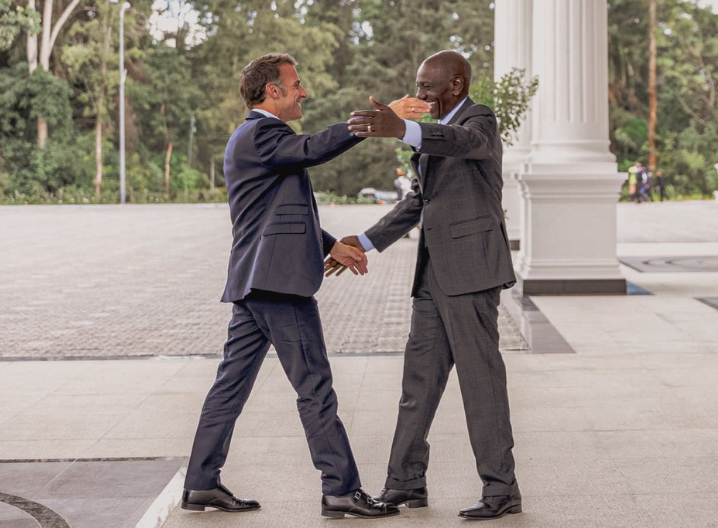
French President Emmanuel Macron has arrived at State House, Nairobi, for the Africa Forward Summit and was welcomed by President William Ruto. PHOTO/PCS.
5. Unlocking the Blue Economy We recognize the Blue Economy as a strategic frontier for growth, jobs and sustainability.
We commit to:
i. A sustainable blue economy grounded in maritime sovereignty, climate resilience, economic transformation, and inclusive prosperity, recognising the ocean as strategic for food security, biodiversity, secure trade corridors, the maritime energy transition, and climate stability.
ii. Recall the historical Africa-France partnership in maritime security, trade, and capacity building, and commit to evolving it into a forward-looking framework of reciprocity, co-investment, and shared value.
iii. Recall further the Africa Blue Economy Strategy, AIMS 2050, Agenda 2063, the Lomé Charter, and France’s National Strategy for the Sea and Coast, we commit to African-led maritime cooperation in conformity with UNCLOS, including the Agreement on Marine Biological Diversity of Areas Beyond National Jurisdiction.
iv. Affirm that cooperation shall respect national sovereignty, international law, and sovereign rights over marine resources, remaining African-led, development-oriented, and anchored in civilian maritime governance, while generating mutual economic, technological, and strategic value.
v. Co-securing the maritime commons through strengthened domain awareness and joint, non-militarised action against piracy, trafficking, and illegal, unreported and unregulated fishing, safeguarding sea lanes, critical infrastructure, and trade stability, and encourage ratification of the Agreement on Port State Measures and the WTO Agreement on Fisheries Subsidies.
vi. Ensure the timely adoption of the IMO Net Zero Framework through established processes, ensuring a just global shipping transition that strengthens Africa’s trade competitiveness, food security, industrialisation, and participation in global maritime value chains, aligned with the Paris Agreement and the principles of equity and common but differentiated responsibilities, with targeted finance and technology transfer.
vii. Welcome investment commitments in maritime and coastal economies, renewable energy, low-carbon maritime solutions, and the conservation, restoration, and sustainable management of blue carbon ecosystems, through strengthened regulatory frameworks, development partnerships, and access to finance and technology.
viii. Recognise climate change and rising sea levels, we urge long-term national strategies grounded in science and nature-based solutions, welcome the Blue NDC Challenge, and call for mobilisation enabling coastal communities to lead responses to the climate crisis.
ix. Affirm that cooperation shall promote a just and equitable ocean transition with affordable, predictable access to finance and technology, recognising differentiated capacities and national ownership of maritime data, regulatory systems, and strategic infrastructure.
x. Call on relevant Ministers and competent authorities to identify, prioritise, and advance cooperation under this Declaration, in accordance with national priorities and applicable legal frameworks.
xi. Establish structured cooperation that strengthens maritime sovereignty, secures resilient trade corridors, accelerates the low-carbon transition, safeguards blue carbon ecosystems, and sustains the ocean as a source of shared prosperity for present and future generations.
6. Harnessing Digital Transformation and Artificial Intelligence
We recognise that digital transformation and artificial intelligence are reshaping economies, public services, knowledge systems, security, creative industries, and global competitiveness.
We further recognise that Africa’s participation in the AI age requires investment across the full digital and AI stack, in line with the African Union Continental Artificial Intelligence Strategy, the AU Data Policy Framework, the AfCFTA Digital Trade Protocol, and Africa’s broader digital transformation agenda.
We commit to:
i. Advance inclusive digital transformation and responsible, safe, secure, trustworthy, and rights-respecting AI, guided by African and international frameworks, with particular attention to human rights, the protection of children and minors, cultural diversity, multilingualism, gender equality, environmental sustainability, and the protection of vulnerable groups.
ii. Close digital divides, including for women, youth, rural communities, persons with disabilities, and underserved populations.
iii. Mobilise public and private investment in resilient digital infrastructure and AI infrastructure, including broadband connectivity, regional data centers, cloud and compute capacity, clean energy and trusted data systems.
iv. Strengthen digital sovereignty and strategic autonomy by supporting Africanled ownership, hosting, processing, and value creation from data and AI systems, while promoting interoperability, open standards, open-source infrastructure, and voluntary technology transfer.
v. Support African language models, local datasets, benchmarks, and openweight AI systems.
vi. Deepen skills development, research collaboration, and innovation ecosystems.
vii. Promote co-investment, co-production, and co-governance among African and French firms, institutions, investors, and innovators.
viii. Advance ethical and pro-innovation AI governance by building on the Paris AI Action Summit of 2025, the AU Continental AI Strategy, the UN Global Digital Compact, and subsequent Africa Forward commitments.
ix. Strengthen digital trade, cross-border interoperability, and trusted data flows under the AfCFTA Digital Trade Protocol, including start-up expansion, and market access for African digital and AI-enabled enterprises.
x. Promote the responsible use of digital technologies and artificial intelligence in the creative economy, while protecting African creative intellectual property,
xi. Strengthen international cooperation to address frontier and socio-technical risks arising from digital technologies and AI, including misinformation, disinformation, online manipulation, AI-generated abuse, cyber-enabled harms.
xii. Promote digital and AI pathways that support a third path for Africa: one grounded in strategic autonomy, reduced dependence on concentrated technological power, transparent and rights-respecting technologies, sustainable infrastructure, and shared capacity to shape the global rules of the AI age.
7. Reforms in the International Financial Architecture
We recognise that the international financial architecture must evolve to reflect contemporary global realities and align with the Sustainable Development Goals (SDGs). We commit to:
i. Work constructively towards an adequate realignment of the International Monetary Fund’s (IMF) quota shares in favor of the most underrepresented countries, to better reflect member’s relative positions in the world economy, which should reduce representation gaps, while protecting the quota shares of the poorest members, including Africa, and support efforts from countries to access concessional finance under the IMF’s Poverty reduction and growth trust and Resilience and sustainability trust.
ii. Secure Africa’s enhanced representation on the IMF’s Executive Board, including the 25th Chair created in November 2024 in favor of SubSaharan Africa.
iii. Ensure that international financing flows to the continent align with Africa’s priorities under Agenda 2063, the Sustainable Development Goals (SDGs) and commitments to support sustainable industrialization, infrastructure and green transitions.
iv. Contribute to mobilizing all forms of development finance, international and domestic, public and private, and work towards efficient and targeted use of concessional resources, while safeguarding their availability to countries with the greatest needs.
v. Ensure the availability of concessional funding for developing countries through the International Development Association (IDA)
vi. Continue to improve the global debt architecture including by stepping up the implementation of the Common Framework between G20 and Paris Club in a predictable, timely, orderly and coordinated manner.
Also Read: All You Need to Know About the Africa Forward Summit 2026
vii. Deploy the SDG Stimulus with the view to promote long-term debt at lower interest rates. viii. Enhance implementation of the Addis Ababa Action Agenda and of the main outcomes of the Sevilla Financing for Development Conference.
ix. Engage constructively in ongoing international discussions, to promote a fair and inclusive global tax system, aimed at addressing tax evasion, profit shifting, and illicit financial flows.
8. Investing in People, Skills, and Innovation We recognize Africa’s youth as a strategic asset.
We commit to:
i. Expand education, training and skills development.
ii. Support innovation eco-systems and entrepreneurship.
iii. Promote knowledge exchange and institutional partnerships.
We affirm that human capital is the foundation of sustainable transformation.
9. Strengthening Infrastructure, Trade and Regional Integration
We reaffirm the importance of infrastructure as a driver of competitiveness and growth.
We commit to:
i. Invest in transport, energy and digital infrastructure.
ii. Support the implementation of the African Continental Free Trade Area (AfCFTA).
iii. Enhance regional value chains and market integration.
We recognise that connectivity is key to unlocking Africa’s full potential.
10. Mobilising Resources for Transformation
We acknowledge that achieving these ambitions requires significant and sustained investment. We commit to:
i. Promote blended finance and public-private partnerships.
ii. Support innovative financing mechanisms and risk-sharing instruments to mobilize more local and international private resources.
iii. Align investments with climate and development priorities on scalable, bankable and impactful projects to deliver tangible results and long-term impact.
iv. Support efforts to strengthen public domestic resource mobilization and public financial management as they are key to macroeconomic stability and the creation of ecosystems conducive to economic development.
11. A Shared Vision for Transformation
We affirm that Africa’s future lies in building productive capacity, advancing industrialisation, and fostering innovation-driven growth.
We commit to supporting a transition from extractive economic models toward value addition, manufacturing and sustainable production systems.
We recognise Africa not only as a market of the future, but as a partner in production, innovation and global economic leadership.
Call to Action
We adopt this Declaration as a shared roadmap for action. We call upon governments, the private sector, development partners and civil society to work together in advancing this vision.
Together, we will build a future defined by sustainable growth, resilience and shared prosperity.
Adopted in Nairobi, Republic of Kenya, this 12th day of May, 2026
Follow our WhatsApp channel for instant news updates
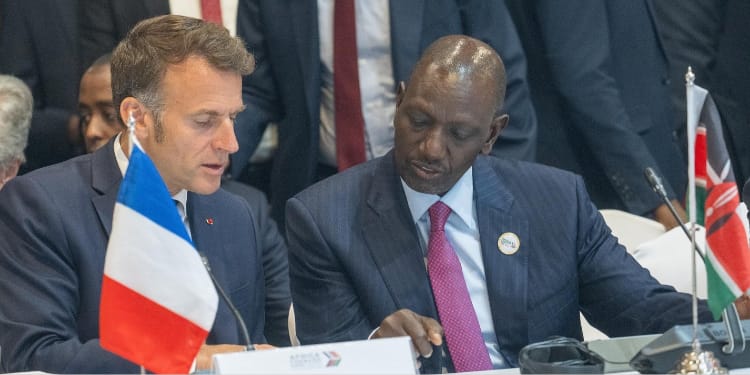
President of Kenya William Ruto with French President Emmanuel Macron. PHOTO/PCS.