
Ruto Sends 5 Key Points to African Leaders
Share
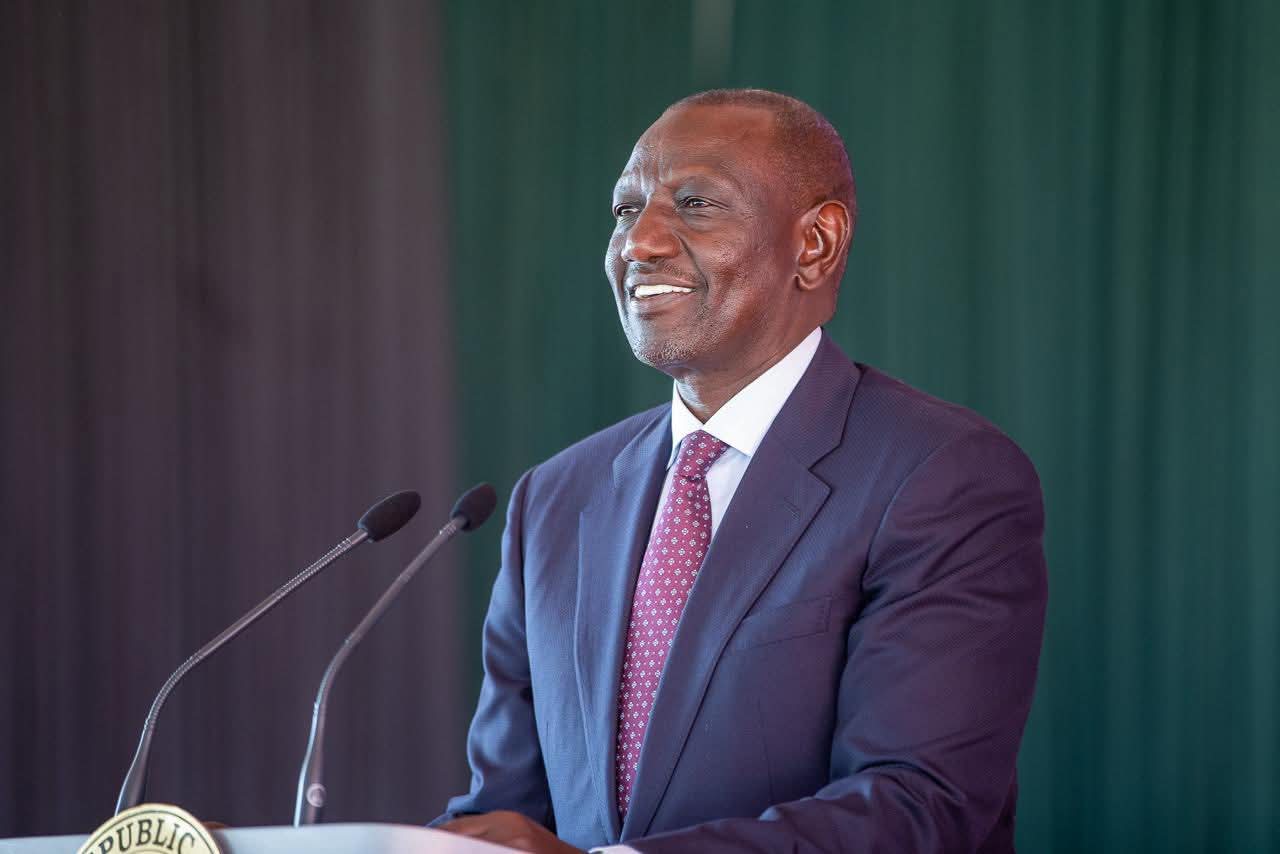
President William Ruto has sent five critical points to all African leaders during his speech at the 7th AU-EU Summit in Luanda, Angola.
Here is the full speech:
1. The 7th AU-EU Summit here in Luanda is like no other before. We meet at a time when the world is turning a great page. Power is shifting, certainties are fading, and new voices are rising.
2 .The world is no longer unipolar, nor even bipolar. It is multipolar, and therefore more complex, more contested, and more connected than ever before.
3. We are here today with great optimism that, despite the wounds of history, Africa stands not at the periphery of the future, but at its very centre. As a result, Africa and Europe must decide not how to revisit the past, but how to reinvent the future.
4. For too long, our partnership has been spoken of in the language of charity and conditionality. Yet charity will not solve Africa’s challenges. We come to this Summit not with empty hands, but with open ones offering partnership, innovation, and opportunity.
Because our destinies are intertwined, we come as equals. Yes, we remember the past. But we are not prisoners of it. We are architects and builders of the future.
5. Across Africa today, young people are driving a quiet revolution. Coding apps in Nairobi, building solar panels in Dakar, experimenting with digital agriculture in Kampala. They are not waiting for permission. They are leading. And they are watching us today, wondering whether the partnership between Africa and Europe will rise to meet their ambitions or fall back into the comfort of old stereotypes
6. My friends, we better not disappoint them.
7. Our continents are bound by geography and destiny. Europe faces a demographic winter; Africa is in the bloom of youth. Europe holds enormous capital, modern technology, and mature institutions; Africa holds immense natural resources, restless youthful energy and a large and growing market.
8. Each has what the other needs. Together, we are not two continents facing each other. We are two halves of a single horizon. So let this Summit in Luanda be remembered not for prevarication, but for decisions.
9. First, let us shore up multilateralism. We are entering an era where great powers are once again drawing lines across the world. But Africa and Europe both know the cost of division. We have no interest in returning to a zero-sum game of global rivalry.
10. We must stand shoulder to shoulder for a rules-based international order that treats every nation with dignity. We must reform the United Nations Security Council to reflect the world as it is. Not as it was in 1945.
11. And we must defend the principle that dialogue, not domination, must govern our shared future. Let us be the voices that say to the world: cooperation is not weakness, and solidarity is not naïvet.
12. Second, we must deepen regional economic integration, beginning with the African Continental Free Trade Area. This is the largest economic integration project since the creation of the European Union itself.
13. A single market of 1.4 billion Africans offers immense opportunities not only for us, but for our partners in Europe. Europe should see AfCFTA not as competition, but as collaboration.
14. As African nations trade more with each other, they will also trade more and better with Europe. We welcome European investment that adds value on African soil, that builds industries, not dependencies.
15. Let us move away from extractive partnerships to productive partnerships, from exporting raw materials to exporting innovation and products.
16. Third, we must act together on climate adaptation urgently and justly. Africa contributes less than 4% of global emissions, yet we pay the highest price.
17. Let us make climate finance accessible, predictable, and fair. A partnership that invests in Africa’s climate resilience is not a gift to Africa. It is an investment in both Africa’s and Europe’s own security and in humanity’s survival.
18. Fourth, we must reimagine migration as a bridge of dignity. Our youth are crossing deserts and seas not because they love danger, but because they seek opportunity. The challenge is not migration itself; it is despair. Let us create legal pathways for skilled and unskilled labour alike.
19. Let us recognise qualifications across borders, establish circular migration frameworks, and protect the rights of migrants wherever they go. A nurse from Ghana working in London, a Kenyan software engineer in Bonn, a Moroccan engineer in Lisbon, a Malawian software developer in Tallinn. These are not stories of loss. They are threads of shared prosperity. Migration should not drain Africa’s talent; it should circulate it.
20. Fifth, let us embrace digitalisation as the great equaliser of our time. Africa is not waiting for technology to arrive. It is inventing its own. From Kigali, through Nairobi to Lagos, digital entrepreneurs are reshaping finance, agriculture, and education.
21. Europe brings regulatory experience, infrastructure, and ethics; Africa brings creativity, youth, and market scale. Together, we can build a digital alliance that creates jobs, secures data, and puts innovation in the hands of all our people. Because in this digital century, Africans must be co-creators, not consumers.
23. Illicit financial flows continue to undermine efforts by many African countries to effectively mobilise financial resources to support public expenditures, which governments have to inevitably undertake on behalf of the tax-paying citizens.
24. The social contract between Governments and their people relies on taxpayers making fair contributions to pay for the delivery of quality public goods and services, which are essential for meeting the human rights obligations of States.
25. Addressing these problems, including the implementation of assets return and recovery based on existing mechanisms, requires to be strengthened further. We look forward to an intergovernmental platform within the United Nations to address this problem, as envisioned by the need to promote inclusive and effective international tax cooperation at that level.
The implementation of the United Nations’ Agenda 2030 for sustainable development and the African Union’s Agenda 2063 hinges on Africa’s ability to mobilise sufficient and timely financial resources. The recently released African Economic Outlook 2024 report by the African Development Bank estimates that the continent needs to close, by 2030, an annual financing gap of US$402.2 billion to fast-track its structural transformation process.
26. Scaling up domestic resource mobilisation will be key to achieving that objective. Domestic resource mobilisation is the only source of finance that is reliable, predictable and timely; hence, strengthening the mobilisation and effective use of domestic resources is key.
27 .But my friends, all this will mean little without trust. Trust cannot be built with words alone; it must be earned through action. Africa asks only for fairness. For a seat at the table, not a place on the menu. For a partnership grounded not in pity, but in parity. The time has come to move from promises to progress, from frameworks to follow-through.
28. Let Luanda mark a turning point: Where we stand together for multilateralism; Where we advance regional integration; Where we act on climate; Where migration becomes opportunity; Where digitalisation becomes inclusion; And where equality becomes the foundation of our future.
29 . My friends, the question before us is not whether we will work together. The question is whether we will have the courage to do so as equals. Because history has already shown us what divides us. The future, if we are wise enough to claim it, can show us what unites us. Africa is ready. The question is whether we are ready together?
Follow our WhatsApp Channel and WhatsApp Community for instant news updates
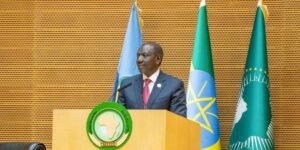
Kenyan President William Ruto speaking during a session on reforms ofr international financial institutions at the Africa-Caricom Summit, Addis Ababa, Ethiopia on September 7, 2025. PHOTO/PCS.