OPINION: Why Kenyan Indians Must Step Into Politics Ahead of 2027
Share
By Peter Ongera
As Kenya gears up for the 2027 general elections, it is time for the Indian community to move from the margins of political spectatorship to the heart of civic engagement.
Kenya’s politics is screaming for broad, deep participation. Yet too often the Indian community- a group that helped literally build this country watches from the sidelines.
This must change.
The history of Indians in Kenya is not one of passive settlement.
It is a history deeply intertwined with Kenya’s own political evolution- a narrative forged on the rails of colonial ambition, shaped by struggle, and yet too often excluded from the electoral stage.
From Railway Builders to Nation Builders
Over 125 years ago, the first large contingent of Indian labourers was brought to East Africa by the British to construct the railway line from Mombasa to Kisumu famously dubbed the “Lunatic Express” for its punishing terrain and deadly cost.
Thousands of Indian workers endured malaria, ruthless conditions and even fatal encounters with wildlife to lay the rails that would eventually bind Kenya together.
Also Read:Explainer: Why Mudavadi Is Heading to India as Israel–Iran Tensions Rise
Many of their successors stayed, planting roots and laying down businesses and communities that became foundational to our economy.
Yet even as they helped shape Kenya’s physical landscape, Kenyan Indians were excluded from meaningful political life for decades.
Shared Struggle, Uneven Recognition
The Indian community’s contribution to Kenya’s political awakening goes far beyond commerce.
Long before independence, Indian activists were part of the push against colonial rule.
Figures like Pio Gama Pinto defied British repression-Pinto was detained and later assassinated for his activism.
Others like Makhan Singh stood with African nationalists in demanding freedom and dignity.
Even Mahatma Gandhi, whose philosophy of resistance would inspire generations, sharpened his political consciousness during his time in Kenya, where he encountered racist practices that shaped his later leadership in India’s struggle for self-rule.
Despite these shared sacrifices, Kenyan Indians were for decades invisible in the fabric of the nation’s political discourse.
Politics After Independence: A Quiet Presence
After 1963, as Kenya navigated its independence and constitutional development, the Indian community’s presence in Parliament was marginal.
Today, there are a few Kenyan Indian MPs representing constituencies in Meru, Eldoret, Kisumu and Nairobi, but these remain isolated successes rather than a trend.
Part of this reality is structural: Kenya’s politics is intensely identity-driven, and electoral success often requires deep tribal and regional networks.
But to retreat from politics on this basis is to cede influence over the very policies that affect one’s businesses, families and future.
Kenyan Indians are disproportionately successful in business, yet underrepresented in political leadership.
The community helped build Kenya’s economy, yet too often steers clear of the political debates that determine the rules of that economy.
In the modern era, where taxes, digital policy, education budgets, trade rules, SMEs and infrastructure priorities are decided in Parliament, economic power without political voice is a vulnerability.
Part of the reason for limited political engagement lies in history: after independence, discriminatory regulations like the 1967 Immigration Act and Trade Licensing Act prompted many Asians to reassess their futures, spurring emigration and a retreat from public life. But these laws are history.
Today’s Constitution enshrines universal suffrage and equal rights.
And yet, participation remains muted; too many Indian Kenyans are comfortable influencing policy from behind the scenes or assume that economic contribution is enough to secure their interests. It is not.
Tribal Recognition: A Step But Not the Destination
In 2017, the Kenyan government formally recognised Kenyans of Asian descent as the country’s 44th tribe, acknowledging their long presence and contribution.
That recognition was welcomed not as an entitlement, but as a symbolic affirmation of belonging.
Yet having a box on a census form does not guarantee influence in Parliament, county assemblies or decision-making bodies.
Recognition without participation is like citizenship without voting: hollow.
Notable Missteps: The Politics of Scandal
Part of the critique of Indian participation in Kenyan politics has been internal: high-profile scandals such as those involving Kamlesh Patnni have reinforced negative stereotypes and undermined community credibility.
These episodes should not define a community, but they do highlight the cost of absence from ethical leadership roles in public life.
If leaders from the Indian community had been more visible in championing transparency and reform, these scandals would have had less political leverage.
It is telling that while Indian Kenyans may have economic clout, they too easily become scapegoats or sidelines when controversy erupts, a sign not just of prejudice, but of political disengagement.
Why 2027 Is a Moment of Choice
With the 2027 elections approaching, there is an urgent need for a shift in attitude.
Voting matters not as a perfunctory act, but as a celebration of citizenship. Running for office matters not only for the seats one might win, but for the debates one shapes.
Shaping platforms, forming coalitions, mentoring youth leaders, participating in party politics- these are how communities build influence.
Kenyan Indians must ask themselves: if not us, then who will articulate our community’s vision for jobs, education, technology, trade, and economic inclusion? If not now, when?
From Influence to Leadership
We have seen moments when Indian-Kenyan politicians have been effective advocates, whether fighting for tribal recognition, championing devolution, or advocating for small business owners.
These victories show that Kenyans across ethnic lines can and do support Indian leaders when they feel seen, understood, and connected to local struggles.
Imagine if that representation were multiplied; if young Indian-Kenyan professionals were encouraged to contest seats, if civic education within the community were prioritised, if voters were mobilised not only to turn up at the polls but to demand platforms on issues that matter to all Kenyans.
Also Read: Govt Addresses Potential Fuel Price Hikes as Israel-Iran Tensions Disrupt Oil Markets
This is not about ethnic politics. It is about inclusive citizenship -a Kenya where every Kenyan community speaks and is heard in shaping national policy.
A Call to Move Beyond the Sidelines
Being a Kenyan of Indian descent should not mean being an “observer” of Kenyan politics.
This community has earned the right to claim its seat at every table where Kenya’s future is decided.
The railway line from Mombasa to Kisumu did more than open trade routes- it symbolised connection.
Let that same spirit of connection guide political participation.
The time for comfortable distance is over. The time for quiet lobbying is behind us.
Kenyan Indians must step forward to vote, to lead, to stand for office, to demand a voice in the debates that will define Kenya’s next decade.
For Kenya’s democracy to be truly inclusive, every community that has helped build this nation must also help shape it.
Because history remembers those who build. And politics remembers those who show up.
Do not change anything. Just give it a suitable SEO friendly title
Follow our WhatsApp channel for instant news updates

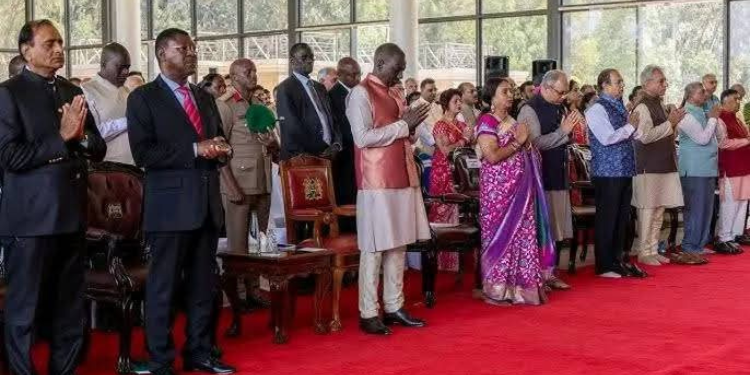
Kenyan-Indians are the 44th tribe in Kenya
PHOTO/CNN