
REVEALED: Duale Names 20 Kenyan Counties at High Risk of Ebola, Including Mombasa
Share

Kenya has identified about 20 counties as being at high risk of Ebola following the country’s first reported case of the virus, Health Cabinet Secretary Aden Duale has said.
Speaking during an interview with NTV on Fixing the Nation on Wednesday, October 7, 2026, Duale said the areas of concern stretch from Mombasa to Malaba and include the Northern Highway corridor.
“And mainly, there are about 20 counties that are at high risk, all the way from Mombasa to Malaba, the highway, the northern highway corridor,” Duale said.
He said the government was reviewing screening measures at points of entry after the case raised questions about the effectiveness of relying mainly on temperature checks, which can be defeated when a traveller takes medication to lower a fever.
“Somebody can take medication and mask the thermal scanner. We have to be more innovative and creative,” Duale said.
Kenya to Increase Screening Personnel
Duale said the Ministry of Health was working with the Kenya Red Cross to increase the number of health personnel stationed at points of entry, including Busia and other border points.
He said additional health workers would help assess travellers beyond temperature checks by looking for other physical symptoms.
Also Read: Kenya Confirms First Ebola Case,CS Duale Reveals
“We might deploy more,” he said.
About 650,000 people have been screened at Kenya’s points of entry, according to Duale, with one person identified as a case of concern.
The CS said the ministry could also review how travellers arriving from Uganda, the Democratic Republic of Congo and neighbouring countries are screened, following the Ebola case.
Travel Forms Help Trace Ebola Contacts
Duale said Kenya relies on detailed health declaration forms to trace people entering the country, with travellers required to provide information on their movements, travel history and residence.
The information helped Kenyan health officials trace the patient’s journey and share details with Uganda’s Director General of Health and the World Health Organization.
“We had to talk to WHO and we traced the whole journey, the pathway of that patient,” he said.
Duale said the forms remain useful even after a person has entered the country because health officials can use the information to trace contacts if symptoms emerge later.
He said Ebola’s incubation period ranges from two to 21 days, with symptoms commonly appearing around the fifth day.
Also Read: Jambojet Issues Statement After Ebola Case on Entebbe-Nairobi Flight
Travelers who develop symptoms after entering Kenya can contact the health emergency helpline 719 and are placed in isolation before testing.
At points of entry, anyone with a high fever is treated as a person of interest and taken to port health isolation before samples are sent to KEMRI for testing.
Duale said 267 people had been tested over the past six months, with all returning negative results.
Follow our WhatsApp channel for more updates
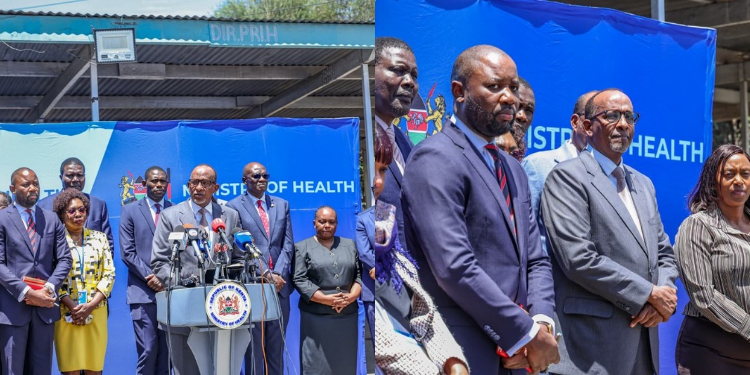
Photo collage of Ministry of Health Delegation led by CS Aden Duale during the briefing of the first imported Ebola case
PHOTO/Duale/X


